

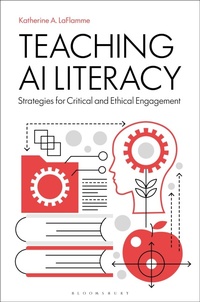
Teaching AI Literacy
Strategies for Critical and Ethical Engagement
Will be published approx. on 4. February 2027
Book
Paperback/Softback
208 pages
979-8-216-43893-9 (ISBN)
Description
This practical and justice-driven guide helps librarians and other educators teach AI literacy with critical awareness, ethical grounding, and pedagogical purpose.
As generative AI tools like ChatGPT and DALL?E reshape how students write, search, and think, this book equips educators with the critical frameworks and practical strategies needed to teach AI literacy ethically, thoughtfully, and with social purpose.
Grounded in critical pedagogy, information literacy, and digital equity, Teaching AI Literacy demystifies artificial intelligence for librarians and other educators by explaining key concepts such as generative AI, predictive algorithms, and algorithmic bias in plain, accessible language with clear examples for classroom use. It equips librarians and other educators with practical tools to teach AI literacy, including adaptable lesson ideas, conversation starters, assessment strategies, and frameworks aligned with the ACRL Framework for Information Literacy for Higher Education. With a focus on access, inclusion, and justice, it empowers educators to design AI-integrated lessons that help students interrogate algorithms rather than simply use them.
This book is for anyone who teaches, supports, or engages with learners in a digitally mediated environment: academic librarians, course instructors, education technologists, and institutional leaders alike. It is especially relevant for those seeking to respond to AI with intentionality rather than fear. This timely and essential book not only offers what to teach about AI, but how and why it matters now more than ever.
As generative AI tools like ChatGPT and DALL?E reshape how students write, search, and think, this book equips educators with the critical frameworks and practical strategies needed to teach AI literacy ethically, thoughtfully, and with social purpose.
Grounded in critical pedagogy, information literacy, and digital equity, Teaching AI Literacy demystifies artificial intelligence for librarians and other educators by explaining key concepts such as generative AI, predictive algorithms, and algorithmic bias in plain, accessible language with clear examples for classroom use. It equips librarians and other educators with practical tools to teach AI literacy, including adaptable lesson ideas, conversation starters, assessment strategies, and frameworks aligned with the ACRL Framework for Information Literacy for Higher Education. With a focus on access, inclusion, and justice, it empowers educators to design AI-integrated lessons that help students interrogate algorithms rather than simply use them.
This book is for anyone who teaches, supports, or engages with learners in a digitally mediated environment: academic librarians, course instructors, education technologists, and institutional leaders alike. It is especially relevant for those seeking to respond to AI with intentionality rather than fear. This timely and essential book not only offers what to teach about AI, but how and why it matters now more than ever.
More details
Series
Language
English
Place of publication
United States
Publishing group
Bloomsbury Publishing Plc
Target group
Professional and scholarly
Product notice
Paperback (trade)
Dimensions
Height: 235 mm
Width: 156 mm
Thickness: 10 mm
Weight
257 gr
ISBN-13
979-8-216-43893-9 (9798216438939)
Copyright in bibliographic data and cover images is held by Nielsen Book Services Limited or by the publishers or by their respective licensors: all rights reserved.
Schweitzer Classification
Person
Katherine A. LaFlamme, MLIS, is an educator and librarian with over a decade of experience.
Content
Series Foreword, Lori Townsend (The University of New Mexico) and Silvia Lin Hanick (LaGuardia Community College)
Part I: Foundations: Understanding AI and Information
1. Why AI Literacy Matters
2. How AI Shapes Information
3. Ethics, Bias, and Power in AI
Part II: Teaching and Learning with AI
4. Thinking and Writing with AI
5. Teaching Students to Analyze and Evaluate AI Output
6. (Re)designing Assignments for the AI Age
7. Student Agency, Confidence, and Empowerment
8. Integrating AI into the Classroom
9. AI Literacy and Career Readiness
Part III: Institutional Implementation
10. Building Institutional Capacity for AI Literacy
11. AI Literacy and the Future of Learning, Work, and Citizenship
12. Conclusion: A Call to Action
Index
Part I: Foundations: Understanding AI and Information
1. Why AI Literacy Matters
2. How AI Shapes Information
3. Ethics, Bias, and Power in AI
Part II: Teaching and Learning with AI
4. Thinking and Writing with AI
5. Teaching Students to Analyze and Evaluate AI Output
6. (Re)designing Assignments for the AI Age
7. Student Agency, Confidence, and Empowerment
8. Integrating AI into the Classroom
9. AI Literacy and Career Readiness
Part III: Institutional Implementation
10. Building Institutional Capacity for AI Literacy
11. AI Literacy and the Future of Learning, Work, and Citizenship
12. Conclusion: A Call to Action
Index