

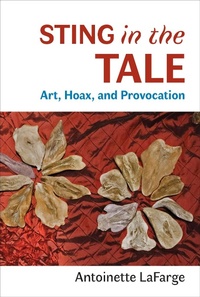
Sting in the Tale
Art, Hoax, and Provocation
Published on 7. October 2021
Book
Paperback/Softback
432 pages
978-1-7339579-5-3 (ISBN)
Description
An illustrated survey of artist hoaxes, including impersonations, fabula, cryptoscience, and forgeries, researched and written by an expert "fictive-art" practitioner.
In her groundbreaking book, internationally recognized multimedia artist and writer Antoinette LaFarge reflects on the most urgent question of today: where does truth lie, and how is it verified? Encouraging readers to critically question the role art plays in shaping reality, Sting in the Tale: Art, Hoax, and Provocation defines a new genre of art that fabricates evidence to support a central fiction. Interweaving contemporary "fictive art" practice with a lineage of hoaxes and impostures dating from the 17th century, LaFarge offers the first comprehensive survey of this practice.
The shift from the early information age to our "infocalypse" era of rampant misinformation has made fictive art an especially radical form as it straddles the lines between fact, fiction, and wild imagination. Artists deploy a wide range of practices to substantiate their fictions, manufacturing artefacts, altering photographs, and posing as experts from many different fields. A fictive-art practitioner herself, LaFarge explores and underscores the myriad ways art can ground or destabilize one's lived reality, forcing us to question our subjective experience and our understanding of what counts as evidence.
Many examples of these curious and sometimes notorious fabrications are included - from nonexistent artists and peculiar museums to cryptoscientific objects like fake skeletons and staged archaeological evidence. From the intriguing Cottingley fairy photographs "captured" in 1917 by teenage sisters, to the Museum of Jurassic Technology; from the work of artists like Iris Haeussler, Joan Fontcuberta, and Eva and Franco Mattes to the enigmatic encyclopedia known as the Codex Seraphinianus, fictive art continues to reframe assumptions made by its contemporaneous culture. With all the attendant consequences of mistrust, outrage, and rejection, fictive art practitioners both past and present play upon the fragile trust that establishes societies, underlining the crucial roles played by perception and doubt.
In her groundbreaking book, internationally recognized multimedia artist and writer Antoinette LaFarge reflects on the most urgent question of today: where does truth lie, and how is it verified? Encouraging readers to critically question the role art plays in shaping reality, Sting in the Tale: Art, Hoax, and Provocation defines a new genre of art that fabricates evidence to support a central fiction. Interweaving contemporary "fictive art" practice with a lineage of hoaxes and impostures dating from the 17th century, LaFarge offers the first comprehensive survey of this practice.
The shift from the early information age to our "infocalypse" era of rampant misinformation has made fictive art an especially radical form as it straddles the lines between fact, fiction, and wild imagination. Artists deploy a wide range of practices to substantiate their fictions, manufacturing artefacts, altering photographs, and posing as experts from many different fields. A fictive-art practitioner herself, LaFarge explores and underscores the myriad ways art can ground or destabilize one's lived reality, forcing us to question our subjective experience and our understanding of what counts as evidence.
Many examples of these curious and sometimes notorious fabrications are included - from nonexistent artists and peculiar museums to cryptoscientific objects like fake skeletons and staged archaeological evidence. From the intriguing Cottingley fairy photographs "captured" in 1917 by teenage sisters, to the Museum of Jurassic Technology; from the work of artists like Iris Haeussler, Joan Fontcuberta, and Eva and Franco Mattes to the enigmatic encyclopedia known as the Codex Seraphinianus, fictive art continues to reframe assumptions made by its contemporaneous culture. With all the attendant consequences of mistrust, outrage, and rejection, fictive art practitioners both past and present play upon the fragile trust that establishes societies, underlining the crucial roles played by perception and doubt.
Reviews / Votes
With Sting in the Tale, Antoinette LaFarge has crafted a masterful study of fictive art - a genre of geofictions, fictive museums, art movements, and invented persona which predate and challenge our current affliction of alternative facts and terrifying political fabulations. At once entertaining and edifying, this scrupulously researched study is a model of interdisciplinary scholarship, bound to generate significant debate for years to come. If Philip K. Dick invented an academic historian to define and taxonomize the interdisciplinary genre of our age, Antoinette LaFarge would be it.- Thyrza Nichols Goodeve
More details
Language
English
Place of publication
Los Angeles
United States
Product notice
Paperback (trade)
Illustrations
over 170 B&W illustrations with spot color and 16 color plates
Dimensions
Height: 228 mm
Width: 154 mm
Thickness: 32 mm
Weight
659 gr
ISBN-13
978-1-7339579-5-3 (9781733957953)
Copyright in bibliographic data and cover images is held by Nielsen Book Services Limited or by the publishers or by their respective licensors: all rights reserved.
Schweitzer Classification
Other editions
Additional editions
E-Book
08/2021
DoppelHouse Press
€24.49
Available for download
Persons
Antoinette LaFarge is an internationally recognized new media artist with a special interest in speculative fiction and alternative histories. She has authored several books, including Louise Brigham and the Early History of Sustainable Furniture Design (Palgrave Macmillan 2019) and Monkey Encyclopedia W (ICI Press 2018). Her writing and artwork have appeared in Art Journal, Wired, Leonardo, Ada, Gnosis, the Southern Quarterly, the MOSF Journal of Science Fiction, and elsewhere, as well as in anthologies from MIT Press, Oxford University Press, and other international presses. She is a longtime contributor to Wikipedia, where she focuses on filling gaps in coverage of women and people of color.
Content
Foreword by G. D. Cohen
Introduction
Defining Fictive Art
Characteristics
Methods
Reception
Invented Artists
Pseudonyms and Personae
The Alienable Self
Speculative History
What Counts as History
Travelers' Tales
Institutions & Movements
Fictive Museums
Artist as Institution
Geofictions and Micronations
Movements and Religions
Cryptoscience & Taxonomic Inventions
Fictive Zoology and Paleontology
Fictive Botany
Fictive Archaeology
Taxonomic Inventions
Conclusion: Culture Jamming and Social Media
Notes
Bibliography
Acknowledgments
Index
Introduction
Defining Fictive Art
Characteristics
Methods
Reception
Invented Artists
Pseudonyms and Personae
The Alienable Self
Speculative History
What Counts as History
Travelers' Tales
Institutions & Movements
Fictive Museums
Artist as Institution
Geofictions and Micronations
Movements and Religions
Cryptoscience & Taxonomic Inventions
Fictive Zoology and Paleontology
Fictive Botany
Fictive Archaeology
Taxonomic Inventions
Conclusion: Culture Jamming and Social Media
Notes
Bibliography
Acknowledgments
Index