

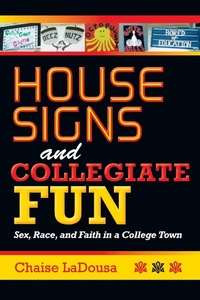
House Signs and Collegiate Fun
Sex, Race, and Faith in a College Town
Published on 24. June 2011
Book
Paperback/Softback
288 pages
978-0-253-22326-5 (ISBN)
Description
It's no secret that fun is important to American college students, but it is unusual for scholars to pay attention to how undergraduates represent and reflect on their partying. Linguist and anthropologist Chaise LaDousa explores the visual manifestations of collegiate fun in a Midwestern college town where house signs on off-campus student residences are a focal point of college culture. With names like Boot 'N Rally, The Plantation, and Crib of the Rib, house signs reproduce consequential categories of gender, sexuality, race, and faith in a medium students say is benign. Through his analysis of house signs and what students say about them, LaDousa introduces the reader to key concepts and approaches in cultural analysis.
Reviews / Votes
"A fascinating, surprising, and intriguing look at pervasive house signs in a Midwestern U.S. college town, this book will delight college students, appeal to those who teach them, and engage those who study them across several disciplines. It is a skillful analysis of contemporary material culture, its playfulness, creativity, and ambiguities. It is also a vivid example of the multiple ways in which people engage with signs (visual or verbal)-from assuming that they have obvious meanings to privileging particular interpretations ,and even to denying that signs have any meaning at all."-Virginia Dominguez, University of Illinois"A very lively read, one of those rare books that brings a sophisticated interpretive perspective together with ethnographic materials that are engaging, thought-provoking, and, for many of us and especially for our students, both experience-near and surprising. Good to read and think with, and likely to become, quite deservedly, a classic for undergraduate teaching."-Don Brenneis, University of California, Santa Cruz
"LaDousa presents weighty matters with intelligence and nuance, and yet always clearly, and with a wealth of data that generates a multitude of 'aha' moments."-James Collins, University at Albany, SUNY
"LaDousa makes excellent use of the formal interviews collected by his students to show that house signs are indeed a serious subject. In doing so he has provided us with a valuable text for introducing students to the field of linguistic anthropology and the process of collecting and analyzing data about textual practices in everyday life.May 2013"-Journal of Linguistic Anthropology
More details
Language
English
Place of publication
Bloomington, IN
United States
Target group
Professional and scholarly
Product notice
Paperback (trade)
Illustrations
50 b&w illus.
Dimensions
Height: 229 mm
Width: 152 mm
Thickness: 15 mm
Weight
424 gr
ISBN-13
978-0-253-22326-5 (9780253223265)
Copyright in bibliographic data and cover images is held by Nielsen Book Services Limited or by the publishers or by their respective licensors: all rights reserved.
Schweitzer Classification
Person
Chaise LaDousa is Associate Professor of Anthropology at Hamilton College.
Content
Introduction "The Ivy League": House Signs and Their Display
1. "Bed, Booze, and Beyond": History and Ethnography of Collegiate Fun
2. "Witty House Name": The Textual Lives of House Signs
3. "Inn Pursuit" of Christ: The Unevenness of Agency
4. "Ghetto Fabulous" and "Plantation": Racial Difference in a Space of Fun
5. "Hot Box," "Box Office," and "Fill Her Up": Reflections on Gender and Sexuality
Conclusion "Where the Sidewalk Ends": Remarks on Cultural Production and Ethnography
Notes
References
Index
1. "Bed, Booze, and Beyond": History and Ethnography of Collegiate Fun
2. "Witty House Name": The Textual Lives of House Signs
3. "Inn Pursuit" of Christ: The Unevenness of Agency
4. "Ghetto Fabulous" and "Plantation": Racial Difference in a Space of Fun
5. "Hot Box," "Box Office," and "Fill Her Up": Reflections on Gender and Sexuality
Conclusion "Where the Sidewalk Ends": Remarks on Cultural Production and Ethnography
Notes
References
Index