

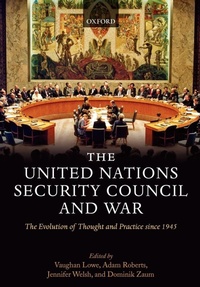
The United Nations Security Council and War
The Evolution of Thought and Practice since 1945
Published on 15. April 2010
Book
Paperback/Softback
816 pages
978-0-19-958330-0 (ISBN)
Description
This is the first major exploration of the United Nations Security Council's part in addressing the problem of war, both civil and international, since 1945. Both during and after the Cold War the Council has acted in a limited and selective manner, and its work has sometimes resulted in failure. It has not been - and was never equipped to be - the centre of a comprehensive system of collective security. However, it remains the body charged with primary responsibility for international peace and security. It offers unique opportunities for international consultation and military collaboration, and for developing legal and normative frameworks. It has played a part in the reduction in the incidence of international war in the period since 1945.
This study examines the extent to which the work of the UN Security Council, as it has evolved, has or has not replaced older systems of power politics and practices regarding the use of force. Its starting point is the failure to implement the UN Charter scheme of having combat forces under direct UN command. Instead, the Council has advanced the use of international peacekeeping forces; it has authorized coalitions of states to take military action; and it has developed some unanticipated roles such as the establishment of post-conflict transitional administrations, international criminal tribunals, and anti-terrorism committees.
The book, bringing together distinguished scholars and practitioners, draws on the methods of the lawyer, the historian, the student of international relations, and the practitioner. It begins with an introductory overview of the Council's evolving roles and responsibilities. It then discusses specific thematic issues, and through a wide range of case studies examines the scope and limitations of the Council's involvement in war. It offers frank accounts of how belligerents viewed the UN, and how the Council acted and sometimes failed to act. The appendices provide comprehensive information - much of it not previously brought together in this form - of the extraordinary range of the Council's activities.
This book is a project of the Oxford Leverhulme Programme on the Changing Character of War.
This study examines the extent to which the work of the UN Security Council, as it has evolved, has or has not replaced older systems of power politics and practices regarding the use of force. Its starting point is the failure to implement the UN Charter scheme of having combat forces under direct UN command. Instead, the Council has advanced the use of international peacekeeping forces; it has authorized coalitions of states to take military action; and it has developed some unanticipated roles such as the establishment of post-conflict transitional administrations, international criminal tribunals, and anti-terrorism committees.
The book, bringing together distinguished scholars and practitioners, draws on the methods of the lawyer, the historian, the student of international relations, and the practitioner. It begins with an introductory overview of the Council's evolving roles and responsibilities. It then discusses specific thematic issues, and through a wide range of case studies examines the scope and limitations of the Council's involvement in war. It offers frank accounts of how belligerents viewed the UN, and how the Council acted and sometimes failed to act. The appendices provide comprehensive information - much of it not previously brought together in this form - of the extraordinary range of the Council's activities.
This book is a project of the Oxford Leverhulme Programme on the Changing Character of War.
Reviews / Votes
A definitive interdisciplinary work on an important subject ... The depth of knowledge and experience provides fascinating and essential reading for anyone interested in the area of international peace and security, regardless of their disciplinary background and whether practitioner or academic * Christian Henderson in International and Comparative Law Quarterly * The United Nations Security Council and War is an essential work, full of astute observations. Set apart by the wealth of ideas and diversity of viewpoints, this edited collection provides a seminal and well-balanced account of the Security Council's dealing with war since 1945. * Robin Geiss in German Yearbook of International Law * a magnificent achievement... this book will stand out as an indispensable tool in the vast literature on the UN Security Council, set apart by the quality of its research, the wealth of extensive and carefully researched data it contains, as well as the diversity of viewpoints it offers. * Professor Gilles Andreani in Survival * An incredible achievement, magisterial and definitive. This is an essential work on anyone's bookshelf. * Professor Lawrence Freedman, June 2008 * this excellent edited collection ... consistently high standard we should not forget that for better or worse the UN can only work well when its Great Powers work together. Analysts and policy-makers alike would be better prepared to bring this about if they read this important new book. * Professor Paul Williams, International Affairs * This substantial, comprehensive, and authoritative volume contains 28 chapters by leading academics, lawyers, and practitioners, plus detailed appendices covering UN resolutions, sanctions, and operations. * Foreign Affairs, December 2008 * Overall, the book contains an insightful analysis of the way the SC has been addressing the issue of war...provides an excellent exposition of the political and legal parameters - often translated as constraints - within which the SC operates, and assesses their impact on the SC's action in an un-emotive but perceptive manner * Nikolaos Tsagourias *More details
Language
English
Place of publication
Oxford
United Kingdom
Target group
College/higher education
Professional and scholarly
Dimensions
Height: 244 mm
Width: 170 mm
Thickness: 44 mm
Weight
1383 gr
ISBN-13
978-0-19-958330-0 (9780199583300)
Copyright in bibliographic data and cover images is held by Nielsen Book Services Limited or by the publishers or by their respective licensors: all rights reserved.
Schweitzer Classification
Other editions
Additional editions
LOWE | Roberts | Welsh
The United Nations Security Council War
The Evolution of Thought and Practice since 1945
Book
06/2008
Oxford University Press
€143.84
Article exhausted; check different version
Persons
Vaughan Lowe is Chichele Professor of Public International Law, and a Fellow of All Souls College, in the University of Oxford. He also practices in the field of international law as a barrister from Essex Court Chambers, London and has appeared in cases before English and International courts, and sits on international tribunals.
Sir Adam Roberts is now President of the British Academy. Previous to this (from 1986 to 2007) he was Montague Burton Professor of International Relations at Oxford University, and a Fellow of Balliol College. His books include (ed. with Benedict Kingsbury), United Nations, Divided World: The UN?s Roles in International Relations, 2nd edn. (Oxford University Press, 1993), and (ed. with Richard Guelff), Documents on the Laws of War, 3rd edn. (Oxford University Press, 2000).
Jennifer Welsh is Professor in International Relations at the University of Oxford and a Fellow of Somerville College. She is the author, most recently, of At Home In The World: Canada's Global Vision For The 21st Century (HarperCollins, 2004), and editor of Humanitarian Intervention and International Relations (Oxford Univeristy Press, 2003). She was recently named a Trudeau Fellow, and is currently on a Leverhulme research grant working on a project on 'sovereignty as responsibility'.
Dominik Zaum is Lecturer in International Relations at the University of Reading, and author of The Sovereignty Paradox: The Norms and Politics of International Statebuilding (Oxford: Oxford University Press, 2007).
Sir Adam Roberts is now President of the British Academy. Previous to this (from 1986 to 2007) he was Montague Burton Professor of International Relations at Oxford University, and a Fellow of Balliol College. His books include (ed. with Benedict Kingsbury), United Nations, Divided World: The UN?s Roles in International Relations, 2nd edn. (Oxford University Press, 1993), and (ed. with Richard Guelff), Documents on the Laws of War, 3rd edn. (Oxford University Press, 2000).
Jennifer Welsh is Professor in International Relations at the University of Oxford and a Fellow of Somerville College. She is the author, most recently, of At Home In The World: Canada's Global Vision For The 21st Century (HarperCollins, 2004), and editor of Humanitarian Intervention and International Relations (Oxford Univeristy Press, 2003). She was recently named a Trudeau Fellow, and is currently on a Leverhulme research grant working on a project on 'sovereignty as responsibility'.
Dominik Zaum is Lecturer in International Relations at the University of Reading, and author of The Sovereignty Paradox: The Norms and Politics of International Statebuilding (Oxford: Oxford University Press, 2007).
Content
1. Introduction ; PART I: THE FRAMEWORK ; 2. A Council for All Seasons: The Creation of the Security Council and Its Relevance Today ; 3. The Charter Limitations on the Use of Force: Theory and Practice ; 4. Proposals for UN Standing Forces: A Critical History ; PART II: THE ROLES OF THE SECURITY COUNCIL ; 5. The Great Powers and the Security Council ; 6. The Security Council, the General Assembly, and War: The Uniting for Peace Resolution ; 7. The Security Council and Peacekeeping ; 8. The Sanctions Era: Themes and Trends in UN Security Council Sanctions since 1990 ; 9. The Authorization by the Security Council of Regional Arrangements to Use Force: The Case of NATO ; 10. The Security Council in the Post-Cold War World ; PART III: CASE STUDIES ; 11. The United Nations, the Security Council, and the Korean War ; 12. The Suez Crisis and the British Dilemma at the United Nations ; 13. The Security Council and the Arab-Israeli Wars: Responsibility without Power ; 14. The Security Council and the India-Pakistan Wars ; 15. The Security Council and the Question of East Timor' ; 16. The Security Council and the Iran-Iraq War ; 17. The Security Council and the 1991 and 2003 Iraq Wars ; 18. The Security Council and the Wars in the former Yugoslavia ; 19. The Security Council and the Bosnia Conflict: A Practitioner's View ; 20. The Security Council and Afghanistan ; 21. The Security Council and Three Wars in West Africa ; 22. The Security Council in the Wings: Exploring the Non-Involvement of the Security Council in Wars ; PART IV: THE SECURITY COUNCIL AND THE CHANGING CHARACTER OF WAR ; 23. The Different Functions of the Security Council with Respect to Humanitarian Law ; 24. The Security Council and Interventions with Humanitarian Purposes ; 25. The Security Council and International Administration of War-Torn and Contested Territories ; 26. The Security Council and International Law on Military Occupations ; 27. The Security Council and Terrorism ; 28. The Security Council and the Use of Private Force ; Appendices ; 1. UN Peacekeeping Operations, 1945 - 2006 ; 2. UN Forces, Missions, and Institutions not Classified as Peacekeeping Operations, 1945 - 2006 ; 3. UN-Authorized Military Operations, 1945 - 2006 ; 4. UN-Authorized Sanctions, 1945 - 2006 ; 5. Vetoed Security Council Resolutions, 1945 - 2006 ; 6. Uses of the Uniting for Peace Resolution, 1950 - 2006 ; 7. List of Armed Conflicts and Crises, 1945 - 2006