

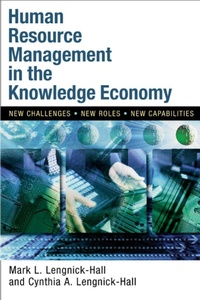
Human Resource Management in the Knowledge Economy - New Challenges, New Roles, New Capabilities
New Challenges, New Roles, New Capabilities
Published on 12. December 2002
Book
Paperback/Softback
224 pages
978-1-57675-159-6 (ISBN)
Description
Synthesizes current thinking on knowledge management and intellectual capital and identifies how human resource management can make a value-added contribution
As more organizations recognize the importance of intellectual capital and knowledge management to competitive success, you would expect human resources (HR) to move to the forefront of organizational leadership. Yet, to the contrary, HR continues to be criticized for its operational and bureaucratic focus and its inability to keep up with changes in the environment.
Human Resource Management in the Knowledge Economy examines how human resource management must change if it is to remain a vital part of the organization. The Lengnick-Halls show how HR departments can move beyond a simple operational focus on attracting, selecting, developing, retaining, and using employees to a more strategic focus on managing human capital and managing knowledge.
The book identifies the most important features of the knowledge economy and details four new roles HR must adopt in order to help organizations succeed in this new environment: human capital steward, knowledge facilitator, relationship builder, and rapid deployment specialist. Each of these roles is defined and described in detail using examples from leading-edge businesses. Human Resource Management in the Knowledge Economy describes how human resource management has evolved and continues to evolve to meet the increasing demands of organizations for sources of competitive advantage.
As more organizations recognize the importance of intellectual capital and knowledge management to competitive success, you would expect human resources (HR) to move to the forefront of organizational leadership. Yet, to the contrary, HR continues to be criticized for its operational and bureaucratic focus and its inability to keep up with changes in the environment.
Human Resource Management in the Knowledge Economy examines how human resource management must change if it is to remain a vital part of the organization. The Lengnick-Halls show how HR departments can move beyond a simple operational focus on attracting, selecting, developing, retaining, and using employees to a more strategic focus on managing human capital and managing knowledge.
The book identifies the most important features of the knowledge economy and details four new roles HR must adopt in order to help organizations succeed in this new environment: human capital steward, knowledge facilitator, relationship builder, and rapid deployment specialist. Each of these roles is defined and described in detail using examples from leading-edge businesses. Human Resource Management in the Knowledge Economy describes how human resource management has evolved and continues to evolve to meet the increasing demands of organizations for sources of competitive advantage.
More details
Language
English
Place of publication
San Francisco
United States
Product notice
Paperback (trade)
Unsewn / adhesive bound
Dimensions
Height: 216 mm
Width: 168 mm
Thickness: 14 mm
Weight
308 gr
ISBN-13
978-1-57675-159-6 (9781576751596)
Copyright in bibliographic data and cover images is held by Nielsen Book Services Limited or by the publishers or by their respective licensors: all rights reserved.
Schweitzer Classification
Other editions
Additional editions
Mark Lengnick-Hall | Cyndy Lengnick-Hall
Human Resource Management in the Knowledge Economy
New Challenges, New Roles, New Capabilities
E-Book
12/2002
1st Edition
Berrett-Koehler Publishers
€67.29
Available for download
LENGNICK-HALL
Human Resource Management in the Knowledge Economy
New Challenges, New Roles, New Capabilities
E-Book
12/2002
1st Edition
Berrett-Koehler Publishers
€24.19
Available for download
Person
Mark L. Lengnick-Hall, Ph.D., is a Professor of Management in the College of Business at the University of Texas at San Antonio. He has human resource management experience in both private industry and state government. Dr. Lengnick-Hall has also consulted with and provided training for numerous organizations.
His articles have been published in journals such as the Academy of Management Review, Human Resource Management Review, Human Resource Management, Personnel Psychology, Personnel, Journal of Organizational Behavior, Organization Development Journal, HR Magazine, Training and Development, Employee Responsibilities and Rights Journal, Health Progress, Public Personnel Management, and the Journal of Management Education. He has co-authored two books: Compensation Decision Making: A Computer-Based Approach, published by Dryden in 1994, and Interactive Human Re- source Management and Strategic Planning, published by Quorum in 1990. Dr. Lengnick-Hall has also contributed chapters to other books.
Cynthia A. Lengnick-Hall, Ph.D., is a Professor of Management in the College of Business at the University of Texas at San Antonio. She has consulting and management experience in both private industry and higher education administration. Dr. Lengnick-Hall has consulted with and provided executive education for a number of organizations.
His articles have been published in journals such as the Academy of Management Review, Human Resource Management Review, Human Resource Management, Personnel Psychology, Personnel, Journal of Organizational Behavior, Organization Development Journal, HR Magazine, Training and Development, Employee Responsibilities and Rights Journal, Health Progress, Public Personnel Management, and the Journal of Management Education. He has co-authored two books: Compensation Decision Making: A Computer-Based Approach, published by Dryden in 1994, and Interactive Human Re- source Management and Strategic Planning, published by Quorum in 1990. Dr. Lengnick-Hall has also contributed chapters to other books.
Cynthia A. Lengnick-Hall, Ph.D., is a Professor of Management in the College of Business at the University of Texas at San Antonio. She has consulting and management experience in both private industry and higher education administration. Dr. Lengnick-Hall has consulted with and provided executive education for a number of organizations.
Content
List of Tables
Preface
Chapter 1: A New Imperative for Human Resource Management
Build Strategic Capability
Expand Boundaries
Manage New Roles
Summary
Chapter 2: Human Resource Management in the Knowledge Economy
What’s Different in the Knowledge Economy?
How Do Organizations Compete in the Knowledge Economy?
Human Resource Management’s Opportunity in the Knowledge Economy
Why Human Resource Management Roles?
New Roles and New Challenges for Human Resource
Management
Conclusion
Chapter 3: Human Capital Steward
What is Human Capital?
Human Capital Steward: A New Role for Human Resource Management
Human Capital Investments
Human Capital Flexibility
Human Capital Leveraging
Why Human Capital Stewardship Is Essential
Chapter 4: Knowledge Facilitator
Why Manage Knowledge?
What Is Knowledge Management?
Human Resource Management as Knowledge Facilitator
Human Resource Management Challenges for the Knowledge Facilitator Role
Conclusion
Chapter 5: Relationship Builder
Anatomy of Relationships
Human Resource Management as Relationship Builder
Conclusion
Chapter 6: Rapid Deployment Specialist
Obtain the Right Human Talent
Be in the Right Place
Act at the Right Time
Do What Is Needed
Orchestrating Rapid Deployment
Chapter 7: New Roles, New Solutions
Human Resource Management and the Resource-Based View of the Firm
New Human Resource Management Roles for New Human Resource Management Contributions
From Human Resources to Strategic Capabilities Unit
References
Index
About the Authors
Preface
Chapter 1: A New Imperative for Human Resource Management
Build Strategic Capability
Expand Boundaries
Manage New Roles
Summary
Chapter 2: Human Resource Management in the Knowledge Economy
What’s Different in the Knowledge Economy?
How Do Organizations Compete in the Knowledge Economy?
Human Resource Management’s Opportunity in the Knowledge Economy
Why Human Resource Management Roles?
New Roles and New Challenges for Human Resource
Management
Conclusion
Chapter 3: Human Capital Steward
What is Human Capital?
Human Capital Steward: A New Role for Human Resource Management
Human Capital Investments
Human Capital Flexibility
Human Capital Leveraging
Why Human Capital Stewardship Is Essential
Chapter 4: Knowledge Facilitator
Why Manage Knowledge?
What Is Knowledge Management?
Human Resource Management as Knowledge Facilitator
Human Resource Management Challenges for the Knowledge Facilitator Role
Conclusion
Chapter 5: Relationship Builder
Anatomy of Relationships
Human Resource Management as Relationship Builder
Conclusion
Chapter 6: Rapid Deployment Specialist
Obtain the Right Human Talent
Be in the Right Place
Act at the Right Time
Do What Is Needed
Orchestrating Rapid Deployment
Chapter 7: New Roles, New Solutions
Human Resource Management and the Resource-Based View of the Firm
New Human Resource Management Roles for New Human Resource Management Contributions
From Human Resources to Strategic Capabilities Unit
References
Index
About the Authors