

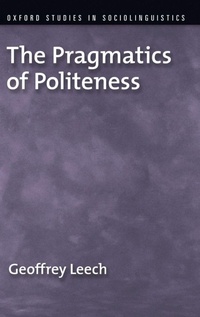
The Pragmatics of Politeness
Published on 5. June 2014
Book
Hardback
368 pages
978-0-19-534138-6 (ISBN)
Description
This readable book presents a new general theoretical understanding of politeness. It offers an account of a wide range of politeness phenomena in English, illustrated by hundreds of examples of actual language use taken largely from authentic British and American sources. Building on his earlier pioneering work on politeness, Geoffrey Leech takes a pragmatic approach that is based on the controversial notion that politeness is communicative altruism. Leech's 1983 book, Principles of Pragmatics, introduced the now widely-accepted distinction between pragmalinguistic and sociopragmatic aspects of politeness; this book returns to the pragmalinguistic side, somewhat neglected in recent work. Drawing on neo-Gricean thinking, Leech rejects the prevalent view that it is impossible to apply the terms 'polite' or 'impolite' to linguistic phenomena.
Leech covers all major speech acts that are either positively or negatively associated with politeness, such as requests, apologies, compliments, offers, criticisms, good wishes, condolences, congratulations, agreement, and disagreement. Additional chapters deal with impoliteness and the related phenomena of irony ("mock politeness") and banter ("mock impoliteness"), and with the role of politeness in the learning of English as a second language. A final chapter takes a fascinating look at more than a thousand years of history of politeness in the English language.
Leech covers all major speech acts that are either positively or negatively associated with politeness, such as requests, apologies, compliments, offers, criticisms, good wishes, condolences, congratulations, agreement, and disagreement. Additional chapters deal with impoliteness and the related phenomena of irony ("mock politeness") and banter ("mock impoliteness"), and with the role of politeness in the learning of English as a second language. A final chapter takes a fascinating look at more than a thousand years of history of politeness in the English language.
Reviews / Votes
Leechs scholarly contribution is a rich addition to existing literature on the subject. The book is notable for the comprehensiveness with which the author conducts his exploration of the area and for providing guidance and pointers for further explorations. * Saw-Choo Teo (University of Sydney),Australian Review of Applied Linguistics * Geoffrey Leech's Pragmatics of Politeness (2014) manages to successfully evaluate the explanatory power of the theory of politeness and provide a robust framework that generates a better understanding of it. * Dr habil. Silvia Florea, Lucian Blaga University of Sibiu *More details
Series
Language
English
Place of publication
New York
United States
Target group
College/higher education
Professional and scholarly
Dimensions
Height: 240 mm
Width: 161 mm
Thickness: 24 mm
Weight
708 gr
ISBN-13
978-0-19-534138-6 (9780195341386)
Copyright in bibliographic data and cover images is held by Nielsen Book Services Limited or by the publishers or by their respective licensors: all rights reserved.
Schweitzer Classification
Other editions
Additional editions
Book
08/2014
Oxford University Press Inc
€83.90
Shipment within 15-20 days
Geoffrey Leech
The Pragmatics of Politeness
E-Book
06/2014
1st Edition
OUP eBook
€39.49
Available for download
Person
Geoffrey Leech is Emeritus Professor of English Linguistics at Lancaster University, where he has been a faculty member for over 40 years. He has published many books and articles in the fields of English grammar, stylistics, pragmatics, semantics, and corpus linguistics. He was elected a Fellow of the British Academy in 1987.
Content
Preface ; PART I - Laying the foundations ; 1. Introduction ; 2. Politeness - Viewpoints ; 3. Pragmatics, indirectness and neg-politeness: a basis for politeness modeling ; 4. Politeness: the model ; PART II - Politeness and impoliteness in practice ; 5. A case study: Apologies ; 6. Requests and other directives ; 7. Other politeness-sensitive speech events ; 8. Politeness and its 'opposites' ; PART III - Further perspectives ; 9. Methods of data collection: empirical pragmatics ; 10. Interlanguage pragmatics and politeness across languages and cultures ; 11. Politeness and the history of English ; Appendix: Pragmatics, indirectness and neg-politeness: the background ; References ; Index