

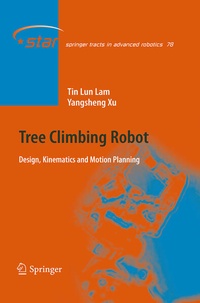
Tree Climbing Robot
Design, Kinematics and Motion Planning
Published on 23. August 2016
Book
Paperback/Softback
XXI, 163 pages
978-3-662-52148-9 (ISBN)
Description
Climbing robot is a challenging research topic that has gained much attention from researchers. Most of the robots reported in the literature are designed to climb on manmade structures, but seldom robots are designed for climbing natural environment such as trees. Trees and manmade structures are very different in nature. It brings different aspects of technical challenges to the robot design. In this book, you can find a collection of the cutting edge technologies in the field of tree-climbing robot and the ways that animals climb. It provides a valuable reference for robot designers to select appropriate climbing methods in designing tree-climbing robots for specific purposes. Based on the study, a novel bio-inspired tree-climbing robot with several breakthrough performances has been developed and presents in this book. It is capable of performing various actions that is impossible in the state-of-the-art tree-climbing robots, such as moving between trunk and branches. This book also proposes several approaches in autonomous tree-climbing, including the sensing methodology, cognition of the environment, path planning and motion planning on both known and unknown environment.
More details
Series
Edition
Softcover reprint of the original 1st ed. 2012
Language
English
Place of publication
Berlin
Germany
Publishing group
Springer Berlin
Target group
Professional and scholarly
Illustrations
XXI, 163 p.
Dimensions
Height: 235 mm
Width: 155 mm
Thickness: 11 mm
Weight
295 gr
ISBN-13
978-3-662-52148-9 (9783662521489)
DOI
10.1007/978-3-642-28311-6
Schweitzer Classification
Other editions
Additional editions
Book
03/2012
Springer
€106.99
Shipment within 7-9 days
Content
Introduction.- State-of-the-Art Tree-climbing Robots.- Methodology of Tree Climbing.- A Novel Tree-climbing Robot: Treebot.- Optimization of the Fastening Force.- Kinematics and Workspace Analysis.- Autonomous Climbing.- Global Path and Motion Planning.- Conclusions and Future Work.