

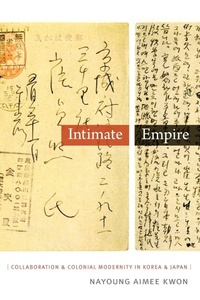
Intimate Empire
Collaboration and Colonial Modernity in Korea and Japan
Published on 19. June 2015
Book
Paperback/Softback
296 pages
978-0-8223-5925-8 (ISBN)
Description
In Intimate Empire Nayoung Aimee Kwon examines intimate cultural encounters between Korea and Japan during the colonial era and their postcolonial disavowal. After the Japanese empire's collapse in 1945, new nation-centered histories in Korea and Japan actively erased these once ubiquitous cultural interactions that neither side wanted to remember. Kwon reconsiders these imperial encounters and their contested legacies through the rise and fall of Japanese-language literature and other cultural exchanges between Korean and Japanese writers and artists in the Japanese empire. The contrast between the prominence of these and other forums of colonial-era cultural collaboration between the colonizers and the colonized, and their denial in divided national narrations during the postcolonial aftermath, offers insights into the paradoxical nature of colonial collaboration, which Kwon characterizes as embodying desire and intimacy with violence and coercion. Through the case study of the formation and repression of imperial subjects between Korea and Japan, Kwon considers the imbrications of colonialism and modernity and the entwined legacies of colonial and Cold War histories in the Asia-Pacific more broadly.
Reviews / Votes
"Besides many compelling analyses and arguments made in Intimate Empire, plentiful visual materials provide us a fascinating glimpse into the cultural fields in the empire.... it is a great contribution to the scholarship on colonial culture and imperialism for its exemplary handling of archives and its succinct arguments made based on comparative readings of texts. It is an essential text for researchers of colonial literature, transcultural colonial exchange, cultural fields in wartime Japan, and translation." - Jooyeon Rhee (Acta Koreana) "Intimate Empire is a most welcome addition to transcultural scholarship on East Asian literatures and cultures and sets an excellent example for future research on imperialism in East Asia and well beyond." - Karen Thornber (Pacific Affairs) "Intimate Empire establishes critical questions for historians to ponder, beginning with: Who writes the empire? How does the language they use matter? Kwon has demonstrated many pathways into, as well as offered new and alternate routes for, future discovery." - Alexis Dudden (American Historical Review) "Nayoung Aimee Kwon's examination of Korean authors during the Japanese imperial period is a richly theorized, sensitive, and engaging work of literary and colonial history." - Denis Gainty (History: Reviews of New Books) "Kwon's book will become an instant classic of the postcolonial theory approach to colonial Korea's literary scene." - Janet Poole (Journal of Asian Studies)More details
Language
English
Place of publication
North Carolina
United States
Target group
Professional and scholarly
Product notice
Paperback (trade)
Illustrations
41 illustrations
Dimensions
Height: 229 mm
Width: 152 mm
Thickness: 16 mm
Weight
427 gr
ISBN-13
978-0-8223-5925-8 (9780822359258)
Copyright in bibliographic data and cover images is held by Nielsen Book Services Limited or by the publishers or by their respective licensors: all rights reserved.
Schweitzer Classification
Other editions
Additional editions

E-Book
01/2015
1st Edition
Duke University Press
€198.99
Available for download
Person
Nayoung Aimee Kwon is Andrew W. Mellon Assistant Professor of Asian and Middle Eastern Studies at Duke University.
Content
Acknowledgments ix
On Naming, Romanization, and Translations xiii
1. Colonial Modernity and the Conundrum of Representation 1
2. Translating Korean Literature 17
3. A Minor Writer 41
4. Into the Light 59
5. Colonial Abject 80
6. Performing Colonial Kitsch 99
7. Overhearing Transcolonial Roundtables 131
8. Turning Local 154
9. Forgetting Manchurian Memories 174
10. Paradox of Postcoloniality 195
Notes 213
Bibliography 247
Index 263
On Naming, Romanization, and Translations xiii
1. Colonial Modernity and the Conundrum of Representation 1
2. Translating Korean Literature 17
3. A Minor Writer 41
4. Into the Light 59
5. Colonial Abject 80
6. Performing Colonial Kitsch 99
7. Overhearing Transcolonial Roundtables 131
8. Turning Local 154
9. Forgetting Manchurian Memories 174
10. Paradox of Postcoloniality 195
Notes 213
Bibliography 247
Index 263