

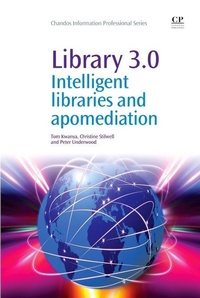
Library 3.0
Intelligent Libraries and Apomediation
Published on 15. December 2014
Book
Paperback/Softback
190 pages
978-1-84334-718-7 (ISBN)
Description
The emerging generation of research and academic library users expect the delivery of user-centered information services. 'Apomediation' refers to the supporting role librarians can give users by stepping in when users need help. Library 3.0 explores the ongoing debates on the "point oh? phenomenon and its impact on service delivery in libraries. This title analyses Library 3.0 and its potential in creating intelligent libraries capable of meeting contemporary needs, and the growing role of librarians as apomediators. Library 3.0 is divided into four chapters. The first chapter introduces and places the topic in context. The second chapter considers "point oh? libraries. The third chapter covers library 3.0 librarianship, while the final chapter explores ways libraries can move towards '3.0'.
More details
Series
Language
English
Place of publication
Witney
United Kingdom
Publishing group
Woodhead Publishing Ltd
Target group
College/higher education
Product notice
Paperback (trade)
Unsewn / adhesive bound
Dimensions
Height: 228 mm
Width: 151 mm
Thickness: 12 mm
Weight
327 gr
ISBN-13
978-1-84334-718-7 (9781843347187)
Copyright in bibliographic data and cover images is held by Nielsen Book Services Limited or by the publishers or by their respective licensors: all rights reserved.
Schweitzer Classification
Other editions
Additional editions
E-Book
12/2014
Chandos Publishing
€58.95
Available for download
Persons
Tom Kwanya is a Knowledge Management specialist with several years of practical experience. He gained a PhD in Information Studies from the University of KwaZulu-Natal, South Africa and is currently consulting for the Government of South Sudan on a project seeking to establish the first modern library and public information centre in the post-conflict country. He previously worked as a Knowledge Management Specialist and E-Communications Manager for research institutions in Kenya. He is currently conducting research on the emerging trends, tools and techniques in library, information and knowledge management. Tom's areas of research include social networking and media, innovation in research libraries, knowledge management, and public relations in libraries. Christine Stilwell is a Professor of Information Studies at the University of KwaZulu-Natal. She has been rated by the National Research Foundation as an established researcher since 2008 and serves on several academic journal editorial advisory committees. Christine has also published a co-edited book, a directory of South African resource centres, book chapters, and numerous journal articles. Peter Underwood is Honorary Professor at the University of KwaZulu-Natal and Emeritus Professor at the University of Cape Town, having occupied the Chair of Librarianship from 1992-2010. He is the author and co-author of several books and journal articles. Peter focuses on information literacy, information systems management, and organizational behaviour in libraries and information services.
Content
About the authors
1: Introduction
Abstract
1.1. Current issues and emerging trends in academic and research librarianship
1.2. Drivers of and barriers to change in libraries and librarianship
1.3. The modern academic and research library user
1.4. The future of academic and research librarianship
2: 'Point oh' libraries
Abstract
2.1. Advances in web technology: webs 1.0, 2.0, 3.0 and 4.0
2.2. 'Point oh' libraries
2.3. Change in libraries: evolution or revolution?
2.4. Reality check: the 'point oh' situation in research and academic libraries
3: Library 3.0
Abstract
3.1. Library 3.0 principles
3.2. Comparing Library 3.0 with the other library service models
3.3. The potential of Library 3.0 for research and academic libraries
4: Library 3.0 librarianship
Abstract
4.1. Core competencies of 'Librarian 3.0'
4.2. Core competencies of users in Library 3.0
4.3. Apomediation in the Library 3.0 context
4.4. Research and academic librarians as apomediaries
5: Becoming 3.0
Abstract
5.1. Library 3.0 in reality
5.2. Library 3.0 tools and resources
5.3. Realising Library 3.0: the roles of users, librarians, professional associations and professional education
Index
1: Introduction
Abstract
1.1. Current issues and emerging trends in academic and research librarianship
1.2. Drivers of and barriers to change in libraries and librarianship
1.3. The modern academic and research library user
1.4. The future of academic and research librarianship
2: 'Point oh' libraries
Abstract
2.1. Advances in web technology: webs 1.0, 2.0, 3.0 and 4.0
2.2. 'Point oh' libraries
2.3. Change in libraries: evolution or revolution?
2.4. Reality check: the 'point oh' situation in research and academic libraries
3: Library 3.0
Abstract
3.1. Library 3.0 principles
3.2. Comparing Library 3.0 with the other library service models
3.3. The potential of Library 3.0 for research and academic libraries
4: Library 3.0 librarianship
Abstract
4.1. Core competencies of 'Librarian 3.0'
4.2. Core competencies of users in Library 3.0
4.3. Apomediation in the Library 3.0 context
4.4. Research and academic librarians as apomediaries
5: Becoming 3.0
Abstract
5.1. Library 3.0 in reality
5.2. Library 3.0 tools and resources
5.3. Realising Library 3.0: the roles of users, librarians, professional associations and professional education
Index