

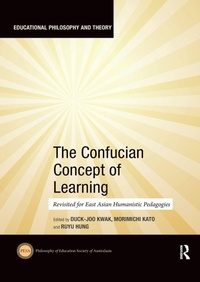
The Confucian Concept of Learning
Revisited for East Asian Humanistic Pedagogies
1st Edition
Published on 12. May 2020
Book
Paperback/Softback
122 pages
978-0-367-53171-3 (ISBN)
Description
What does the Confucian heritage mean to modern East Asian education today? Is it invalid and outdated, or an irreplaceable cultural resource for an alternative approach to education? And to what extent can we recover the humanistic elements of the Confucian tradition of education for use in world education?
Written from a comparative perspective, this book attempts to collectively explore these pivotal questions in search of future directions in education. In East Asian countries like China, Japan, Korea and Taiwan, Confucianism as a philosophy of learning is still deeply embedded in the ways people think of and practice education in their everyday life, even if their official language puts on the Western scientific mode. It discusses how Confucian concepts including rite, rote-learning and conformity to authority can be differently understood for the post-liberal and post-metaphysical culture of education today. The contributors seek to make sense of East Asian experiences of modern education, and to find a way to make Confucian philosophy of education compatible with the Western idea of liberal education.
This book was originally published as a special issue of Educational Philosophy and Theory.
Written from a comparative perspective, this book attempts to collectively explore these pivotal questions in search of future directions in education. In East Asian countries like China, Japan, Korea and Taiwan, Confucianism as a philosophy of learning is still deeply embedded in the ways people think of and practice education in their everyday life, even if their official language puts on the Western scientific mode. It discusses how Confucian concepts including rite, rote-learning and conformity to authority can be differently understood for the post-liberal and post-metaphysical culture of education today. The contributors seek to make sense of East Asian experiences of modern education, and to find a way to make Confucian philosophy of education compatible with the Western idea of liberal education.
This book was originally published as a special issue of Educational Philosophy and Theory.
More details
Series
Language
English
Place of publication
London
United Kingdom
Publishing group
Taylor & Francis Ltd
Target group
College/higher education
Professional and scholarly
Dimensions
Height: 246 mm
Width: 174 mm
Thickness: 8 mm
Weight
253 gr
ISBN-13
978-0-367-53171-3 (9780367531713)
Copyright in bibliographic data and cover images is held by Nielsen Book Services Limited or by the publishers or by their respective licensors: all rights reserved.
Schweitzer Classification
Other editions
Additional editions
Duck-Joo Kwak | Morimichi Kato | Ruyu Hung
The Confucian Concept of Learning
Revisited for East Asian Humanistic Pedagogies
E-Book
12/2019
1st Edition
Routledge
€55.49
Available for download
Duck-Joo Kwak | Morimichi Kato | Ruyu Hung
The Confucian Concept of Learning
Revisited for East Asian Humanistic Pedagogies
E-Book
12/2019
1st Edition
Routledge
€55.49
Available for download
Duck-Joo Kwak | Morimichi Kato | Ruyu Hung
The Confucian Concept of Learning
Revisited for East Asian Humanistic Pedagogies
Book
05/2018
1st Edition
Routledge
€205.60
Shipment within 10-20 days
Persons
Duck-Joo Kwak is Professor of Philosophy of Education at Seoul National University, Korea. She is the author of Education for Self-transformation: Essay as an Educational Practice (2011) and numerous articles on values education and teacher education.
Morimichi Kato is Professor of Philosophy of the Faculty of Human Sciences at Sophia University, Japan. He has a long-standing interest in the history of Platonism and humanism in the West, and has written extensively on Plato, Aristotle, Cicero, Renaissance philosophers, Heidegger, Charles Taylor and Gianni Vattimo.
Ruyu Hung is Professor of Philosophy of Education at National Chiayi University, Taiwan. She is the author of Leaning Nature (2010), Education between Speech and Writing: Crossing the Boundaries of Dao and Deconstruction (2017) and many other philosophical and educational articles.
Morimichi Kato is Professor of Philosophy of the Faculty of Human Sciences at Sophia University, Japan. He has a long-standing interest in the history of Platonism and humanism in the West, and has written extensively on Plato, Aristotle, Cicero, Renaissance philosophers, Heidegger, Charles Taylor and Gianni Vattimo.
Ruyu Hung is Professor of Philosophy of Education at National Chiayi University, Taiwan. She is the author of Leaning Nature (2010), Education between Speech and Writing: Crossing the Boundaries of Dao and Deconstruction (2017) and many other philosophical and educational articles.
Content
Introduction: The Confucian Concept of Learning Revisited for East Asian Humanistic Pedagogies 1. Ethics of Learning and Self-knowledge: Two cases in the Socratic and Confucian teachings 2. Humanistic Traditions, East and West: Convergence and divergence 3. ''The Source of Learning is Thought'' Reading the Chin-ssu lu with a ''Western Eye'' 4. A Theory of Learning in Confucian Perspective 5. The Corporeality of Learning: Confucian Education in Early Modern Japan 6. Lixue, the Lost Art: Confucianism as a form of cultivation of mind 7. A Critique of Confucian Learning: On Learners and Knowledge 8. Two Concerns of the Confucian Learner 9. Modern Versus Tradition: Are there two different approaches to reading of the Confucian classics?