

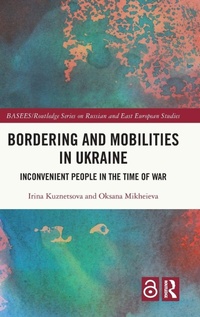
Bordering and Mobilities in Ukraine
Inconvenient People in the Time of War
1st Edition
Published on 21. October 2025
Book
Hardback
156 pages
978-1-032-46066-6 (ISBN)
Description
This book analyses how war and bordering impact daily life and mobility and immobility tactics. It brings to light the memories of people who were displaced from Ukraine's eastern regions because of Russian aggression against Ukraine started in 2014.
Based on extensive in-depth research including interviews with individuals who were direct witnesses, participants, and victims of the events in Donetsk and Luhansk oblasts, the study presents a novel perspective. It explores everyday experiences of war, bordering, and (im)mobilities through the lens of 'inconvenient people' including their hard journeys and resistance in occupied territories, the loss of home and struggles to find housing, volunteering, and the traumatic responses. The book amplifies the voices and agency of civilians who experienced the war and displacement, including older adults and people with disabilities, and provides theoretical and practical implications beyond Ukraine in a context of global uncertainties and growing mass population displacement.
The book urges politicians and experts to look at the experiences of both displaced and immobile people who lived through the war in Ukraine before the full invasion. It will be of great interest to scholars of Race and Ethnic Studies, Asian Studies, European Politics, Security Studies, Migration Studies, Human Geography, and War and Conflict Studies.
The Open Access version of this book, available at http://www.taylorfrancis.com, has been made available under a Creative Commons Attribution-Non Commercial-No Derivatives (CC BY-NC-ND) 4.0 license.
Based on extensive in-depth research including interviews with individuals who were direct witnesses, participants, and victims of the events in Donetsk and Luhansk oblasts, the study presents a novel perspective. It explores everyday experiences of war, bordering, and (im)mobilities through the lens of 'inconvenient people' including their hard journeys and resistance in occupied territories, the loss of home and struggles to find housing, volunteering, and the traumatic responses. The book amplifies the voices and agency of civilians who experienced the war and displacement, including older adults and people with disabilities, and provides theoretical and practical implications beyond Ukraine in a context of global uncertainties and growing mass population displacement.
The book urges politicians and experts to look at the experiences of both displaced and immobile people who lived through the war in Ukraine before the full invasion. It will be of great interest to scholars of Race and Ethnic Studies, Asian Studies, European Politics, Security Studies, Migration Studies, Human Geography, and War and Conflict Studies.
The Open Access version of this book, available at http://www.taylorfrancis.com, has been made available under a Creative Commons Attribution-Non Commercial-No Derivatives (CC BY-NC-ND) 4.0 license.
More details
Series
Language
English
Place of publication
London
United Kingdom
Publishing group
Taylor & Francis Ltd
Target group
College/higher education
Postgraduate
Dimensions
Height: 240 mm
Width: 161 mm
Thickness: 14 mm
Weight
426 gr
ISBN-13
978-1-032-46066-6 (9781032460666)
Copyright in bibliographic data and cover images is held by Nielsen Book Services Limited or by the publishers or by their respective licensors: all rights reserved.
Schweitzer Classification
Other editions
Additional editions
Irina Kuznetsova | Oksana Mikheieva
Bordering and Mobilities in Ukraine
Inconvenient People in the Time of War
E-Book
10/2025
Routledge
€0.00
Available for download
Irina Kuznetsova | Oksana Mikheieva
Bordering and Mobilities in Ukraine
Inconvenient People in the Time of War
E-Book
10/2025
Routledge
€0.00
Available for download
Persons
Irina Kuznetsova is Associate Professor in the School of Geography, Earth and Environmental Sciences at the University of Birmingham. She has extensively researched the social impacts of displacement from Ukraine's war-affected regions and led the UK Art and Humanities Research Council -funded Ukraine's Hidden Tragedy project. With over 25 years of experience in migration, immobility, and social exclusion across countries, she brings a cross-disciplinary, impact-driven approach to collaborative research, particularly in understanding both internal and international dimensions of war and conflict- related displacement.
Oksana Mikheieva is Professor of Sociology at the Kyiv School of Economics. During her work at various academic institutions, including Donetsk State University of Management, Ukrainian Catholic University (Lviv), and European University Viadrina Frankfurt (Oder), as well as during research fellowships at the Ukrainian Research Institute at Harvard University (HURI), Institute for Human Sciences (IWM), ZOiS/the Centre for East European and International Studies, and Wissenschaftskolleg zu Berlin - Institute for Advanced Study, she researched various aspects of migration processes related to war and forced displacement. She also focuses her research on aspects of paramilitary motivations, everyday life under conditions of war and occupation.
Oksana Mikheieva is Professor of Sociology at the Kyiv School of Economics. During her work at various academic institutions, including Donetsk State University of Management, Ukrainian Catholic University (Lviv), and European University Viadrina Frankfurt (Oder), as well as during research fellowships at the Ukrainian Research Institute at Harvard University (HURI), Institute for Human Sciences (IWM), ZOiS/the Centre for East European and International Studies, and Wissenschaftskolleg zu Berlin - Institute for Advanced Study, she researched various aspects of migration processes related to war and forced displacement. She also focuses her research on aspects of paramilitary motivations, everyday life under conditions of war and occupation.
Content
Chapter 1: Understanding displacement, immobility, and bordering in Ukraine
Chapter 2: Fleeing, staying, and in-between: forced mobilities since 2014
Chapter 3: The Unseen Struggles of Older Adults and People with Disabilities in both the Occupied Territories and During Displacement
Chapter 4: The bordering and de-bordering of Donetsk: politics of re-de-commemoration and everyday resistance
Chapter 5: The loss of home: navigating housing through displacement
Chapter 6: Agents of Change: Volunteering in the Face of the War and Displacement
Chapter 7: Living through violence: (invisible) trauma and the changing of mental health approaches
Chapter 8: There is not yet a conclusion
Chapter 2: Fleeing, staying, and in-between: forced mobilities since 2014
Chapter 3: The Unseen Struggles of Older Adults and People with Disabilities in both the Occupied Territories and During Displacement
Chapter 4: The bordering and de-bordering of Donetsk: politics of re-de-commemoration and everyday resistance
Chapter 5: The loss of home: navigating housing through displacement
Chapter 6: Agents of Change: Volunteering in the Face of the War and Displacement
Chapter 7: Living through violence: (invisible) trauma and the changing of mental health approaches
Chapter 8: There is not yet a conclusion