

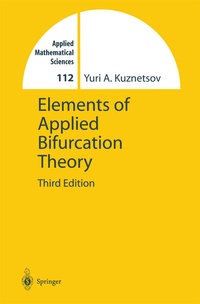
Elements of Applied Bifurcation Theory
3rd Edition
Published on 25. November 2010
Book
Paperback/Softback
XXII, 632 pages
978-1-4419-1951-9 (ISBN)
Description
Providing readers with a solid basis in dynamical systems theory, as well as explicit procedures for application of general mathematical results to particular problems, the focus here is on efficient numerical implementations of the developed techniques. The book is designed for advanced undergraduates or graduates in applied mathematics, as well as for Ph.D. students and researchers in physics, biology, engineering, and economics who use dynamical systems as model tools in their studies. A moderate mathematical background is assumed, and, whenever possible, only elementary mathematical tools are used. This new edition preserves the structure of the first while updating the context to incorporate recent theoretical developments, in particular new and improved numerical methods for bifurcation analysis.
Reviews / Votes
Review of earlier edition"I know of no other book that so clearly explains the basic phenomena of bifurcation theory." Math Reviews "The book is a fine addition to the dynamical systems literature. It is good to see, in our modern rush to quick publication, that we, as a mathematical community, still have time to bring together, and in such a readable and considered form, the important results on our subject." Bulletin of the AMSFrom the reviews of the third edition:"In the third edition of this textbook, the material again has been slightly extended while the main structure of the book was kept. . the clear structure of the book allows applied scientists to use it as a reference book. . Kuznetsov's book on applied bifurcation theory is still very useful both as a textbook and as a reference work for researchers from the natural sciences, engineering or economics." (Jörg Härterich, Zentralblatt MATH, Vol. 1082, 2006)"This book deals with the theory of dynamical systems relevant for applications. The material is presented in a systematic and very readable form. It covers recent developments in bifurcation theory, with special attention to efficient numerical implementations. The text aims at an audience of graduate and Ph.D. students in applied mathematics, and researchers in science and engineering, who use dynamical systems and bifurcation analysis as a tool. Each chapter contains useful examples and many illustrations." (Dirk Roose, Bulletin of the Belgian Mathematical Society, 2007)More details
Product info
Previously published in hardcover
Series
Edition
Softcover reprint of hardcover 3rd ed. 2004
Language
English
Place of publication
New York
United States
Target group
Professional and scholarly
Research
Edition type
Revised edition
Illustrations
XXII, 632 p.
Dimensions
Height: 23.5 cm
Width: 15.5 cm
Weight
2010 gr
ISBN-13
978-1-4419-1951-9 (9781441919519)
DOI
10.1007/978-1-4757-3978-7
Schweitzer Classification
Other editions
New editions
Yuri A. Kuznetsov
Elements of Applied Bifurcation Theory
Book
04/2023
4th Edition
Springer
€181.89
Shipment within 15-20 days
Additional editions
Yuri Kuznetsov
Elements of Applied Bifurcation Theory
Book
06/2004
3rd Edition
Springer
€181.89
Shipment within 5-7 days
Content
1 Introduction to Dynamical Systems.- 2 Topological Equivalence, Bifurcations, and Structural Stability of Dynamical Systems.- 3 One-Parameter Bifurcations of Equilibria in Continuous-Time Dynamical Systems.- 4 One-Parameter Bifurcations of Fixed Points in Discrete-Time Dynamical Systems.- 5 Bifurcations of Equilibria and Periodic Orbits in n-Dimensional Dynamical Systems.- 6 Bifurcations of Orbits Homoclinic and Heteroclinic to Hyperbolic Equilibria.- 7 Other One-Parameter Bifurcations in Continuous-Time Dynamical Systems.- 8 Two-Parameter Bifurcations of Equilibria in Continuous-Time Dynamical Systems.- 9 Two-Parameter Bifurcations of Fixed Points in Discrete-Time Dynamical Systems.- 10 Numerical Analysis of Bifurcations.- A Basic Notions from Algebra, Analysis, and Geometry.- A.1 Algebra.- A.1.1 Matrices.- A.1.2 Vector spaces and linear transformations.- A.1.3 Eigenvectors and eigenvalues.- A.1.4 Invariant subspaces, generalized eigenvectors, and Jordan normal form.- A.1.5 Fredholm Alternative Theorem.- A.1.6 Groups.- A.2 Analysis.- A.2.1 Implicit and Inverse Function Theorems.- A.2.2 Taylor expansion.- A.2.3 Metric, normed, and other spaces.- A.3 Geometry.- A.3.1 Sets.- A.3.2 Maps.- A.3.3 Manifolds.- References.