

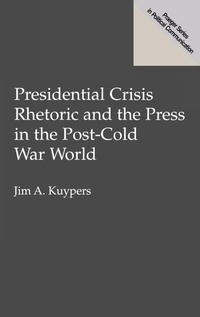
Presidential Crisis Rhetoric and the Press in the Post-Cold War World
Published on 26. August 1997
Book
Hardback
264 pages
978-0-275-95721-6 (ISBN)
Description
Kuypers combines rhetorical theory and framing analysis in an examination of the interaction of the press and the president during international crisis situations in the post-Cold War world. Three crises are examined: Bosnia, Haiti, and the North Korean nuclear capability issue. Kuypers effectively demonstrates the changed nature of presidential crisis rhetoric since the end of the Cold War.
Kuypers employs a new historical/critical approach to analyze both the press and the Clinton administration's handling of three international crisis situations. Using case studies of Bosnia, Haiti, and the alleged North Korean nuclear buildup in 1993, he examines contemporary presidential crisis communication and the agenda-setting and agenda-extension functions of the press.
The importance of this study lies in its timeliness; President Clinton is the first atomic-age president not to have the Cold War meta-narrative to use in legitimating international crises. Prior studies in presidential crisis rhetoric found that the president received broad and consistent support during times of crisis. Kuypers found that the press often advanced an oppositional frame to that used by the Clinton administration. The press frames were found to limit the options of the President, even when the press supported a particular presidential strategy. This is a major study that will be of interest to scholars and researchers of the press, the modern presidency, and American foreign policy.
Kuypers employs a new historical/critical approach to analyze both the press and the Clinton administration's handling of three international crisis situations. Using case studies of Bosnia, Haiti, and the alleged North Korean nuclear buildup in 1993, he examines contemporary presidential crisis communication and the agenda-setting and agenda-extension functions of the press.
The importance of this study lies in its timeliness; President Clinton is the first atomic-age president not to have the Cold War meta-narrative to use in legitimating international crises. Prior studies in presidential crisis rhetoric found that the president received broad and consistent support during times of crisis. Kuypers found that the press often advanced an oppositional frame to that used by the Clinton administration. The press frames were found to limit the options of the President, even when the press supported a particular presidential strategy. This is a major study that will be of interest to scholars and researchers of the press, the modern presidency, and American foreign policy.
More details
Language
English
Place of publication
United States
Publishing group
Bloomsbury Publishing Plc
Target group
College/higher education
Professional and scholarly
Dimensions
Height: 240 mm
Width: 161 mm
Thickness: 19 mm
Weight
558 gr
ISBN-13
978-0-275-95721-6 (9780275957216)
Copyright in bibliographic data and cover images is held by Nielsen Book Services Limited or by the publishers or by their respective licensors: all rights reserved.
Schweitzer Classification
Other editions
Additional editions
E-Book
08/1997
1st Edition
Praeger Publishers Inc
€82.99
Available for download
Person
JIM A. KUYPERS is Senior Lecturer and Director of the Office of Speech, Dartmouth College. He has written on rhetoric and communications in such journals as Eastern Communication Journal and Southern Communication Journal.
Content
Series Foreword by Robert E. Denton, Jr. Introduction Presidential Crisis Rhetoric Agenda-Setting, Agenda-Extension, and Framing Analysis North Korea and Nuclear Nonproliferation The Bosnian Crisis: 21 November 1995 to 15 December 1995 The Haitian Crisis: From Bush to Clinton From Initial Success Erupts Crisis: Haiti, Part Two Conclusion Bibliography Index