

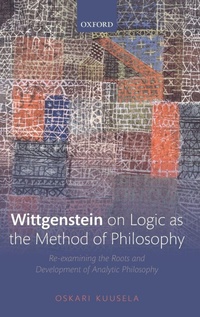
Wittgenstein on Logic as the Method of Philosophy
Re-examining the Roots and Development of Analytic Philosophy
Published on 14. January 2019
Book
Hardback
312 pages
978-0-19-882975-1 (ISBN)
Description
In Wittgenstein on Logic as the Method of Philosophy, Oskari Kuusela examines Wittgenstein's early and late philosophies of logic, situating their philosophical significance in early and middle analytic philosophy with particular reference to Frege, Russell, Carnap, and Strawson. He argues that not only the early but also the later Wittgenstein sought to further develop the logical-philosophical approaches of his contemporaries. Throughout his career Wittgenstein's aim was to resolve problems with and address the limitations of Frege's and Russell's accounts of logic and their logical methodologies so as to achieve the philosophical progress that originally motivated the logical-philosophical approach. By re-examining the roots and development of analytic philosophy, Kuusela seeks to open up covered up paths for the further development of analytic philosophy. Offering a novel interpretation of the philosopher, he explains how Wittgenstein extends logical methodology beyond calculus-based logical methods and how his novel account of the status of logic enables one to do justice to the complexity and richness of language use and thought while retaining rigour and ideals of logic such as simplicity and exactness. In addition, this volume outlines the new kind of non-empiricist naturalism developed in Wittgenstein's later work and explaining how his account of logic can be used to dissolve the long-standing methodological dispute between the ideal and ordinary language schools of analytic philosophy. It is of interest to scholars, researchers, and advance students of philosophy interested in engaging with a number of scholarly debates.
Reviews / Votes
Overall, Kuusela's book is an excellent piece of scholarship... * Forma de Vida * an original and thought-provoking defense of a novel position . . . one can only admire his clear and systematic statement of a positive interpretation of Wittgenstein's method. * David G. Stern, Notre Dame Philosophical Reviews *More details
Language
English
Place of publication
Oxford
United Kingdom
Target group
College/higher education
Dimensions
Height: 240 mm
Width: 161 mm
Thickness: 21 mm
Weight
634 gr
ISBN-13
978-0-19-882975-1 (9780198829751)
Copyright in bibliographic data and cover images is held by Nielsen Book Services Limited or by the publishers or by their respective licensors: all rights reserved.
Schweitzer Classification
Other editions
Additional editions
Oskari Kuusela
Wittgenstein on Logic as the Method of Philosophy
Re-examining the Roots and Development of Analytic Philosophy
E-Book
01/2019
1st Edition
OUP eBook
€51.49
Available for download
Oskari Kuusela
Wittgenstein on Logic as the Method of Philosophy
Re-examining the Roots and Development of Analytic Philosophy
E-Book
12/2018
1st Edition
OUP eBook
€46.99
Available for download
Person
Oskari Kuusela is a Senior Lecturer in Philosophy at the University of East Anglia. The main foci of his work are philosophical methodology, the philosophy of logic and language, history of analytic philosophy, and ethics. He is the author of The Struggle against Dogmatism (Harvard 2008) and Key Terms in Ethics (Continuum 2010), co-editor of Wittgenstein and His Interpreters (Blackwell-Wiley 2007) and The Oxford Handbook of Wittgenstein (Oxford 2011), and has two forthcoming books: Wittgenstein and Phenomenology (Routledge) and Ethics in the Wake of Wittgenstein (Routledge).
Content
Introduction
1: Frege's and Russell's new logic: the promise of philosophical progress
2: The Tractatus' philosophy of logic and the logocentric predicament
3: The Tractatus' philosophy of logic and Carnap
4: Ideality and reality: beyond apriorism, empiricism and conventionalism
5: The method of language-games as a method of logic
6: Non-empiricist naturalism: the uses of natural history in logic
7: Resolving the dispute between ideal and ordinary language approaches
Epilogue
1: Frege's and Russell's new logic: the promise of philosophical progress
2: The Tractatus' philosophy of logic and the logocentric predicament
3: The Tractatus' philosophy of logic and Carnap
4: Ideality and reality: beyond apriorism, empiricism and conventionalism
5: The method of language-games as a method of logic
6: Non-empiricist naturalism: the uses of natural history in logic
7: Resolving the dispute between ideal and ordinary language approaches
Epilogue