

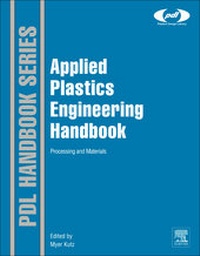
Applied Plastics Engineering Handbook
Processing and Materials
Published on 20. July 2011
Book
Hardback
574 pages
978-1-4377-3514-7 (ISBN)
Description
A practical reference for all plastics engineers who are seeking to answer a question, solve a problem, reduce a cost, improve a design or fabrication process, or even venture into a new market. Applied Plastics Engineering Handbook covers both polymer basics - helpful to bring readers quickly up to speed if they are not familiar with a particular area of plastics processing - and recent developments - enabling practitioners to discover which options best fit their requirements. Each chapter is an authoritative source of practical advice for engineers, providing authoritative guidance from experts that will lead to cost savings and process improvements. Throughout the book, the focus is on the engineering aspects of producing and using plastics. The properties of plastics are explained along with techniques for testing, measuring, enhancing and analyzing them.
Reviews / Votes
"An authoritative source of practical advice for engineers, providing authoritative guidance from experts that will lead to cost savings and process improvements. Throughout the book, the focus is on the engineering aspects of producing and using plastics. The properties of plastics are explained along with techniques for testing, measuring, enhancing and analyzing them. Materials and additives are described as well as their characteristics and effects. The technologies and machinery used in processing operations are covered with reference to product design. And recent developments in a cross-section of applications demonstrate in a pragmatic way, the opportunities as well as the limitations of plastics." --Biospace.comMore details
Series
Language
English
Place of publication
Norwich
United States
Target group
Professional and scholarly
Plastics engineers, polymer scientists, materials engineers, equipment manufacturers, product design engineers, mechanical engineers, chemical engineers, biomaterials engineers, consultants, research & development departments, academics. Also, marketing/sales managers in consumer industries (appliances, decorative, food and beverage processing); industrial (automotive, construction, aeronautics, chemical, electronics); medical devices and biopharmaceutical industries.
Dimensions
Height: 276 mm
Width: 216 mm
Weight
1740 gr
ISBN-13
978-1-4377-3514-7 (9781437735147)
Copyright in bibliographic data and cover images is held by Nielsen Book Services Limited or by the publishers or by their respective licensors: all rights reserved.
Schweitzer Classification
Other editions
New editions
Book
10/2016
2nd Edition
William Andrew Publishing
€222.50
Shipment within 15-20 days
Additional editions
E-Book
07/2011
William Andrew
€195.00
Available for download
Person
Myer Kutz has been heading his own firm, Myer Kutz Associates, Inc., since 1990. For the past two decades, he has focused on writing and developing engineering handbooks on a wide range of technical topics, such as mechanical, materials, biomedical, transportation, and environmentally conscious engineering. Earlier, his firm supplied consulting services to a large client roster, including Fortune 500 companies, scientific societies, and large and small publishers. He has been a trustee of the Online Computer Library Center (OCLC) and chaired committees of the American Society of Mechanical Engineers (ASME) and the Association of American Publishers (AAP). He is a long-time judge for the AAP's annual PROSE Awards, and holds engineering degrees from MIT and RPI, served as an officer in the US Army Ordnance Corp, and worked in the aerospace industry on the Apollo project. He is the author of nine books. He writes "The Scholarly Publishing Scene?, a column for the magazine Against the Grain. He lives in Delmar, New York, with his wife, Arlene.
Content
Part I Plastics Engineering: Basic Fundamentals (7 chapters)
Introduction to Plastics Engineering (sections 1-4 and 6-8 of old Chapter 22, The Plastics Industry)
Electrical Properties
Mechanical Properties
Testing of Plastics
Testing and Instrumental Analysis for the plastics processing industry: key technologies
Plastics Processing (sections 5 of old Chapter 22, The Plastics Industry)
Additives for Plastics
Part II Plastics Engineering: New Developments
Plastics Materials (9 chapters)
Engineering Thermoplastics
Thermoplastic Elastomers and Their Applications
Thermoset Elastomers
Fluoropolymers
Nanocomposites: preparation, structure, properties
Polyolefins
Polyvinyl Chloride (PVC)
Biodegradable Plastics
Polymeric Biomaterials
Additives (7 chapters)
Adhesion Promotion
Coatings and Colorant Processing Fundamentals (two chapters combined)
Dispersants and Coupling Agents
Functional Fillers for Plastics
Flame Retardants
Pasticizers
Polymer Stabilization
Processes (11 chapters)
Blow Molding
Chaotic advection and its application for forming structured plastic materials
Chemical Mechanical Polishing: Role of Polymeric Additives and Composite Materials
Compression Molding
Extrusion
Injection Molding
Microcellular Processing
Rotational Molding
Thermoforming
Process Monitoring & Control
Recycling of Plastics
Applications (6 chapters)
Design of Plastic Parts
Plastics in Building and Construction
Fiber Reinforced Polymer Composites Applications
Plastic Piping Materials
Polyethylene Terephthalate (PET) Bottles
Tissue Engineering Scaffolds Fabrication
Introduction to Plastics Engineering (sections 1-4 and 6-8 of old Chapter 22, The Plastics Industry)
Electrical Properties
Mechanical Properties
Testing of Plastics
Testing and Instrumental Analysis for the plastics processing industry: key technologies
Plastics Processing (sections 5 of old Chapter 22, The Plastics Industry)
Additives for Plastics
Part II Plastics Engineering: New Developments
Plastics Materials (9 chapters)
Engineering Thermoplastics
Thermoplastic Elastomers and Their Applications
Thermoset Elastomers
Fluoropolymers
Nanocomposites: preparation, structure, properties
Polyolefins
Polyvinyl Chloride (PVC)
Biodegradable Plastics
Polymeric Biomaterials
Additives (7 chapters)
Adhesion Promotion
Coatings and Colorant Processing Fundamentals (two chapters combined)
Dispersants and Coupling Agents
Functional Fillers for Plastics
Flame Retardants
Pasticizers
Polymer Stabilization
Processes (11 chapters)
Blow Molding
Chaotic advection and its application for forming structured plastic materials
Chemical Mechanical Polishing: Role of Polymeric Additives and Composite Materials
Compression Molding
Extrusion
Injection Molding
Microcellular Processing
Rotational Molding
Thermoforming
Process Monitoring & Control
Recycling of Plastics
Applications (6 chapters)
Design of Plastic Parts
Plastics in Building and Construction
Fiber Reinforced Polymer Composites Applications
Plastic Piping Materials
Polyethylene Terephthalate (PET) Bottles
Tissue Engineering Scaffolds Fabrication