

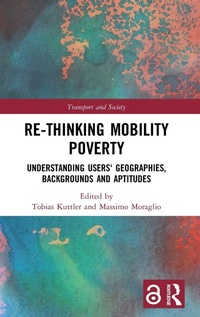
Re-thinking Mobility Poverty
Understanding Users' Geographies, Backgrounds and Aptitudes
1st Edition
Published on 18. December 2020
Book
Hardback
284 pages
978-0-367-33330-0 (ISBN)
Description
This book seeks to better conceptualise and define mobility poverty, addressing both its geographies and socio-economic landscapes. It moves beyond the analysis of 'transport poverty' and innovatively explores mobility inequalities and social construction of mobility disadvantages.
The debate on mobility poverty is gaining momentum due to its role in triggering social exclusion and economic deprivation. In this light, this book examines the social construction of mobility poverty by delving into mobility patterns and needs as they are differently experienced by social groups in different geographical situations. It considers factors such as the role of transport regimes and their social value when analysing the social construction of individual?s mobility needs. Furthermore, the gaps between articulated and unarticulated needs are identified by observing actual travel patterns of individuals. The book offers a comparison of the global phenomenon through fieldwork conducted in six different European countries - Greece, Portugal, Italy, Luxembourg, Romania and Germany.
This book will be useful reading for planners, sociologists, geographers, mobility/transport researchers, mobility advocates, policy-makers and transport practitioners.
The Open Access version of this book, available at https://doi.org/10.4324/9780367333317, has been made available under a Creative Commons Attribution 4.0 license.
The debate on mobility poverty is gaining momentum due to its role in triggering social exclusion and economic deprivation. In this light, this book examines the social construction of mobility poverty by delving into mobility patterns and needs as they are differently experienced by social groups in different geographical situations. It considers factors such as the role of transport regimes and their social value when analysing the social construction of individual?s mobility needs. Furthermore, the gaps between articulated and unarticulated needs are identified by observing actual travel patterns of individuals. The book offers a comparison of the global phenomenon through fieldwork conducted in six different European countries - Greece, Portugal, Italy, Luxembourg, Romania and Germany.
This book will be useful reading for planners, sociologists, geographers, mobility/transport researchers, mobility advocates, policy-makers and transport practitioners.
The Open Access version of this book, available at https://doi.org/10.4324/9780367333317, has been made available under a Creative Commons Attribution 4.0 license.
More details
Series
Language
English
Place of publication
London
United Kingdom
Publishing group
Taylor & Francis Ltd
Target group
College/higher education
Illustrations
56 s/w Abbildungen, 29 s/w Photographien bzw. Rasterbilder, 27 s/w Zeichnungen, 7 s/w Tabellen
7 Tables, black and white; 27 Line drawings, black and white; 29 Halftones, black and white; 56 Illustrations, black and white
Dimensions
Height: 240 mm
Width: 161 mm
Thickness: 22 mm
Weight
643 gr
ISBN-13
978-0-367-33330-0 (9780367333300)
Copyright in bibliographic data and cover images is held by Nielsen Book Services Limited or by the publishers or by their respective licensors: all rights reserved.
Schweitzer Classification
Other editions
Additional editions
Tobias Kuttler | Massimo Moraglio
Re-thinking Mobility Poverty
Understanding Users' Geographies, Backgrounds and Aptitudes
Book
05/2023
1st Edition
Routledge
€65.80
Shipment within 15-20 days
Tobias Kuttler | Massimo Moraglio
Re-thinking Mobility Poverty
Understanding Users' Geographies, Backgrounds and Aptitudes
E-Book
12/2020
1st Edition
Routledge
€0.00
Available for download
Tobias Kuttler | Massimo Moraglio
Re-thinking Mobility Poverty
Understanding Users' Geographies, Backgrounds and Aptitudes
E-Book
12/2020
1st Edition
Routledge
€0.00
Available for download
Persons
Tobias Kuttler is a geographer and urban planner, working on urban development,
mobility and social disadvantage. He is a researcher at TU Berlin
and PhD Candidate at TU Munich. He is writing his PhD dissertation on
the transformation of the taxi industry in Mumbai, India.
Massimo Moraglio is a Senior Researcher at Technische Universitat Berlin
and Coordinator of the MBA "Sustainable Mobility". His work explores
the relationship between technology and society, focusing on scenarios and
transitions. He is a member of the editorial board of Mobilities and Applied
Mobilities, and editor-in-chief of The Journal of Transport History.
mobility and social disadvantage. He is a researcher at TU Berlin
and PhD Candidate at TU Munich. He is writing his PhD dissertation on
the transformation of the taxi industry in Mumbai, India.
Massimo Moraglio is a Senior Researcher at Technische Universitat Berlin
and Coordinator of the MBA "Sustainable Mobility". His work explores
the relationship between technology and society, focusing on scenarios and
transitions. He is a member of the editorial board of Mobilities and Applied
Mobilities, and editor-in-chief of The Journal of Transport History.
Content
Foreword: A Mobility Justice Lens on Mobility Poverty by Mimi Sheller Introduction; Part 1: Social Skills and Individual Aptitudes 1. Learning Mobility 2. Unequal Mobilities, Network Capital and Mobility Justice 3. The Impact of Life Events on Travel Behaviour Part 2: Geographies of Mobility Poverty 4. The Spatial Dimension of Mobility Poverty 5. The Urban Arena 6. The Rural Arena Part 3: Societal Roots and Impacts 7. Women and Gender-Related Aspects 8. People on Low Income and Unemployed Persons 9. Impacts on Mobility in An Ageing Europe 10. The Predicaments of European Disabled People 11. Migrants, Ethnic Minorities and Mobility Poverty 12. Children and Young People Part 4: The Fieldwork 13. Forced Car Ownership and Forced Bus Usage. Contrasting Realities of Unemployed And Elderly People In Rural Regions: The Case Of Guarda, Portugal 14. Perception of Mobility Poverty in Remote Peri-Urban Salento (Italy) 15. Isolation, Individualism and Sharing: Mobility Poverty in Naxos And Small Cyclades, Greece 16. Unmet Needs: Exploring Mobility Poverty in Buzau, Romania 17. Towards an Understanding of The Social Meanings of Mobility - The Case Of Esslingen, Germany 18. Mobility Poverty in Luxembourg: Crossing Borders, Real Estate, Vulnerable Groups and Migrants Conclusion Findings and Conclusions