

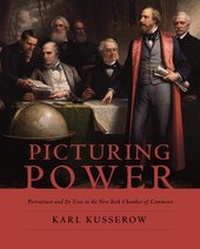
Picturing Power
Portraiture and Its Uses in the New York Chamber of Commerce
Published on 2. April 2013
Book
Hardback
424 pages
978-0-231-12358-7 (ISBN)
Description
The almost three hundred portraits that once composed the New York Chamber of Commerce's renowned collection capture the giants of American business with aesthetic and symbolic power. The images of civic leaders and entrepreneurs, carefully assembled over two hundred years, tell the story of American industry as shaped and reflected in the life of a major institution. Interpreting these images as historical documents, Picturing Power traces the establishment, growth, and eventual decline of the nation's most powerful business organization. Lavishly illustrated, this book also charts the social and aesthetic course of institutional portraiture in the United States. From its inception in 1768, the Chamber regulated and codified commercial practice, provided business interests with a unified means of forming and advancing their agendas, and consolidated and elevated the status of its members and their professions. By linking commercial development to social and cultural progress, portraiture did much to support these ends.
Whether enhancing, sanitizing, or stabilizing the reputations of business leaders; downplaying their wealth; or whitewashing their questionable practices, portraiture fashioned a public identity that matched corporate and civic needs as they evolved over time. By following changes in the use of these images, Picturing Power reveals the strategies and preoccupations of an American business culture that strove for egalitarian virtue while remaining firmly committed to the principles of competitive capitalism. Americans' shifting and ambivalent relationship to commerce situates these portraits-representations of the human face of business-at the critical intersection of enduring contests in American life, between self-interest and the greater good, between equality and the social hierarchy that wealth engenders.
Whether enhancing, sanitizing, or stabilizing the reputations of business leaders; downplaying their wealth; or whitewashing their questionable practices, portraiture fashioned a public identity that matched corporate and civic needs as they evolved over time. By following changes in the use of these images, Picturing Power reveals the strategies and preoccupations of an American business culture that strove for egalitarian virtue while remaining firmly committed to the principles of competitive capitalism. Americans' shifting and ambivalent relationship to commerce situates these portraits-representations of the human face of business-at the critical intersection of enduring contests in American life, between self-interest and the greater good, between equality and the social hierarchy that wealth engenders.
Reviews / Votes
In its celebration of individuality, portraiture became a fundamental art form of American democracy. Karl Kusserow and his colleagues explore one of the most important portrait collections in the country. Beginning with Matthew Pratt's portrait of colonial governor Cadwallader Colden and John Trumbull's great full-length image of Alexander Hamilton it showcases U.S. presidents and titans of finance, painted by many of the era's prominent portraitists. There is fascinating material here for readers of many interests: history, biography, business, architecture, and art. In our age of Occupy Wall Street, and its issues of money and power, this book couldn't be more timely. -- John Wilmerding, Professor emeritus of American Art, Princeton University This volume provides a rare look at institutional portraits and their meanings and uses. Journal of American History An impressive collection of essays about an important but neglected collection of art. -- John Ott CAA ReviewsMore details
Language
English
Place of publication
New York
United States
Target group
Professional and scholarly
Product notice
Trade binding
Illustrations
<B>200 illus.</B>
Dimensions
Height: 254 mm
Width: 203 mm
Thickness: 36 mm
Weight
1885 gr
ISBN-13
978-0-231-12358-7 (9780231123587)
Copyright in bibliographic data and cover images is held by Nielsen Book Services Limited or by the publishers or by their respective licensors: all rights reserved.
Schweitzer Classification
Persons
Karl Kusserow is curator of American art at the Princeton University Art Museum.
Content
List of Illustrations Preface and Acknowledgments Introduction, by Karl Kusserow Portraiture's Use, and Disuse, at the Chamber of Commerce and Beyond, by Karl Kusserow The Capitalist Portrait, by Paul Staiti Exercising Power: The New York Chamber of Commerce and the Community of Interest, by Elizabeth Blackmar Portraits in the Great Hall: The Chamber's "Voice" on Liberty Street, by Daniel Bluestone "The Whole Lustre of Gold": Framing and Displaying Power at the Chamber of Commerce, by David L. Barquist Memory, Metaphor, and Meaning in Daniel Huntington's Atlantic Cable Projectors, by Karl Kusserow Index
Read an excerpt from the chapter, "The Capitalist Portrait," by Paul Staiti: