

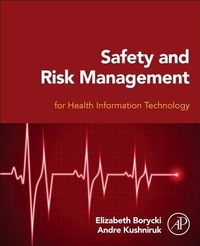
Safety and Risk Management for Health Information Technology
Will be published approx. on 1. January 2029
Book
Paperback/Softback
220 pages
978-0-12-803208-4 (ISBN)
Description
Safety and Risk Management for Health Information Technology provides health information technology (HIT) professionals and clinical informatics professionals with information and approaches on how to prevent HIT safety issues from arising. In addition, the book helps individuals retrospectively analyze HIT related medical errors and develop an effective eHealth safety strategy that is specific to their organization (e.g,. vendor, regional health authority) and context (i.e., acute care, home care, long-term care, public health/community health setting).
Notwithstanding the importance of the area, most books don't focus on helping vendors, healthcare organizations, and managers in developing an effective strategy for HIT safety issues. The authors have noticed as educators that both undergraduate and graduate students, and those who are currently HIT professionals, are constantly in need of relevant texts, educational resources, and guides on how to create a successful strategy based on current research in the area.
Notwithstanding the importance of the area, most books don't focus on helping vendors, healthcare organizations, and managers in developing an effective strategy for HIT safety issues. The authors have noticed as educators that both undergraduate and graduate students, and those who are currently HIT professionals, are constantly in need of relevant texts, educational resources, and guides on how to create a successful strategy based on current research in the area.
More details
Language
English
Place of publication
San Diego
United States
Publishing group
Elsevier Science Publishing Co Inc
Target group
Professional and scholarly
health information technology professionals; practitioners interested in HIT; graduate students engaged in health information programs.
Product notice
Paperback (trade)
Unsewn / adhesive bound
Dimensions
Height: 235 mm
Width: 191 mm
Thickness: 18 mm
Weight
450 gr
ISBN-13
978-0-12-803208-4 (9780128032084)
Copyright in bibliographic data and cover images is held by Nielsen Book Services Limited or by the publishers or by their respective licensors: all rights reserved.
Schweitzer Classification
Persons
Andre Kushniruk, BA, BSc, MSc, PhD is a Professor at the School of Health Information Science at the University of Victoria, Canada. Dr. Kushniruk is also an Adjunct Professor in the Faculty of Science and Engineering at Aalborg University, Denmark and an Honorary Professor at the University of Hong Kong. He conducts research in a number of areas including evaluation of the effects of technology in health informatics and improving the usability of healthcare information systems. His work is known internationally and he has published widely in the area of usability engineering in health informatics. His work has involved the development of new methods for designing and evaluating healthcare technologies and systems. He has been involved in bringing usability engineering practices into healthcare for the past twenty years. Dr. Kushniruk has held academic positions at a number of Canadian universities and worked with major hospitals in both Canada, the United States and internationally. He holds undergraduate degrees in Psychology and Biology, as well as a M.Sc. in Computer Science from McMaster University and a Ph.D. in Cognitive Psychology from McGill University. Dr. Kushniruk was elected as a fellow of the American College of Medical Informatics in 2009. Elizabeth Borycki, RN, HBScN, MN, PhD is an Associate Professor at the School of Health Information Science at the University of Victoria, Canada. Dr. Borycki has worked in numerous roles among them a Clinical Informatics Specialist, an Emergency Program Coordinator, Disease Management Specialist, Consultant and Researcher. She teaches systems evaluation, organizational behaviour and change management, quality improvement, research methods and biomedical fundamentals in the undergraduate and graduate programs in health informatics. Her research interests include clinical informatics, clinical simulations, organizational change management, health information system implementations, patient safety, project management and information seeking involving health information systems. Elizabeth has co-authored numerous papers examining the effects of health information system design upon Patient Safety. More recently, she has edited a book on respiratory disease and has edited a book on the human and social impact of information technologies in healthcare. Dr. Borycki holds a PhD from the University of Toronto.
Content
1. Introduction
2. Background - Defining technology-induced errors, HIT safety and risk management
3. Background - What theor(ies) (including models and frameworks) can be used to inform
4. Methods
5. Methods for Improving Safety and Risk Management of HIT
6. Clinical Simulations
7. Ethnographic Approaches
8. Case Studies
9. Monitoring Systems for Reports on HIT Safety Issues10. Cost-effectiveness of using the approaches
11. Organizational HIT Strategy and Integrating Risk Management
12. International Trends in HIT Safety and Risk Management
13. Discussion
14. Exercises
15. References
16. Suggested Readings
17. Appendices
2. Background - Defining technology-induced errors, HIT safety and risk management
3. Background - What theor(ies) (including models and frameworks) can be used to inform
4. Methods
5. Methods for Improving Safety and Risk Management of HIT
6. Clinical Simulations
7. Ethnographic Approaches
8. Case Studies
9. Monitoring Systems for Reports on HIT Safety Issues10. Cost-effectiveness of using the approaches
11. Organizational HIT Strategy and Integrating Risk Management
12. International Trends in HIT Safety and Risk Management
13. Discussion
14. Exercises
15. References
16. Suggested Readings
17. Appendices