

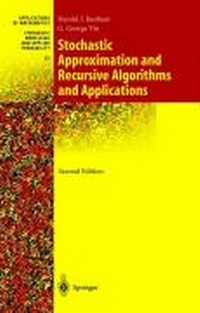
Stochastic Approximation and Recursive Algorithms and Applications
2nd Edition
Published on 17. July 2003
Book
Hardback
XXII, 478 pages
978-0-387-00894-3 (ISBN)
Description
This book presents a thorough development of the modern theory of stochastic approximation or recursive stochastic algorithms for both constrained and unconstrained problems. This second edition is a thorough revision, although the main features and structure remain unchanged. It contains many additional applications and results as well as more detailed discussion.
Reviews / Votes
From the reviews of the second edition: "This is the second edition of an excellent book on stochastic approximation, recursive algorithms and applications ... . Although the structure of the book has not been changed, the authors have thoroughly revised it and added additional material ... ." (Evelyn Buckwar, Zentralblatt MATH, Vol. 1026, 2004) "The book attempts to convince that ... algorithms naturally arise in many application areas ... . I do not hesitate to conclude that this book is exceptionally well written. The literature citation is extensive, and pertinent to the topics at hand, throughout. This book could be well suited to those at the level of the graduate researcher and upwards." (A. C. Brooms, Journal of the Royal Statistical Society Series A: Statistics in Society, Vol. 169 (3), 2006)More details
Product info
Book
Series
Language
English
Place of publication
New York, NY
United States
Target group
Research
Edition type
New edition
Product notice
Laminated cover
Illustrations
9 s/w Tabellen
9 black & white tables, biography
Dimensions
Height: 234 mm
Width: 164 mm
Thickness: 33 mm
Weight
904 gr
ISBN-13
978-0-387-00894-3 (9780387008943)
DOI
10.1007/b97441
Schweitzer Classification
Other editions
Additional editions
Harold Kushner | George Yin
Stochastic Approximation and Recursive Algorithms and Applications
Book
11/2010
2nd Edition
Springer
€213.99
Shipment within 15-20 days
Previous edition

Harold Kushner | G. George Yin
Stochastic Approximation and Recursive Algorithms and Applications
Book
05/2002
Springer
€85.59
Article exhausted; check for reprint
Content
Introduction
1 Review of Continuous Time Models
1.1 Martingales and Martingale Inequalities
1.2 Stochastic Integration
1.3 Stochastic Differential Equations: Diffusions
1.4 Reflected Diffusions
1.5 Processes with Jumps
2 Controlled Markov Chains
2.1 Recursive Equations for the Cost
2.2 Optimal Stopping Problems
2.3 Discounted Cost
2.4 Control to a Target Set and Contraction Mappings
2.5 Finite Time Control Problems
3 Dynamic Programming Equations
3.1 Functionals of Uncontrolled Processes
3.2 The Optimal Stopping Problem
3.3 Control Until a Target Set Is Reached
3.4 A Discounted Problem with a Target Set and Reflection
3.5 Average Cost Per Unit Time
4 Markov Chain Approximation Method: Introduction
4.1 Markov Chain Approximation
4.2 Continuous Time Interpolation
4.3 A Markov Chain Interpolation
4.4 A Random Walk Approximation
4.5 A Deterministic Discounted Problem
4.6 Deterministic Relaxed Controls
5 Construction of the Approximating Markov Chains
5.1 One Dimensional Examples
5.2 Numerical Simplifications
5.3 The General Finite Difference Method
5.4 A Direct Construction
5.5 Variable Grids
5.6 Jump Diffusion Processes
5.7 Reflecting Boundaries
5.8 Dynamic Programming Equations
5.9 Controlled and State Dependent Variance
6 Computational Methods for Controlled Markov Chains
6.1 The Problem Formulation
6.2 Classical Iterative Methods
6.3 Error Bounds
6.4 Accelerated Jacobi and Gauss-Seidel Methods
6.5 Domain Decomposition
6.6 Coarse Grid-Fine Grid Solutions
6.7 A Multigrid Method
6.8 Linear Programming
7 The Ergodic Cost Problem: Formulation and Algorithms
7.1 Formulation of the Control Problem
7.2 A Jacobi Type Iteration
7.3 Approximation in Policy Space
7.4 Numerical Methods
7.5 The Control Problem
7.6 The Interpolated Process
7.7 Computations
7.8 Boundary Costs and Controls
8 Heavy Traffic and Singular Control
8.1 Motivating Examples
&nb
1 Review of Continuous Time Models
1.1 Martingales and Martingale Inequalities
1.2 Stochastic Integration
1.3 Stochastic Differential Equations: Diffusions
1.4 Reflected Diffusions
1.5 Processes with Jumps
2 Controlled Markov Chains
2.1 Recursive Equations for the Cost
2.2 Optimal Stopping Problems
2.3 Discounted Cost
2.4 Control to a Target Set and Contraction Mappings
2.5 Finite Time Control Problems
3 Dynamic Programming Equations
3.1 Functionals of Uncontrolled Processes
3.2 The Optimal Stopping Problem
3.3 Control Until a Target Set Is Reached
3.4 A Discounted Problem with a Target Set and Reflection
3.5 Average Cost Per Unit Time
4 Markov Chain Approximation Method: Introduction
4.1 Markov Chain Approximation
4.2 Continuous Time Interpolation
4.3 A Markov Chain Interpolation
4.4 A Random Walk Approximation
4.5 A Deterministic Discounted Problem
4.6 Deterministic Relaxed Controls
5 Construction of the Approximating Markov Chains
5.1 One Dimensional Examples
5.2 Numerical Simplifications
5.3 The General Finite Difference Method
5.4 A Direct Construction
5.5 Variable Grids
5.6 Jump Diffusion Processes
5.7 Reflecting Boundaries
5.8 Dynamic Programming Equations
5.9 Controlled and State Dependent Variance
6 Computational Methods for Controlled Markov Chains
6.1 The Problem Formulation
6.2 Classical Iterative Methods
6.3 Error Bounds
6.4 Accelerated Jacobi and Gauss-Seidel Methods
6.5 Domain Decomposition
6.6 Coarse Grid-Fine Grid Solutions
6.7 A Multigrid Method
6.8 Linear Programming
7 The Ergodic Cost Problem: Formulation and Algorithms
7.1 Formulation of the Control Problem
7.2 A Jacobi Type Iteration
7.3 Approximation in Policy Space
7.4 Numerical Methods
7.5 The Control Problem
7.6 The Interpolated Process
7.7 Computations
7.8 Boundary Costs and Controls
8 Heavy Traffic and Singular Control
8.1 Motivating Examples
&nb