

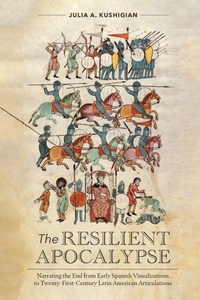
The Resilient Apocalypse
Narrating the End from Early Spanish Visualizations to Twenty-First Century Latin American Articulations
Published on 1. May 2024
Book
Paperback/Softback
258 pages
978-1-4696-8188-7 (ISBN)
Description
Portraits of good battling evil in the geography of hell come in many forms in the Hispanic World. Apocalyptic nightmares, frightful images of chaos and death are inclusive and interrelated, yet simultaneously project an exceptional quality ("never seen or experienced before," "the mother of all battles," "I am the only one who can fix it"). This investigation explores how narrative logic may challenge unified notions of finalities when images remain unfulfilled in a proscribed End. By redeploying transglobal character and narrative potential, the Apocalypse suggests bewildering complexities as it trains its lens on New Beginnings. Here analysis explores resilient formulas for combating the End through resistance in Latin America, Spain and Latin@ communities in the US. Whether revealed through gilded illustrations, messianic chronicles, poetry, Baroque letters, racially-motivated novels, sexuality and spirituality in film or intimidating immigrant photos, apocalyptic examples explode notions of final moments. The Resilient Apocalypse ironically performs as both an internal defense (a vehicle for mourning) and a counter-discourse to power (a mechanism for resistance). This study argues for a strategy that listens to and keeps the enemy "in sight and in mind," a method for grappling with and engaging difference by decolonizing the politics of the End. It reformulates an incomplete, mythical, and uncanny narrative into a poetics of resistance with communal solutions and obligations. When the Apocalypse is unremittingly sought after to impose social justice, salvation and reason, it paradoxically introduces future hope against itself. In the works of Beato de Liebana, Sor Juana Ines de la Cruz, Cirilo Villaverde, Cristina Garcia, Martin Kohan, Jennifer Maytorena Taylor, Santiago Roncagliolo, Alfonso Cuaron, etc., rival traditions internalize competing apocalyptic worldviews and arrive at sustainable plans of action for negotiating the afterward. By bracketing the finality of the End and proposing a tension between conflict archaeology and the transcendence of opposition through renovation, salvation or hope, this study reveals how plural, competing viewpoints of the End go a long way to legitimizing each other. Ultimately, The Resilient Apocalypse traces a compelling narrative theory of unfulfilled promise that forever changes the way we engage the other and value the self during intervals of fear.
More details
Series
Language
English
Place of publication
Chapel Hill
United States
Target group
Professional and scholarly
Product notice
Paperback (trade)
Illustrations
6 figures
Dimensions
Height: 229 mm
Width: 152 mm
Thickness: 16 mm
Weight
427 gr
ISBN-13
978-1-4696-8188-7 (9781469681887)
Copyright in bibliographic data and cover images is held by Nielsen Book Services Limited or by the publishers or by their respective licensors: all rights reserved.
Schweitzer Classification
Other editions
Additional editions
Julia A. Kushigian
The Resilient Apocalypse
Narrating the End from Early Spanish Visualizations to Twenty-First Century Latin American Articulations
E-Book
05/2024
UNC Department of Romance Studies
€29.49
Available for download
Person
Julia A. Kushigian is the Hanna Hafkesbrink Professor of Hispanic Studies at Connecticut College. Her literary and cultural studies are transnational probes of immersive works that engage compelling views of the Spanish-speaking world. She is the author of Orientalism in the Hispanic Literary Tradition. In Dialogue with Borges, Paz and Sarduy; Reconstructing Childhood. Strategies of Reading for Culture and Gender in the Spanish-American Bildungsroman; and Cronicas orientalistas y autorrealizadas: Entrevistas con Borges, Fuentes, Goytisolo, Poniatowska, Sarduy y Vargas Llosa.