

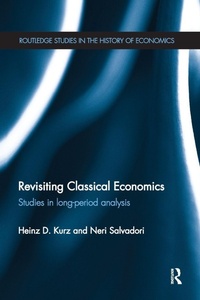
Revisiting Classical Economics
Studies in Long-Period Analysis
1st Edition
Published on 30. September 2020
Book
Paperback/Softback
326 pages
978-0-367-66942-3 (ISBN)
Description
The financial crisis and the economic crisis that followed triggered a crisis in the subject of economics, as it is typically being taught today especially in macroeconomics and related fields. A renewed interest in earlier authors, especially the classical economists from Adam Smith to David Ricardo and John Maynard Keynes, developed. This book may also be seen as a response to this interest. What can we learn from the authors mentioned, what we could not learn from the mainstream?
This volume contains a selection of essays which deepens and widens the understanding of the classical approach to important problems, such as value and distribution, growth and technical progress, and exhaustible natural resources. It is the fourth collection in a row and reflects an on-going discussion of the fecundity of the classical approach.
A main topic of the essays is a comparison between the classical approaches with modern theory and thus an identification of what can be learned by elaborating on the ideas of Smith and Ricardo and Marx above and beyond and variously in contradiction to certain mainstream view. Since the work of Piero Sraffa spurred the revival of classical economic thought, his contributions are dealt with in some detail. The attention then focuses on economic growth and the treatment of exhaustible resources within a classical framework of the analysis.
This volume contains a selection of essays which deepens and widens the understanding of the classical approach to important problems, such as value and distribution, growth and technical progress, and exhaustible natural resources. It is the fourth collection in a row and reflects an on-going discussion of the fecundity of the classical approach.
A main topic of the essays is a comparison between the classical approaches with modern theory and thus an identification of what can be learned by elaborating on the ideas of Smith and Ricardo and Marx above and beyond and variously in contradiction to certain mainstream view. Since the work of Piero Sraffa spurred the revival of classical economic thought, his contributions are dealt with in some detail. The attention then focuses on economic growth and the treatment of exhaustible resources within a classical framework of the analysis.
Reviews / Votes
"Kurz and Salvadori... provide an up-todate development of many aspects of the classical approach to economics. The book will be useful to those interested in the classical approach and here we include not only the historians of economic thought, but also those economic theorists interested in a relevant and also viable alternative to the neoclassical approach, capable of addressing current problems."- Lefteris Tsoulfidis, in the European Journal of the History of Economic Thought
More details
Series
Language
English
Place of publication
London
United Kingdom
Publishing group
Taylor & Francis Ltd
Target group
College/higher education
Postgraduate and Undergraduate
Dimensions
Height: 234 mm
Width: 156 mm
Thickness: 19 mm
Weight
529 gr
ISBN-13
978-0-367-66942-3 (9780367669423)
Copyright in bibliographic data and cover images is held by Nielsen Book Services Limited or by the publishers or by their respective licensors: all rights reserved.
Schweitzer Classification
Other editions
Additional editions
E-Book
08/2014
Routledge
€58.99
Available for download
E-Book
08/2014
Routledge
€59.49
Available for download
Book
08/2014
1st Edition
Routledge
€227.50
Shipment within 15-20 days
Persons
Heinz D. Kurz is Professor of Economics at the University of Graz, Austria, and Chairman of the Graz Schumpeter Centre.
Neri Salvadori is Professor of Economics at the University of Pisa, Italy, and Chairman of CISCE (Centro Ineruniversitario per lo Studio sulla Crescita e lo Sviluppo Economico).
Neri Salvadori is Professor of Economics at the University of Pisa, Italy, and Chairman of CISCE (Centro Ineruniversitario per lo Studio sulla Crescita e lo Sviluppo Economico).
Content
1. Classical Economics and Modern Theory 2. On Sraffa's contribution 3. Production of commodities by means of commodities in its making 4. Growth and Distribution 4. Exhaustible Resources