

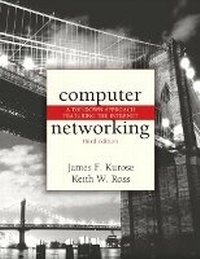
Computer Networking
A Top-Down Approach Featuring the Internet: United States Edition
3rd Edition
Published on 11. June 2004
Book
Hardback
848 pages
978-0-321-22735-5 (ISBN)
Description
Revised to reflect the rapid changes in the field of networking, Computer Networking provides a top-down approach to this study by beginning with applications-level protocols and then working down the protocol stack. An early emphasis is placed on application-layer paradigms and application programming interfaces to allow readers to get their "hands-dirty" with protocols and networking concepts in the context of applications they will use in the industry.
Networking today is much more (and far more interesting) than standards specifying message formats and protocol behaviors. Professors Kurose and Ross focus on describing emerging principles in a lively and engaging manner and then illustrate these principles with examples drawn from Internet architecture.
Networking today is much more (and far more interesting) than standards specifying message formats and protocol behaviors. Professors Kurose and Ross focus on describing emerging principles in a lively and engaging manner and then illustrate these principles with examples drawn from Internet architecture.
More details
Edition
3rd edition
Language
English
Place of publication
United States
Publishing group
Pearson Education (US)
Target group
College/higher education
Dimensions
Height: 241 mm
Width: 189 mm
Thickness: 37 mm
Weight
1436 gr
ISBN-13
978-0-321-22735-5 (9780321227355)
Copyright in bibliographic data and cover images is held by Nielsen Book Services Limited or by the publishers or by their respective licensors: all rights reserved.
Schweitzer Classification
Other editions
New editions

Book
05/2007
4th Edition
Pearson
€65.60
Article exhausted; check for reprint
James F. Kurose | Keith W. Ross
Computer Networking Complete Package
Book
03/2007
3rd Edition
Pearson
€56.94
Article is exhausted; no reprint
Previous edition
James F. Kurose | Keith W. Ross
Computer Networking
A Top-Down Approach Featuring the Internet: United States Edition
Book
08/2002
2nd Edition
Pearson
€80.46
Article exhausted; check for reprint
Content
1. Computer Networks and the Internet.
What is the Internet?
The Network Edge.
Case History: Search for Extraterrestrial Life.
The Network Core.
Network Access and Physical Media
ISPs and Internet Backbones.
Delay and Loss in Packet-Switched Networks.
Protocol Layers and Their Service Models.
History of Computer Networking and the Internet.
2. Application Layer.
Principles of Application Layer Protocols.
The Web and HTTP.
File Transfer:FTP.
Electronic Mail in the Internet.
DNS-The Internet's Directory Service.
Socket Programming with TCP.
Socket Programming with UDP.
Building a Simple Web Server.
Content Distribution.
3. Transport Layer.
Introduction and Transport-Layer Services.
Multiplexing and Demultiplexing.
Connectionless Transport: UDP.
Principles of Reliable Data Transfer.
Connection-Oriented Transport: TCP.
Principles of Congestion Control.
TCP Congestion Control.
4. Networking Layer & Routing.
Introduction and Network Service Model.
Routing Principles.
Hierarchical Routing.
The Internet Protocol.
Routing and the Internet.
What's Inside a Router.
IPv6.
Multicast Routing.
Mobility and the Network Layer.
5. Link Layer.
Data Link Layer: Introduction and Services.
Error Detection and Correction Techniques.
Multiple Access Protocols.
LAN Addresses and ARP.
Ethernet.
Hubs, Bridges and Switches.
Wireless Links.
PPP: The Point-to-Point Protocol.
Asynchronous Transfer Mode (ATM).
Frame Relay.
6. Wireless & Mobility.
Introduction to Wireless and Mobility.
Wi-fi.
Mobility Principles.
Cellular Telephony.
Mobile IP.
Ad hoc Networks.
Moving Beyond the Link Layer-An Interlude.
7. Multimedia.
Multimedia Networking Applications.
Streaming Stored Audio and Video.
Making the Best of the Best-Effort Service: An INternet Phone Example.
Protocols for Real-Time Interactive Applications.
Beyond Best-Effort.
Scheduling and Policing Mechanisms.
Integrated Services.
RSVP.
Differentiated Services.
8. Security.
What is Network Security?
Principles of Cryptography.
Authentication.
Integrity.
Key Distribution and Certification.
Access Control: Firewalls.
Attacks and Countermeasures.
Security in Many Layers: Case Studies.
9. Network Management.
What is Network Management?
The Infrastructure for Network Management.
The Internet Network-Management Framework.
ASN.1.
Appendix.
Lab: Building a Multi-Thread Web Server in Java.
Lab: Building a Mail User Agent in Java.
Lab: Implementing a Distributed, Asynchronous Distance Vector Routing.
Lab: Video Streaming Using RTP and RTSP.
RTP and RTSP.
What is the Internet?
The Network Edge.
Case History: Search for Extraterrestrial Life.
The Network Core.
Network Access and Physical Media
ISPs and Internet Backbones.
Delay and Loss in Packet-Switched Networks.
Protocol Layers and Their Service Models.
History of Computer Networking and the Internet.
2. Application Layer.
Principles of Application Layer Protocols.
The Web and HTTP.
File Transfer:FTP.
Electronic Mail in the Internet.
DNS-The Internet's Directory Service.
Socket Programming with TCP.
Socket Programming with UDP.
Building a Simple Web Server.
Content Distribution.
3. Transport Layer.
Introduction and Transport-Layer Services.
Multiplexing and Demultiplexing.
Connectionless Transport: UDP.
Principles of Reliable Data Transfer.
Connection-Oriented Transport: TCP.
Principles of Congestion Control.
TCP Congestion Control.
4. Networking Layer & Routing.
Introduction and Network Service Model.
Routing Principles.
Hierarchical Routing.
The Internet Protocol.
Routing and the Internet.
What's Inside a Router.
IPv6.
Multicast Routing.
Mobility and the Network Layer.
5. Link Layer.
Data Link Layer: Introduction and Services.
Error Detection and Correction Techniques.
Multiple Access Protocols.
LAN Addresses and ARP.
Ethernet.
Hubs, Bridges and Switches.
Wireless Links.
PPP: The Point-to-Point Protocol.
Asynchronous Transfer Mode (ATM).
Frame Relay.
6. Wireless & Mobility.
Introduction to Wireless and Mobility.
Wi-fi.
Mobility Principles.
Cellular Telephony.
Mobile IP.
Ad hoc Networks.
Moving Beyond the Link Layer-An Interlude.
7. Multimedia.
Multimedia Networking Applications.
Streaming Stored Audio and Video.
Making the Best of the Best-Effort Service: An INternet Phone Example.
Protocols for Real-Time Interactive Applications.
Beyond Best-Effort.
Scheduling and Policing Mechanisms.
Integrated Services.
RSVP.
Differentiated Services.
8. Security.
What is Network Security?
Principles of Cryptography.
Authentication.
Integrity.
Key Distribution and Certification.
Access Control: Firewalls.
Attacks and Countermeasures.
Security in Many Layers: Case Studies.
9. Network Management.
What is Network Management?
The Infrastructure for Network Management.
The Internet Network-Management Framework.
ASN.1.
Appendix.
Lab: Building a Multi-Thread Web Server in Java.
Lab: Building a Mail User Agent in Java.
Lab: Implementing a Distributed, Asynchronous Distance Vector Routing.
Lab: Video Streaming Using RTP and RTSP.
RTP and RTSP.