

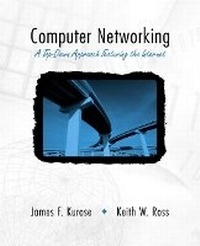
Computer Networking
A Top-Down Approach Featuring the Internet
Published on 19. July 2000
Book
Paperback/Softback
712 pages
978-0-201-47711-5 (ISBN)
Description
By starting at the application-layer and working down to the protocol stack, Computer Networking: A Top-Down Approach Featuring the Internet provides a motivational treatment of important concepts for networking students. Based on the rationale that once a student understands the applications of networks they can understand the network services needed to support these applications, this book takes a "top-down" approach where students are first exposed to a concrete application and then drawn into some of the deeper issues of networking.
Computer Networking: A Top-Down Approach Featuring the Internet focuses on the Internet as opposed to addressing it as just one of many computer network technologies. Students are enormously curious about what is "under the hood" of the Internet, creating an extremely motivational vehicle for teaching fundamental computer networking concepts.
This text features a comprehensive companion website which includes the entire text online. It allows for direct access to some of the best Internet sites relating to computer networks and Internet protocols. The website has many interactive features, including direct access to the Traceroute program, direct access to search engines for Internet Drafts, Java applets that animate difficult concepts, and direct streaming audio. Finally, the website makes it possible to update the material to keep up-to-date with this rapidly changing field.
Computer Networking: A Top-Down Approach Featuring the Internet focuses on the Internet as opposed to addressing it as just one of many computer network technologies. Students are enormously curious about what is "under the hood" of the Internet, creating an extremely motivational vehicle for teaching fundamental computer networking concepts.
This text features a comprehensive companion website which includes the entire text online. It allows for direct access to some of the best Internet sites relating to computer networks and Internet protocols. The website has many interactive features, including direct access to the Traceroute program, direct access to search engines for Internet Drafts, Java applets that animate difficult concepts, and direct streaming audio. Finally, the website makes it possible to update the material to keep up-to-date with this rapidly changing field.
More details
Language
English
Place of publication
United States
Publishing group
Pearson Education (US)
Target group
College/higher education
Dimensions
Height: 240 mm
Width: 195 mm
Thickness: 33 mm
Weight
1287 gr
ISBN-13
978-0-201-47711-5 (9780201477115)
Copyright in bibliographic data and cover images is held by Nielsen Book Services Limited or by the publishers or by their respective licensors: all rights reserved.
Schweitzer Classification
Other editions
New editions
James F. Kurose | Keith W. Ross
Computer Networking
A Top-Down Approach Featuring the Internet: United States Edition
Book
08/2002
2nd Edition
Pearson
€80.46
Article exhausted; check for reprint
Persons
Since January 1998, Keith Ross is a Professor and Department Head in the Multimedia Communications Department at Institute EurEcom, in Sophia Antipolis, France. From 1985 to December 1997, Keith Ross was with the University of Pennsylvania, Department of Systems Engineering, as Assistant, Associate, and Full Professor.
He has published over 40 papers in leading journals and has published a book on multiservice loss models for broadband telecommunication networks. Along with Jim Kurose, he is currently writing an online multimedia textbook on Internet protocols and data networks. He is or has been on the following editorial boards: Queuing Systems, Theory and Applications; Probability in the Engineering and Information Sciences; Operations Research; Telecommunications Systems; and IEEE Transactions on Automatic Control. He was the Program Chairman of the 1995 INFORMS Telecommunications Conference. He received his MS from Columbia University (1981) in Electrical Engineering , and his Ph.D. from the University of Michigan (1985) in Computer, Information and Control Engineering.
Jim Kurose received a B.A. degree in physics from Wesleyan University in 1978 and his M.S. and Ph.D. degrees in computer science from Columbia University in 1980 and 1984, respectively. He is currently a Professor of Computer Science at the University of Massachusetts, where he is also co-director of the Networking Research Laboratory of the Multimedia Systems Laboratory. He is currently serving a term as Chairman of the Department of Computer Science. Professor Kurose was a Visiting Scientist at IBM Research during the 1990/91 academic year, and at INRIA and at EURECOM, both in Sophia Antipolis, France, during the 1997/98 academic year.
His research interests include real-time and multimedia communication, network and operating system support for servers, and modeling and performance evaluation. Dr. Kurose is the past Editor-in-Chief of the IEEE Transactions on Communications and of the IEEE/ACM Transactions on Networking. He has been active in the program committees for IEEE Infocom, ACM SIGCOMM, and ACM SIGMETRICS conferences for a number of years.
He is the six-time recipient of the Outstanding Teacher Award from the National Technological University (NTU), the recipient of the Outstanding Teacher Award from the College of Science and Natural Mathematics at the University of Massachusetts, and the recipient of the 1996 Outstanding Teaching Award of the Northeast Association of Graduate Schools. He has been the recipient of a GE Fellowship, IBM Faculty Development Award, and a Lilly Teaching Fellowship. He is a Fellow of the IEEE, and a member of ACM, Phi Beta Kappa, Eta Kappa Nu, and Sigma Xi.
He is currently working on an on-line introductory networking textbook, "Computer Networking: A Top Down Approach Featuring the Internet," with Keith Ross. The book is available on-line, and is to be published by Addison-Wesley Longman in 2000.
0201477114AB04062001
He has published over 40 papers in leading journals and has published a book on multiservice loss models for broadband telecommunication networks. Along with Jim Kurose, he is currently writing an online multimedia textbook on Internet protocols and data networks. He is or has been on the following editorial boards: Queuing Systems, Theory and Applications; Probability in the Engineering and Information Sciences; Operations Research; Telecommunications Systems; and IEEE Transactions on Automatic Control. He was the Program Chairman of the 1995 INFORMS Telecommunications Conference. He received his MS from Columbia University (1981) in Electrical Engineering , and his Ph.D. from the University of Michigan (1985) in Computer, Information and Control Engineering.
Jim Kurose received a B.A. degree in physics from Wesleyan University in 1978 and his M.S. and Ph.D. degrees in computer science from Columbia University in 1980 and 1984, respectively. He is currently a Professor of Computer Science at the University of Massachusetts, where he is also co-director of the Networking Research Laboratory of the Multimedia Systems Laboratory. He is currently serving a term as Chairman of the Department of Computer Science. Professor Kurose was a Visiting Scientist at IBM Research during the 1990/91 academic year, and at INRIA and at EURECOM, both in Sophia Antipolis, France, during the 1997/98 academic year.
His research interests include real-time and multimedia communication, network and operating system support for servers, and modeling and performance evaluation. Dr. Kurose is the past Editor-in-Chief of the IEEE Transactions on Communications and of the IEEE/ACM Transactions on Networking. He has been active in the program committees for IEEE Infocom, ACM SIGCOMM, and ACM SIGMETRICS conferences for a number of years.
He is the six-time recipient of the Outstanding Teacher Award from the National Technological University (NTU), the recipient of the Outstanding Teacher Award from the College of Science and Natural Mathematics at the University of Massachusetts, and the recipient of the 1996 Outstanding Teaching Award of the Northeast Association of Graduate Schools. He has been the recipient of a GE Fellowship, IBM Faculty Development Award, and a Lilly Teaching Fellowship. He is a Fellow of the IEEE, and a member of ACM, Phi Beta Kappa, Eta Kappa Nu, and Sigma Xi.
He is currently working on an on-line introductory networking textbook, "Computer Networking: A Top Down Approach Featuring the Internet," with Keith Ross. The book is available on-line, and is to be published by Addison-Wesley Longman in 2000.
0201477114AB04062001
Content
(Each chapter concludes with a Summary, Homework Problems and Questions, Problems, Discussion Questions and Programming Assignments.)
1. Computer Networks and the Internet.
What is the Internet?
What is a Protocol?
The Network Edge.
The Network Core.
Interactive Programs for Tracing Routes in the Internet.
Java Applet: Message Switching and Packet Switching.
Access Networks and Physical Media.
Delay and Loss in Packet-Switched Networks.
Protocol Layers and Their Service Models.
Internet Backbones, NAPs and ISPs.
A Brief History of Computer Networking and the Internet.
ATM.
2. Application Layer.
Principles of Application-Layer Protocols.
The World Wide Web: HTTP.
File Transfer: FTP.
Electronic Mail in the Internet.
The Internet's Directory Service: DNS.
Interactive Programs for Exploring DNS.
Socket Programming with TCP.
Socket Programming with UDP.
Building a Simple Web Server.
3. Transport Layer.
Transport-Layer Services and Principles.
Multiplexing and Demultiplexing Applications.
Connectionless Transport: UDP.
Principles of Reliable Data Transfer.
Java Applet: Flow Control in Action.
Connection-Oriented Transport: TCP.
Principles of Congestion Control.
TCP Congestion Control.
4. Network Layer and Routing.
Introduction and Network Service Model.
Routing Principles.
Hierarchical Routing.
Internet Protocol.
Java Applet: IP Fragmentation.
Routing in the Internet.
What's Inside a Router?
IPv6.
Multicast Routing.
5. Link Layer and Local Area Networks.
The Data Link Layer: Introduction, Services.
Error Detection and Correction.
Multiple Access Protocols and LANs.
LAN Addresses and ARP.
Ethernet.
CSMA/CD Applet.
Hubs, Bridges and Switches.
Wireless LANs: IEEE 802.11.
The Point-to-Point Protocol.
ATM.
X.25 and Frame Relay.
6. Multimedia Networking.
Multimedia Networking Applications.
Streaming Stored Audio and Video.
Making the Best of the Best-Effort Service: An Internet Phone Example.
RTP.
Beyond Best-Effort.
Scheduling and Policing Mechanisms.
Integrated Services.
RSVP.
Differentiated Services.
7. Security in Computer Networks.
What is Network Security?
Principles of Cryptography.
Authentication: Who are You?
Integrity.
Key Distribution and Certification.
Secure E-Mail.
Internet Commerce.
Network-Layer Security: IPsec.
1999 Panel Discussion on Internet Security.
8. Network Management.
Introduction to Network Management.
The Internet Network-Management Framework.
ASN.1.
Firewalls.
Appendix.
Lab: Building a multi-thread Web sever in Java.
Lab: Building a mail user agent in Java.
Lab: Implementing a distributed, asynchronous distance vector routing. 0201477114T04062001
1. Computer Networks and the Internet.
What is the Internet?
What is a Protocol?
The Network Edge.
The Network Core.
Interactive Programs for Tracing Routes in the Internet.
Java Applet: Message Switching and Packet Switching.
Access Networks and Physical Media.
Delay and Loss in Packet-Switched Networks.
Protocol Layers and Their Service Models.
Internet Backbones, NAPs and ISPs.
A Brief History of Computer Networking and the Internet.
ATM.
2. Application Layer.
Principles of Application-Layer Protocols.
The World Wide Web: HTTP.
File Transfer: FTP.
Electronic Mail in the Internet.
The Internet's Directory Service: DNS.
Interactive Programs for Exploring DNS.
Socket Programming with TCP.
Socket Programming with UDP.
Building a Simple Web Server.
3. Transport Layer.
Transport-Layer Services and Principles.
Multiplexing and Demultiplexing Applications.
Connectionless Transport: UDP.
Principles of Reliable Data Transfer.
Java Applet: Flow Control in Action.
Connection-Oriented Transport: TCP.
Principles of Congestion Control.
TCP Congestion Control.
4. Network Layer and Routing.
Introduction and Network Service Model.
Routing Principles.
Hierarchical Routing.
Internet Protocol.
Java Applet: IP Fragmentation.
Routing in the Internet.
What's Inside a Router?
IPv6.
Multicast Routing.
5. Link Layer and Local Area Networks.
The Data Link Layer: Introduction, Services.
Error Detection and Correction.
Multiple Access Protocols and LANs.
LAN Addresses and ARP.
Ethernet.
CSMA/CD Applet.
Hubs, Bridges and Switches.
Wireless LANs: IEEE 802.11.
The Point-to-Point Protocol.
ATM.
X.25 and Frame Relay.
6. Multimedia Networking.
Multimedia Networking Applications.
Streaming Stored Audio and Video.
Making the Best of the Best-Effort Service: An Internet Phone Example.
RTP.
Beyond Best-Effort.
Scheduling and Policing Mechanisms.
Integrated Services.
RSVP.
Differentiated Services.
7. Security in Computer Networks.
What is Network Security?
Principles of Cryptography.
Authentication: Who are You?
Integrity.
Key Distribution and Certification.
Secure E-Mail.
Internet Commerce.
Network-Layer Security: IPsec.
1999 Panel Discussion on Internet Security.
8. Network Management.
Introduction to Network Management.
The Internet Network-Management Framework.
ASN.1.
Firewalls.
Appendix.
Lab: Building a multi-thread Web sever in Java.
Lab: Building a mail user agent in Java.
Lab: Implementing a distributed, asynchronous distance vector routing. 0201477114T04062001