

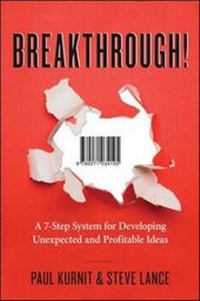
Breakthrough!
A 7-Step System for Developing Unexpected and Profitable Ideas
Published on 16. November 2010
Book
Hardback
224 pages
978-0-8144-1562-7 (ISBN)
Description
Consider some big ideas that have become business and cultural phenomena: how Starbucks transformed a declining coffee market by combining an experience destination with a premium product. Or how the established notion that "dolls are for girls" was shattered by a toy line called G.I. Joe.Most people mistakenly think breakthrough ideas are a matter of divine inspiration and luck. This book reveals a step-by-step methodology individuals and organizations can use to develop, create, and nurture the kinds of new products and services that capture the public's imagination. Loaded with examples and packed with straightforward explanations of the processes that can lead to breakout hits this book shows readers how to create an idea methodology, encourage free-thinking, keep good ideas, and bring revolutionary, revenue generating new concepts to market.
More details
Language
English
Place of publication
New York
United States
Target group
Professional and scholarly
Dimensions
Height: 236 mm
Width: 160 mm
Thickness: 23 mm
Weight
298 gr
ISBN-13
978-0-8144-1562-7 (9780814415627)
Copyright in bibliographic data and cover images is held by Nielsen Book Services Limited or by the publishers or by their respective licensors: all rights reserved.
Schweitzer Classification
Persons
Paul Kurnit is a well-known marketing expert and marketing professor at Pace University whose achievements at agencies such as Benton and Bowles, Ogilvy and DDB's Griffin Bacal include campaigns for Crest, American Express, and Transformers.
Steve Lance is a thirty-year veteran of advertising and marketing and an award-winning copywriter and creative director. He is coauthor of The Little Blue Book of Advertising. Together, they are the authors of The Little Blue Book of Marketing.
Steve Lance is a thirty-year veteran of advertising and marketing and an award-winning copywriter and creative director. He is coauthor of The Little Blue Book of Advertising. Together, they are the authors of The Little Blue Book of Marketing.
Content
CONTENTS
Introduction
Acknowledgments
Overview: What's a Big Idea?
Step 1: Put an End to Business as Usual
1 How Ya Doin'?
2 Why Rules Are Traps
3 The New Rules
Step 2: Get Business Buy-In
4 Build the Sale
5 Make It Stick
Step 3: Organize the Team and Process
6 True Believers, Consensus Builders, and Odd Ducks
7 Fire Up the Engines
8 Parameters and Process
Step 4: Land on the Big Idea
9 What Are You Selling?
10 What Are You Looking For?
11 The Competitive Landscape
12 Coming Up with the Big Idea
13 Give Every Idea a Chance to Live
14 Sifting and Winnowing
Step 5: Build Momentum for the Idea
15 Determine the Dimensions of the Idea
16 Research
17 Due Diligence
18 Budgets
19 Management Buy-In
Step 6: Develop the Plan
20 What Should the Plan Look Like?
21 Sell in the Plan
22 Who Ya Gonna Call?
Step 7: The Launch
23 Let's Do Launch
24 Implement a Readable Test
25 Read, Roll, or Kill
26 Celebrate!
27 The End-And the Beginning
Index
About the Authors
Introduction
Acknowledgments
Overview: What's a Big Idea?
Step 1: Put an End to Business as Usual
1 How Ya Doin'?
2 Why Rules Are Traps
3 The New Rules
Step 2: Get Business Buy-In
4 Build the Sale
5 Make It Stick
Step 3: Organize the Team and Process
6 True Believers, Consensus Builders, and Odd Ducks
7 Fire Up the Engines
8 Parameters and Process
Step 4: Land on the Big Idea
9 What Are You Selling?
10 What Are You Looking For?
11 The Competitive Landscape
12 Coming Up with the Big Idea
13 Give Every Idea a Chance to Live
14 Sifting and Winnowing
Step 5: Build Momentum for the Idea
15 Determine the Dimensions of the Idea
16 Research
17 Due Diligence
18 Budgets
19 Management Buy-In
Step 6: Develop the Plan
20 What Should the Plan Look Like?
21 Sell in the Plan
22 Who Ya Gonna Call?
Step 7: The Launch
23 Let's Do Launch
24 Implement a Readable Test
25 Read, Roll, or Kill
26 Celebrate!
27 The End-And the Beginning
Index
About the Authors