

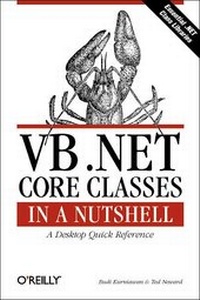
VB.Net Core Classes in a Nutshell
A Desktop Quick Reference
Published on 30. July 2002
Book
Paperback/Softback
574 pages
978-0-596-00257-2 (ISBN)
Description
In this text, VB Programmers should find a concise reference to the types found in the core namespaces of the .NET Framework Class Library. The heart of the book is a Nutshell quick reference to all the types found in 22 core .NETnamespaces. The entry for each type describes its significance, explains how the type is used in .NET applications and lists its members and their signatures in readable VB.NET syntax. The core namespaces documented in this book include types in the following areas: essential system and programming services found in the System namespace; text handling and regular expression pattern searches; diagnostics, debugging, and performance monitoring; generalized and specialized collection objects; reflection; Extensible Markup Language (XML); Input/output and serialization; networking; threading and timers; and COM interop and globalization. The accompanying CD-ROM offers full access to its 22 namespace overviews and 700-plus type entries.
More details
Persons
Budi Kurniawan is an independent consultant with extensive experience in VB and VBA programming. He is the author of Internet Programming with VB, five books on VBA programming with Microsoft Access, and a guide to developing ASP applications with WebClasses. Ted Neward is an independent software development architect and mentor in the Sacramento, California area. He is the author of a number of books, including Server-Based Java Programming (Manning), the forthcoming EffectiveEnterprise Java (Addison-Wesley) and Shared Source CLI Essentials (O'Reilly) and co-author of C SHARP In a Nutshell (O'Reilly) with Peter Drayton and Ben Albahari. He is also an instructor with DevelopMentor, where he teaches and authors both the Java and .NET curriculum. He speaks frequently for technology user groups and writes technical papers for www.javageeks.com and www.clrgeeks.com. He currently labors on behalf of the University of California, Davis, architecting a rebuild of the Davis Accounting and Financial Information Services software system. Past clients include companies like Pacific Bell, EdFund, Synergex and Intuit.
Content
Preface PART 1: Introduction Chapter 1. Introduction Before the .NET FCL The .NET Framework Class Library Working with the .NET FCL The Types of a .NET Namespace Approaching the .NET FCL PART 2: .NET Core Classes Quick Reference Chapter 2. Reference Finding a Quick-Reference Entry Reading a Quick-Reference Entry Chapter 3. Microsoft.Win32 Chapter 4. System Chapter 5. System.Collections Chapter 6. System.Collections.Specialized Chapter 7. System.Diagnostics Chapter 8. System.Globalization Chapter 9. System.IO Chapter 10. System.IO.IsolatedStorage Chapter 11. System.Net Chapter 12. System.Net.Sockets Chapter 13. System.Reflection Chapter 14. System.Reflection.Emit Chapter 15. System.Runtime.InteropServices Chapter 16. System.Runtime.Serialization Chapter 18. System.Text Chapter 19. System.Text.RegularExpressions Chapter 20. System.Threading Chapter 21. System.Timers Chapter 22. System.Xml Chapter 23. System.Xml.XPath Chapter 24. System.Xml.Xsl PART 3: Appendixes Appendix A. Regular Expressions Appendix B. Format Specifiers Appendix C. Data Marshaling Appendix D. Namespaces and Assemblies Appendix E. Type, Method, Property