

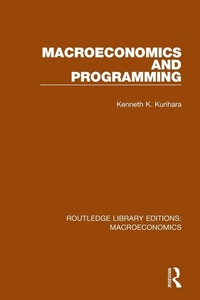
Macroeconomics and Programming
1st Edition
Published on 1. August 2017
Book
Paperback/Softback
100 pages
978-1-138-94095-6 (ISBN)
Description
This volume, originally published in 1964, is intended for students of macroeconomic theory and mathematical programming. Part 1 includes critical discussion of debates from the 1950s and 60s in the related fields of income-employment , trade cycles and general prices, with an ultimate view to extending macroeconomic analysis and policy beyond the conventional purview; Part 2 suggests various possible macro applications of mathematical programming techniques to optimization problems, with a secondary view to forwwarding the synthesis of aggregative economic theory and multisectoral input-output analysis.
More details
Series
Language
English
Place of publication
London
United Kingdom
Publishing group
Taylor & Francis Ltd
Target group
College/higher education
Professional and scholarly
General, Postgraduate, Professional, and Undergraduate
Dimensions
Height: 234 mm
Width: 156 mm
Weight
453 gr
ISBN-13
978-1-138-94095-6 (9781138940956)
Copyright in bibliographic data and cover images is held by Nielsen Book Services Limited or by the publishers or by their respective licensors: all rights reserved.
Schweitzer Classification
Other editions
Additional editions
Kenneth K. Kurihara
Macroeconomics and Programming
E-Book
09/2015
Routledge
€44.99
Available for download
Kenneth K. Kurihara
Macroeconomics and Programming
E-Book
09/2015
Routledge
€44.99
Available for download

Kenneth K. Kurihara
Macroeconomics and Programming
Book
09/2015
1st Edition
Routledge
€163.42
Shipment within 10-20 days
Person
Kenneth K. Kurihara
Content
Part 1: Macro Analysis and Policy 1. Multiplier Analysis and Fiscal Policy 2. Monetary Theory and General Prices 3. The Liquidity Trap and Full Employment 4. An Endogenous Model of Cyclical Growth Part 2: Macro Linear Programming 5. Input-Output Preliminaries to Linear Programming 6. Linear Programming for Optimal Employment and Investment 7. The Harrod Matrix and Multisectoral Linear Programming 8. Parametric Non-Linear Programming for Optimal Growth