


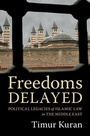
Freedoms Delayed
Political Legacies of Islamic Law in the Middle East
Published on 20. July 2023
Book
Hardback
450 pages
978-1-009-32001-6 (ISBN)
Description
According to diverse indices of political performance, the Middle East is the world's least free region. Some believe that it is Islam that hinders liberalization. Others retort that Islam cannot be a factor because the region is no longer governed under Islamic law. This book by Timur Kuran, author of the influential Long Divergence, explores the lasting political effects of the Middle East's lengthy exposure to Islamic law. It identifies several channels through which Islamic institutions, both defunct and still active, have limited the expansion of basic freedoms under political regimes of all stripes: secular dictatorships, electoral democracies, monarchies legitimated through Islam, and theocracies. Kuran suggests that Islam's rich history carries within it the seeds of liberalization on many fronts; and that the Middle East has already established certain prerequisites for a liberal order. But there is no quick fix for the region's prevailing record of human freedoms.
Reviews / Votes
'A capstone achievement that explains why political freedoms have expanded so haltingly in the Middle East ... Everyone who cares about human freedom and flourishing in the Middle East should read this book.' Richard A. Nielsen, MIT 'In the past decade, Timur Kuran has revolutionalized our understanding of the economic development in the Middle East. Now he turns to politics. This book is compulsory reading for anyone who wants to understand the modern world.' James A. Robinson, University of Chicago 'Freedoms Delayed is a must-read for anyone who wants to understand why the struggle for political rights has been so contentious in the modern Middle East. In this powerful book, Kuran makes the case for the importance of deeply-rooted legacies of Islamic law as a key determinant of political freedom today.' Lisa Blaydes, Stanford University 'The Middle East is the least free part of the modern world. In this tour de force, Timur Kuran rigorously probes the sources of this problem, and objectively exposes its roots in the Islamic tradition...' Mustafa Akyol, Senior Fellow at the Cato InstituteMore details
Language
English
Place of publication
Cambridge
United Kingdom
Target group
Professional and scholarly
Product notice
sewn/stitched
Cloth over boards
Illustrations
Worked examples or Exercises
Dimensions
Height: 233 mm
Width: 155 mm
Thickness: 32 mm
Weight
786 gr
ISBN-13
978-1-009-32001-6 (9781009320016)
Copyright in bibliographic data and cover images is held by Nielsen Book Services Limited or by the publishers or by their respective licensors: all rights reserved.
Schweitzer Classification
Other editions
Additional editions
Person
Timur Kuran is Professor of Economics and Political Science, and Gorter Family Professor of Islamic Studies at Duke University. His publications include Private Truths, Public Lies: The Social Consequences of Preference Falsification (1995) and The Long Divergence: How Islamic Law Held Back the Middle East (2011), each widely translated.
Content
Preface; Part I. The Modern Middle East's Authoritarian Face: 1. Islam and political development; 2. Explaining illiberalism, identifying opportunities for liberalization; Part II. Persistent Social Atomization: 3. Non-governmental organizations under Islamic law; 4. The political impotence of Islamic Waqfs; 5. Waqf corruption and its degradation of civic life; 6. The Islamic Waqf's long civic shadow; Part III. Religious Repression: 7. Religious freedoms in Islamic history; 8. Marginalization of Islam; 9. Resurgence of assertive Islam; 10. The absence of liberal schisms; Part IV. Economic Hindrances: 11. Unshackled states, shallow economic governance; 12. Politically powerless entrepreneurs and enterprises; 13. Islamism's missed opportunity to strengthen rule of law; Part V. Conclusion: 14. Islam and Muslim freedoms; References.