

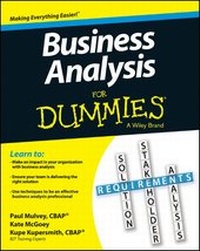
Business Analysis For Dummies
Published on 9. August 2013
Book
Paperback/Softback
384 pages
978-1-118-51058-2 (ISBN)
Description
Your go-to guide on business analysis
Business analysis refers to the set of tasks and activities that help companies determine their objectives for meeting certain opportunities or addressing challenges and then help them define solutions to meet those objectives. Those engaged in business analysis are charged with identifying the activities that enable the company to define the business problem or opportunity, define what the solutions looks like, and define how it should behave in the end. As a BA, you lay out the plans for the process ahead.
Business Analysis For Dummies is the go to reference on how to make the complex topic of business analysis easy to understand. Whether you are new or have experience with business analysis, this book gives you the tools, techniques, tips and tricks to set your project's expectations and on the path to success.
* Offers guidance on how to make an impact in your organization by performing business analysis
* Shows you the tools and techniques to be an effective business analysis professional
* Provides a number of examples on how to perform business analysis regardless of your role
If you're interested in learning about the tools and techniques used by successful business analysis professionals, Business Analysis For Dummies has you covered.
Business analysis refers to the set of tasks and activities that help companies determine their objectives for meeting certain opportunities or addressing challenges and then help them define solutions to meet those objectives. Those engaged in business analysis are charged with identifying the activities that enable the company to define the business problem or opportunity, define what the solutions looks like, and define how it should behave in the end. As a BA, you lay out the plans for the process ahead.
Business Analysis For Dummies is the go to reference on how to make the complex topic of business analysis easy to understand. Whether you are new or have experience with business analysis, this book gives you the tools, techniques, tips and tricks to set your project's expectations and on the path to success.
* Offers guidance on how to make an impact in your organization by performing business analysis
* Shows you the tools and techniques to be an effective business analysis professional
* Provides a number of examples on how to perform business analysis regardless of your role
If you're interested in learning about the tools and techniques used by successful business analysis professionals, Business Analysis For Dummies has you covered.
More details
Other editions
New editions
Book
02/2023
2nd Edition
Wiley
€29.00
Available immediately
Additional editions
Kupe Kupersmith | Paul Mulvey | Kate McGoey
Business Analysis For Dummies
E-Book
07/2013
Wiley
€19.99
Available for download
Kupe Kupersmith | Paul Mulvey | Kate McGoey
Business Analysis For Dummies
E-Book
06/2013
Wiley
€19.99
Available for download
Persons
Paul Mulvey, CBAP, Director, Client Solutions, B2T Training, has been involved in business analysis since 1995. Kate McGoey, Director, Client Solutions, B2T Training, has more than 20 years' experience in application development and life cycle processes business. Kupe Kupersmith, CBAP, President of B2T Training, possesses more than 14 years of experience in software systems development. He serves as a mentor for business analysis professionals.
Content
Introduction 1
Part I: Getting Started with Business Analysis 5
Chapter 1: Business Analysis in a Nutshell 7
Chapter 2: Breaking Down the Different Levels of Business Analysis 19
Chapter 3: Identifying and Working with Stakeholders 31
Part II: The BA Toolkit: Tools, Terms, and Techniques 51
Chapter 4: Talking about Tools of the Trade 53
Chapter 5: Understanding What Requirements Truly Entail 73
Chapter 6: Hunting for the Right Information, Part 1: The Process 97
Chapter 7: Hunting for the Right Information, Part 2: The Techniques 113
Chapter 8: Uncovering and Analyzing Needs 139
Part III: Selling the Plan and Keeping It on Track 161
Chapter 9: Making the (Business) Case 163
Chapter 10: Creating and Maintaining Scope 185
Chapter 11: Creating Your Work Plan 209
Part IV: Achieving Goals with Business Analysis 235
Chapter 12: Defi ning Solutions, Part 1: Taking a Closer Look at Your Requirements 237
Chapter 13: Defi ning Solutions, Part 2: Choosing the Right Analysis Technique 251
Chapter 14: Verifying and Validating Solutions 283
Chapter 15: Transition: Moving from Planning to Implementing 307
Part V: The Part of Tens 319
Chapter 16: Ten Ways to Keep Your Business Analysis Skills Sharp 321
Chapter 17: Ten Ways to Prepare Yourself for a New Project 329
Chapter 18: Ten Experts Chime In 337
Index 347
Part I: Getting Started with Business Analysis 5
Chapter 1: Business Analysis in a Nutshell 7
Chapter 2: Breaking Down the Different Levels of Business Analysis 19
Chapter 3: Identifying and Working with Stakeholders 31
Part II: The BA Toolkit: Tools, Terms, and Techniques 51
Chapter 4: Talking about Tools of the Trade 53
Chapter 5: Understanding What Requirements Truly Entail 73
Chapter 6: Hunting for the Right Information, Part 1: The Process 97
Chapter 7: Hunting for the Right Information, Part 2: The Techniques 113
Chapter 8: Uncovering and Analyzing Needs 139
Part III: Selling the Plan and Keeping It on Track 161
Chapter 9: Making the (Business) Case 163
Chapter 10: Creating and Maintaining Scope 185
Chapter 11: Creating Your Work Plan 209
Part IV: Achieving Goals with Business Analysis 235
Chapter 12: Defi ning Solutions, Part 1: Taking a Closer Look at Your Requirements 237
Chapter 13: Defi ning Solutions, Part 2: Choosing the Right Analysis Technique 251
Chapter 14: Verifying and Validating Solutions 283
Chapter 15: Transition: Moving from Planning to Implementing 307
Part V: The Part of Tens 319
Chapter 16: Ten Ways to Keep Your Business Analysis Skills Sharp 321
Chapter 17: Ten Ways to Prepare Yourself for a New Project 329
Chapter 18: Ten Experts Chime In 337
Index 347