

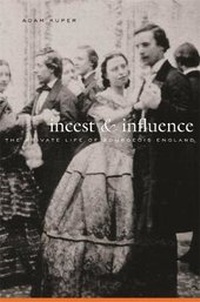
Incest and Influence
The Private Life of Bourgeois England
Published on 1. October 2009
Book
Hardback
304 pages
978-0-674-03589-8 (ISBN)
Description
Like many gentlemen of his time, Charles Darwin married his first cousin. In fact, marriages between close relatives were commonplace in nineteenth-century England, and Adam Kuper argues that they played a crucial role in the rise of the bourgeoisie.
Incest and Influence shows us just how the political networks of the eighteenth-century aristocracy were succeeded by hundreds of in-married bourgeois clans-in finance and industry, in local and national politics, in the church, and in intellectual life. In a richly detailed narrative, Kuper deploys his expertise as an anthropologist to analyze kin marriages among the Darwins and Wedgwoods, in Quaker and Jewish banking families, and in the Clapham Sect and their descendants over four generations, ending with a revealing account of the Bloomsbury Group, the most eccentric product of English bourgeois endogamy.
These marriage strategies were the staple of novels, and contemporaries were obsessed with them. But there were concerns. Ideas about incest were in flux as theological doctrines were challenged. For forty years Victorian parliaments debated whether a man could marry his deceased wife's sister. Cousin marriage troubled scientists, including Charles Darwin and his cousin Francis Galton, provoking revolutionary ideas about breeding and heredity.
This groundbreaking study brings out the connection between private lives, public fortunes, and the history of imperial Britain.
Incest and Influence shows us just how the political networks of the eighteenth-century aristocracy were succeeded by hundreds of in-married bourgeois clans-in finance and industry, in local and national politics, in the church, and in intellectual life. In a richly detailed narrative, Kuper deploys his expertise as an anthropologist to analyze kin marriages among the Darwins and Wedgwoods, in Quaker and Jewish banking families, and in the Clapham Sect and their descendants over four generations, ending with a revealing account of the Bloomsbury Group, the most eccentric product of English bourgeois endogamy.
These marriage strategies were the staple of novels, and contemporaries were obsessed with them. But there were concerns. Ideas about incest were in flux as theological doctrines were challenged. For forty years Victorian parliaments debated whether a man could marry his deceased wife's sister. Cousin marriage troubled scientists, including Charles Darwin and his cousin Francis Galton, provoking revolutionary ideas about breeding and heredity.
This groundbreaking study brings out the connection between private lives, public fortunes, and the history of imperial Britain.
Reviews / Votes
Adam Kuper, perhaps the most original of anthropologists working in the present day, has turned from the study of African tribes to scrutinize cousin marriages and other consanguineous unions from Jane Austen's characters to the Darwin family and on throughout the great families of the Victorian era--and has come up with a startling and irresistible contribution to nineteenth-century social history. -- Horace Freeland Judson [A] thoughtful, revealing [book] about the kind of networking that existed long before the Internet, flourishing in the 19th century... [Kuper's] anthropological analysis results in sociological conclusions that are very revealing about culture--scientific, political, economic, social-scientific--in the Victorian age. Here is one scholar who is fearlessly far-ranging in his scope. -- Martin Rubin * Washington Times * Incest and Influence presents a richly detailed and fascinating picture of the distinctive family life of the Victorian bourgeoisie. -- Gowan Dawson * American Scientist * Adam Kuper brings an anthropologist's understanding to what he calls "one of the great neglected themes" of social and literary history: the preference of the English bourgeoisie for marriage with relatives...He traces clans of bankers and merchants, dynasties of barristers, judges, clergymen, bishops, top civil servants, writers, scientists and thinkers--an urban elite. His thesis is that kin networks provided the basis for the consolidation of the bourgeoisie in the nineteenth century, and that marriage within the family was a strategy. -- Norma Clarke * Times Literary Supplement *More details
Language
English
Place of publication
Cambridge, Mass
United States
Target group
Professional and scholarly
US School Grade: College Graduate Student
Illustrations
19 line art
Dimensions
Height: 210 mm
Width: 140 mm
ISBN-13
978-0-674-03589-8 (9780674035898)
Copyright in bibliographic data and cover images is held by Nielsen Book Services Limited or by the publishers or by their respective licensors: all rights reserved.
Schweitzer Classification
Other editions
Additional editions
E-Book
02/2010
Harvard University Press
€93.99
Available for download
Person
Adam Kuper is Centennial Professor of Anthropology at the London School of Economics and Political Science and a Fellow of the British Academy.
Content
* Prologue: Darwin's Marriage * Introduction Part I: A Question of Incest * The Romance of Incest and the Love of Cousins * The Law of Incest * The Science of Incest and Heredity Part II: Family Concerns * The Family Business * Wilberforce and the Clapham Sect * Difficulties with Siblings Part III: The Intellectuals * The Bourgeois Intellectuals * The Bloomsbury Version * Coda: The End of the Line * Notes * Index