

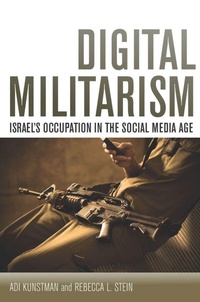
Digital Militarism
Israel's Occupation in the Social Media Age
Published on 1. April 2015
Book
Hardback
192 pages
978-0-8047-8567-9 (ISBN)
Description
Israel's occupation has been transformed in the social media age. Over the last decade, military rule in the Palestinian territories grew more bloody and entrenched. In the same period, Israelis became some of the world's most active social media users. In Israel today, violent politics are interwoven with global networking practices, protocols, and aesthetics. Israeli soldiers carry smartphones into the field of military operations, sharing mobile uploads in real-time. Official Israeli military spokesmen announce wars on Twitter. And civilians encounter state violence first on their newsfeeds and mobile screens.
Across the globe, the ordinary tools of social networking have become indispensable instruments of warfare and violent conflict. This book traces the rise of Israeli digital militarism in this global context-both the reach of social media into Israeli military theaters and the occupation's impact on everyday Israeli social media culture. Today, social media functions as a crucial theater in which the Israeli military occupation is supported and sustained.
Across the globe, the ordinary tools of social networking have become indispensable instruments of warfare and violent conflict. This book traces the rise of Israeli digital militarism in this global context-both the reach of social media into Israeli military theaters and the occupation's impact on everyday Israeli social media culture. Today, social media functions as a crucial theater in which the Israeli military occupation is supported and sustained.
Reviews / Votes
"Digital Militarism [...] unravels and explores ways of reading the complex, paradoxical, and often uncomfortable interplay between social media and militarist politics . . . Kuntsman's and Stein's work moves beyond the geopolitical and temporal specificity of the Israeli military occupation of Palestinian territories. Their work offers new ways of engaging and thinking about the everyday digitisation of militarism, and the militarisation of the digital everyday more generally . . . Digital Militarism is anything but ordinary."-Esperanza Miyake, darkmatter Journal "Amidst the hype of Facebook revolutions and the ostensible democratizing power of social media, Adi Kuntsman and Rebecca Stein illuminate the counterpoint: online militarization and the extension of state politics into the virtual realm. They expose the machinery of the Israeli state power at work within social media, and show the possibilities for countering the force of this machinery. Powerfully argued, beautifully researched, and thought-provoking, Digital Militarism is vitally important."-Laleh Khalili, SOAS, University of London, author of Time in the Shadows: Confinement in Counterinsurgencies "Digital Militarism is a pioneering book, showing how information and communication technologies have turned into wartime arsenals, and the Internet and social networks into digital battlefields. Just when one thinks that all has been said about the Israeli/Palestinian conflict, a totally original perspective emerges. Digital Militarism is a must read."-Neve Gordon, Ben-Gurion University, author of Israel's Occupation "Digital Militarism is a riveting guide to contemporary media strategies, improvisations, and accidents in the theatre of Israeli militarism. The book is as ethical as it is political, searchingly mindful of how documentary practice produces mixed consequences in the everyday and at the limit of life."-Lauren Berlant, University of Chicago "With this genuinely innovative study, Kunstman and Stein open an entirely new direction of research on the Israel/Palestine issue, and pave the way for future debate on the growing digitalisation of military discourses (and militarisation of digital spaces) in the broader context of contemporary armed conflicts, making this book useful not only for scholars specialising in the area, but for all social scientists investigating the cultures and practices of war and soldiering. Finally, warning how information technologies can slowly and subtly transform into new weapons of war and contribute to a process of domestication of violence in a context of prolonged military occupation, the book highlights the need - political and ethical, as well as scientific - for further and deeper investigation into the topic."-Giorgio Gristina, Social Anthropology "Digital Militarism is a well-researched and well-executed study, packed full of examples and visual imagery that help progress our understanding of militarism in the digital age. It skillfully demonstrates how the pervasive nature of social media holds enormous contemporary and strategic importance for those involved in war and violence. And not least, it highlights the pressures placed on the regulatory measures currently in place to manage social media usage by military actors."-Rikke Bjerg Jensen, Media, Culture & SocietyMore details
Series
Edition
New edition
Language
English
Place of publication
Palo Alto
United States
Edition type
New edition
Product notice
Cloth
Illustrations
34 illustrations
Dimensions
Height: 223 mm
Width: 144 mm
Thickness: 22 mm
Weight
358 gr
ISBN-13
978-0-8047-8567-9 (9780804785679)
Copyright in bibliographic data and cover images is held by Nielsen Book Services Limited or by the publishers or by their respective licensors: all rights reserved.
Schweitzer Classification
Persons
Adi Kuntsman is Lecturer in Information and Communications at Manchester Metropolitan University, and author of Figurations of Violence and Belonging: Queerness, Migranthood and Nationalism in Cyberspace and Beyond (2009).
Rebecca L. Stein is the Nicholas J. & Theresa M. Leonardy Associate Professor of Anthropology at Duke University, and author of Itineraries in Conflict: Israelis, Palestinians, and the Political Lives of Tourism (2008).
Rebecca L. Stein is the Nicholas J. & Theresa M. Leonardy Associate Professor of Anthropology at Duke University, and author of Itineraries in Conflict: Israelis, Palestinians, and the Political Lives of Tourism (2008).
Content
Contents and Abstracts1When Instagram Went to War: Israel's Occupation in the Social Media Age chapter abstractThis chapter provides the historical and theoretical parameters of the book, defining the term "digital militarism" and outlining the ways it has changed during the first two decades of the twenty-first century. It sketches the relationship between the changing Israeli political playfield of these years and the growth of the national culture in social networking and digital literacy. Through a focus on the Instagram accounts of Israeli soldiers during Israel's 2012 assault on the Gaza Strip, the chapter studies the ordinary ways that patriotic militarism can be translated into social media grammars (e.g., selfies, hashtags, "likes").
2"Another War Zone": The Development of Digital Militarism chapter abstractThis chapter traces the growth of digital militarism in the first two decades of the twenty-first century, chiefly the ways that social media have been incorporated into the toolbox of the Israeli state during times of war and military operations in the occupied Palestinian territories. It focuses on the use of social media by numerous Israeli and pro-Israeli actors - civilians and military users - during two Israeli military assaults on the Gaza Strip (2008-9 and 2012), and during the Flotilla affair of 2010. The chapter also traces the rise of personalized militarism by means of social media and the ways it functions to obscure and excuse Israeli violence.
3Anatomy of a Facebook Scandal: Social Media as Alibi chapter abstractThis chapter focuses on a landmark case in the history of digital militarism: the 2010 exposure of a Facebook album of former Israeli soldier Eden Abergil, containing her joyful self-portraits with bound and blindfolded Palestinian detainees. The chapter traces the social life of this scandal, with a focus on the varying strategies used by Israeli publics to manage the event's dangerous virality by turning away from matters of military occupation onto questions of social media.
4Palestinians Who Never Die: The Politics of Digital Suspicion chapter abstractThis chapter studies the digital doctoring charges that proliferated on Israeli social networks during the 2012 Israeli incursion into the Gaza Strip. Israeli social media users took aim at images of Palestinian dead and injured, using digital forensics and everyday modes of what we term "digital suspicion" to assert forgery claims. This is a study of the ways that Israeli and pro-Israeli social media users have employed doctoring charges as a tool of digital militarism. This study is framed within the much longer history of Israeli suspicion of Palestinian political claims and associated evidence.
5Selfie Militarism: The Normalization of Digital Militarism chapter abstractThe book's final chapter reflects on the development of Israeli digital militarism from 2008 to 2014, tracking key shifts in this formulation. It focuses on the changing ways that soldiers have used selfies-the popular genre of mobile self-portraiture, images shared on photo-sharing platforms such as Instagram-to document their experience of life in the Israeli armed forces. The chapter proposes that digital militarism began as an aberrant phenomenon, the activity of marginalized Israeli youth, and has since become an ordinary Israeli practice, an everyday way of living with and representing Israeli military rule.
2"Another War Zone": The Development of Digital Militarism chapter abstractThis chapter traces the growth of digital militarism in the first two decades of the twenty-first century, chiefly the ways that social media have been incorporated into the toolbox of the Israeli state during times of war and military operations in the occupied Palestinian territories. It focuses on the use of social media by numerous Israeli and pro-Israeli actors - civilians and military users - during two Israeli military assaults on the Gaza Strip (2008-9 and 2012), and during the Flotilla affair of 2010. The chapter also traces the rise of personalized militarism by means of social media and the ways it functions to obscure and excuse Israeli violence.
3Anatomy of a Facebook Scandal: Social Media as Alibi chapter abstractThis chapter focuses on a landmark case in the history of digital militarism: the 2010 exposure of a Facebook album of former Israeli soldier Eden Abergil, containing her joyful self-portraits with bound and blindfolded Palestinian detainees. The chapter traces the social life of this scandal, with a focus on the varying strategies used by Israeli publics to manage the event's dangerous virality by turning away from matters of military occupation onto questions of social media.
4Palestinians Who Never Die: The Politics of Digital Suspicion chapter abstractThis chapter studies the digital doctoring charges that proliferated on Israeli social networks during the 2012 Israeli incursion into the Gaza Strip. Israeli social media users took aim at images of Palestinian dead and injured, using digital forensics and everyday modes of what we term "digital suspicion" to assert forgery claims. This is a study of the ways that Israeli and pro-Israeli social media users have employed doctoring charges as a tool of digital militarism. This study is framed within the much longer history of Israeli suspicion of Palestinian political claims and associated evidence.
5Selfie Militarism: The Normalization of Digital Militarism chapter abstractThe book's final chapter reflects on the development of Israeli digital militarism from 2008 to 2014, tracking key shifts in this formulation. It focuses on the changing ways that soldiers have used selfies-the popular genre of mobile self-portraiture, images shared on photo-sharing platforms such as Instagram-to document their experience of life in the Israeli armed forces. The chapter proposes that digital militarism began as an aberrant phenomenon, the activity of marginalized Israeli youth, and has since become an ordinary Israeli practice, an everyday way of living with and representing Israeli military rule.