

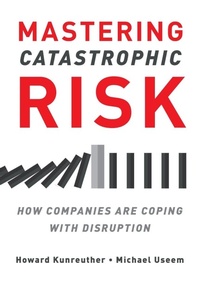
Mastering Catastrophic Risk
How Companies Are Coping with Disruption
Published on 24. February 2021
Book
Paperback/Softback
264 pages
978-0-19-754913-1 (ISBN)
Description
A profound and insightful look at how company leaders prepare for and respond to shocks and crises that threaten their business.
Successful firms strategically manage and are more accurate in their assessment of large-scale risks. Doing so is increasingly challenging given the pace of change, whether financial, technological, regulatory, or environmental. Mastering Catastrophic Risk provides real-world practical insights into how large companies are responding to this new reality and develops a framework for smarter thinking about events that can damage a business.
As leading authorities on risk management, strategy, and company leadership, Howard Kunreuther and Michael Useem take us on a groundbreaking tour of firms' decision making process. They demonstrate how improving readiness for and resilience against future shocks is now an integral part of company strategy. Using the "DISRUPT" model they have developed, they highlight the seven primary Drivers of disruption: Interdependencies increase exposure; Short-term focus results in limited vision; Regulations require change and constrain opportunities; Urbanization increases the costs of disasters; Probabilities of disasters have increased; and Transparency has enhanced public awareness of problems and impacts on firms' reputations. This updated paperback edition includes a new preface to address threats to business that have emerged or intensified in the past two years including existential threats like the coronavirus, self-inflicted calamities like the Wells Fargo customer account scandal, and natural disasters like the West Coast wildfires and hurricanes on the Atlantic.
Some disruptions can be anticipated, while others arrive without warning. Their onset stresses decision makers, impairs company operations, and may even put the enterprise at risk. The bottom-line: business leaders and their governing boards face ever more challenging disruptions and must be ever more on guard. If your company is hit tomorrow, will it bounce back, or drown?
Successful firms strategically manage and are more accurate in their assessment of large-scale risks. Doing so is increasingly challenging given the pace of change, whether financial, technological, regulatory, or environmental. Mastering Catastrophic Risk provides real-world practical insights into how large companies are responding to this new reality and develops a framework for smarter thinking about events that can damage a business.
As leading authorities on risk management, strategy, and company leadership, Howard Kunreuther and Michael Useem take us on a groundbreaking tour of firms' decision making process. They demonstrate how improving readiness for and resilience against future shocks is now an integral part of company strategy. Using the "DISRUPT" model they have developed, they highlight the seven primary Drivers of disruption: Interdependencies increase exposure; Short-term focus results in limited vision; Regulations require change and constrain opportunities; Urbanization increases the costs of disasters; Probabilities of disasters have increased; and Transparency has enhanced public awareness of problems and impacts on firms' reputations. This updated paperback edition includes a new preface to address threats to business that have emerged or intensified in the past two years including existential threats like the coronavirus, self-inflicted calamities like the Wells Fargo customer account scandal, and natural disasters like the West Coast wildfires and hurricanes on the Atlantic.
Some disruptions can be anticipated, while others arrive without warning. Their onset stresses decision makers, impairs company operations, and may even put the enterprise at risk. The bottom-line: business leaders and their governing boards face ever more challenging disruptions and must be ever more on guard. If your company is hit tomorrow, will it bounce back, or drown?
Reviews / Votes
Mastering Catastrophic Risk is a timely and indispensable guide for corporate boards and executives contemplating an increasing variety of high consequence risks. Globalization, financial concentration, climate change, and political volatility have heightened the intensity and range of potential disruptions that may impact enterprises. This volume crisply lays out a disciplined and practical set of approaches for identifying and preparing for high impact enterprise risks. * Michael Chertoff, Former United States Secretary of Homeland Security* This interesting book uses interviews and case studies from the business world to identify 21 categories of risk faced by publicly traded companies and to draw useful lessons about how to prepare for them." - Richard N. Cooper, Foreign Affairs
More details
Language
English
Place of publication
New York
United States
Target group
Professional and scholarly
Dimensions
Height: 234 mm
Width: 156 mm
Thickness: 16 mm
Weight
455 gr
ISBN-13
978-0-19-754913-1 (9780197549131)
Copyright in bibliographic data and cover images is held by Nielsen Book Services Limited or by the publishers or by their respective licensors: all rights reserved.
Schweitzer Classification
Other editions
Additional editions
Howard Kunreuther | Michael Useem
Mastering Catastrophic Risk
How Companies Are Coping with Disruption
Book
09/2018
Oxford University Press Inc
€32.40
Shipment within 15-20 days
Persons
Howard Kunreuther is the James G. Dinan Professor Emreitus of Decision Sciences and Public Policy and Co-Director of the Center for Risk Management and Decision Processes at The Wharton School, University of Pennsylvania.
Michael Useem is the William and Jaclyn Egan Professor of Management and Director of the Center for Leadership and Change Management at The Wharton School, University of Pennsylvania.
Michael Useem is the William and Jaclyn Egan Professor of Management and Director of the Center for Leadership and Change Management at The Wharton School, University of Pennsylvania.
Content
Prologue: On a Sunny Day
Part I. A More Risky Era
Chapter 1 Risk on the Agenda
Chapter 2 Impact of Severe Events
Part II. Enterprise Decisions for Managing Disruptions
Chapter 3 From Intuitive to Deliberative Thinking
Chapter 4 The Risk Analysis Cycle
Chapter 5 Risk Management Praxis
Part III. What Disrupted Companies Do
Chapter 6 Crisis at Lufthansa and Deutsche Bank
Chapter 7 From Reactive to Proactive Boardroom
Chapter 8 Corporate Giving for Disaster Relief
Part IV. Reaching Vital Stakeholders
Chapter 9 Disclosing Threats
Chapter 10 A Two-Edged Sword
Chapter 11 Safeguarding Value
Chapter 12 Managing Disruptions and a Checklist for Action
Epilogue: On a Rainy Day
Appendices
About the Authors
Acknowledgments
References
Part I. A More Risky Era
Chapter 1 Risk on the Agenda
Chapter 2 Impact of Severe Events
Part II. Enterprise Decisions for Managing Disruptions
Chapter 3 From Intuitive to Deliberative Thinking
Chapter 4 The Risk Analysis Cycle
Chapter 5 Risk Management Praxis
Part III. What Disrupted Companies Do
Chapter 6 Crisis at Lufthansa and Deutsche Bank
Chapter 7 From Reactive to Proactive Boardroom
Chapter 8 Corporate Giving for Disaster Relief
Part IV. Reaching Vital Stakeholders
Chapter 9 Disclosing Threats
Chapter 10 A Two-Edged Sword
Chapter 11 Safeguarding Value
Chapter 12 Managing Disruptions and a Checklist for Action
Epilogue: On a Rainy Day
Appendices
About the Authors
Acknowledgments
References