

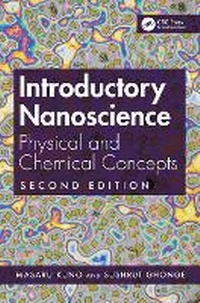
Introductory Nanoscience
Physical and Chemical Concepts
2nd Edition
Will be published approx. on 13. May 2026
Book
Hardback
464 pages
978-1-032-91082-6 (ISBN)
Description
This comprehensive new edition provides a pedagogical introduction to what makes nanoscience unique, featuring quantitative descriptions of key concepts and solved examples throughout. The textbook demonstrates how understanding scale-dependent property changes allows us to predict the behavior and functionality of nanomaterials.
Introductory Nanoscience, Physical and Chemical Concepts, Second Edition asks key questions about the quantitative concepts that make up this new field. How are the optical and electrical properties of nanomaterials dependent upon size, shape, and morphology? How do we construct nanometer-sized objects? The authors rationalize simplifications often made by researchers analyzing their data. Updated throughout with new examples and current applications, fundamental concepts are reinforced through end-of-chapter problems and further readings. A new chapter on electricity and magnetism has also been included, and it covers the fundamentals of how nanomaterials respond to electric and magnetic fields, and provides the basis of shape-dependent optical properties of nanomaterials.
Designed for upper-level undergraduate and graduate students, users will appreciate complete derivations of relevant equations, simplified assumptions for practical calculations, listed references, and a historical overview about the development of colloidal quantum dots. A solutions manual is available for adopting professors.
Introductory Nanoscience, Physical and Chemical Concepts, Second Edition asks key questions about the quantitative concepts that make up this new field. How are the optical and electrical properties of nanomaterials dependent upon size, shape, and morphology? How do we construct nanometer-sized objects? The authors rationalize simplifications often made by researchers analyzing their data. Updated throughout with new examples and current applications, fundamental concepts are reinforced through end-of-chapter problems and further readings. A new chapter on electricity and magnetism has also been included, and it covers the fundamentals of how nanomaterials respond to electric and magnetic fields, and provides the basis of shape-dependent optical properties of nanomaterials.
Designed for upper-level undergraduate and graduate students, users will appreciate complete derivations of relevant equations, simplified assumptions for practical calculations, listed references, and a historical overview about the development of colloidal quantum dots. A solutions manual is available for adopting professors.
More details
Edition
2nd edition
Language
English
Place of publication
London
United Kingdom
Target group
College/higher education
Postgraduate and Undergraduate Advanced
Illustrations
19 s/w Photographien bzw. Rasterbilder, 12 Farbfotos bzw. farbige Rasterbilder, 5 s/w Zeichnungen, 153 farbige Zeichnungen, 34 farbige Tabellen, 24 s/w Abbildungen, 165 farbige Abbildungen
34 Tables, color; 153 Line drawings, color; 5 Line drawings, black and white; 12 Halftones, color; 19 Halftones, black and white; 165 Illustrations, color; 24 Illustrations, black and white
Dimensions
Height: 254 mm
Width: 178 mm
ISBN-13
978-1-032-91082-6 (9781032910826)
Copyright in bibliographic data and cover images is held by Nielsen Book Services Limited or by the publishers or by their respective licensors: all rights reserved.
Schweitzer Classification
Other editions
Additional editions
E-Book
05/2026
2nd Edition
Garland Science
€158.99
Not yet available
E-Book
05/2026
2nd Edition
Garland Science
€158.99
Not yet available
Book
approx. 05/2026
2nd Edition
Taylor & Francis
€148.50
Not yet published
Persons
Masaru Kuno earned his PhD at the Massachusetts Institute of Technology, followed by an NRC postdoctoral fellowship at JILA, University of Colorado at Boulder. He is an Associate Professor of Chemistry and Biochemistry at the University of Notre Dame working on the synthesis and optical microscopy of solution-based semiconductor nanowires.
Sushrut Ghonge completed his undergraduate studies in Engineering Physics at the Indian Institute of Technology Delhi, India. He then earned his PhD in Physics and Materials Science & Engineering from the University of Notre Dame in 2024, advised by Boldizsar Janko and Masaru Kuno. He is a theoretical physicist, and his research interests lie in quantum optics, quantum thermodynamics, and non-equilibrium statistical mechanics.
Sushrut Ghonge completed his undergraduate studies in Engineering Physics at the Indian Institute of Technology Delhi, India. He then earned his PhD in Physics and Materials Science & Engineering from the University of Notre Dame in 2024, advised by Boldizsar Janko and Masaru Kuno. He is a theoretical physicist, and his research interests lie in quantum optics, quantum thermodynamics, and non-equilibrium statistical mechanics.
Content
1 Introduction 2 Structure 3 Length Scales 4 Types of Nanostructures 5 Absorption and Emission Basics 6 A Quantum Mechanics Review 7 Model Quantum Mechanics Problems 8 Additional Model Problems 9 Density of States 10 Bands 11 Time-Dependent Perturbation Theory 12 Interband Transitions 13 Synthesis 14 Characterization 15 Applications