

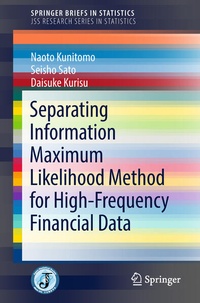
Separating Information Maximum Likelihood Method for High-Frequency Financial Data
Published on 2. July 2018
Book
Paperback/Softback
VIII, 114 pages
978-4-431-55928-3 (ISBN)
Description
This book presents a systematic explanation of the SIML (Separating Information Maximum Likelihood) method, a new approach to financial econometrics.
Considerable interest has been given to the estimation problem of integrated volatility and covariance by using high-frequency financial data. Although several new statistical estimation procedures have been proposed, each method has some desirable properties along with some shortcomings that call for improvement. For estimating integrated volatility, covariance, and the related statistics by using high-frequency financial data, the SIML method has been developed by Kunitomo and Sato to deal with possible micro-market noises.
The authors show that the SIML estimator has reasonable finite sample properties as well as asymptotic properties in the standard cases. It is also shown that the SIML estimator has robust properties in the sense that it is consistent and asymptotically normal in the stable convergence sense when there are micro-market noises, micro-market (non-linear) adjustments, and round-off errors with the underlying (continuous time) stochastic process. Simulation results are reported in a systematic way as are some applications of the SIML method to the Nikkei-225 index, derived from the major stock index in Japan and the Japanese financial sector.
Considerable interest has been given to the estimation problem of integrated volatility and covariance by using high-frequency financial data. Although several new statistical estimation procedures have been proposed, each method has some desirable properties along with some shortcomings that call for improvement. For estimating integrated volatility, covariance, and the related statistics by using high-frequency financial data, the SIML method has been developed by Kunitomo and Sato to deal with possible micro-market noises.
The authors show that the SIML estimator has reasonable finite sample properties as well as asymptotic properties in the standard cases. It is also shown that the SIML estimator has robust properties in the sense that it is consistent and asymptotically normal in the stable convergence sense when there are micro-market noises, micro-market (non-linear) adjustments, and round-off errors with the underlying (continuous time) stochastic process. Simulation results are reported in a systematic way as are some applications of the SIML method to the Nikkei-225 index, derived from the major stock index in Japan and the Japanese financial sector.
Reviews / Votes
"The authors develop a new statistical approach, which is called the separating information maximum likelihood (SIML) method, for estimating integrated volatility and integrated covariance by using high-frequency data in the presence of possible micro-market noise. . The book is useful for students and professionals in mathematical finance." (Pavel Stoynov, zbMath 1416.91004, 2019)More details
Series
Edition
1st ed. 2018
Language
English
Place of publication
Tokyo
Japan
Target group
Professional and scholarly
Research
Product notice
Paperback (trade)
Unsewn / adhesive bound
Illustrations
8 s/w Abbildungen
VIII, 114 p. 8 illus.
Dimensions
Height: 236 mm
Width: 158 mm
Thickness: 10 mm
Weight
213 gr
ISBN-13
978-4-431-55928-3 (9784431559283)
DOI
10.1007/978-4-431-55930-6
Schweitzer Classification
Other editions
Additional editions
Naoto Kunitomo | Seisho Sato | Daisuke Kurisu
Separating Information Maximum Likelihood Method for High-Frequency Financial Data
E-Book
06/2018
Springer
€58.84
Available for download
Persons
Naoto Kunitomo, Meiji University
Seisho Sato, The University of Tokyo
Daisuke Kurisu, Tokyo Institute of Technology
Seisho Sato, The University of Tokyo
Daisuke Kurisu, Tokyo Institute of Technology
Content
1. Introduction.- 2. High-Frequency Financial Data and Statistical Problems.- 3. The SIML method.- 4. Asymptotic Properties.- 5. Simulation and Finite Sample Properties.- 6. Asymptotic Robustness.- 7. Two Dimension Applications.- 8. Concluding Remarks.- 9. References.