

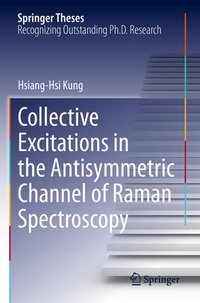
Collective Excitations in the Antisymmetric Channel of Raman Spectroscopy
Published on 9. December 2022
Book
Paperback/Softback
XVI, 151 pages
978-3-030-89334-7 (ISBN)
Description
This thesis contains three breakthrough results in condensed matter physics. Firstly, broken reflection symmetry in the hidden-order phase of the heavy-fermion material URu2Si2 is observed for the first time. This represents a significant advance in the understanding of this enigmatic material which has long intrigued the condensed matter community due to its emergent long range order exhibited at low temperatures (the so-called "hidden order"). Secondly and thirdly, a novel collective mode (the chiral spin wave) and a novel composite particle (the chiral exciton) are discovered in the three dimensional topological insulator Bi2Se3. This opens up new avenues of possibility for the use of topological insulators in photonic, optoelectronic, and spintronic devices. These discoveries are facilitated by using low-temperature polarized Raman spectroscopy as a tool for identifying optically excited collective modes in strongly correlated electron systems and three-dimensional topological insulators.
More details
Series
Edition
2022 ed.
Language
English
Place of publication
Cham
Switzerland
Publishing group
Springer International Publishing
Target group
Professional and scholarly
Illustrations
11 s/w Abbildungen, 53 farbige Abbildungen
XVI, 151 p. 64 illus., 53 illus. in color.
Dimensions
Height: 235 mm
Width: 155 mm
Thickness: 10 mm
Weight
265 gr
ISBN-13
978-3-030-89334-7 (9783030893347)
DOI
10.1007/978-3-030-89332-3
Schweitzer Classification
Other editions
Additional editions
Book
12/2021
Springer
€181.89
Shipment within 7-9 days
Person
Hsiang-Hsi (Sean)
Kung
is a postdoctoral researcher at the Quantum Matter Institute at the University of British Columbia. He received his PhD from Rutgers University in 2018.
Content
Chapter 1. Introduction.- Chapter 2. Experimental setup.- Chapter 3. Raman scattering in URu2Si2.- Chapter 4. Secondary emission in Bi2Se3.- Chapter 5. Conclusion.