

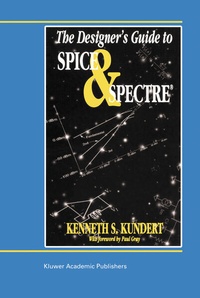
The Designer's Guide to Spice and Spectre®
Published on 31. May 1995
Book
Hardback
XVIII, 382 pages
978-0-7923-9571-3 (ISBN)
Description
Engineering productivity in integrated circuit product design and - velopment today is limited largely by the effectiveness of the CAD tools used. For those domains of product design that are highly dependent on transistor-level circuit design and optimization, such as high-speed logic and memory, mixed-signal analog-digital int- faces, RF functions, power integrated circuits, and so forth, circuit simulation is perhaps the single most important tool. As the complexity and performance of integrated electronic systems has increased with scaling of technology feature size, the capabilities and sophistication of the underlying circuit simulation tools have correspondingly increased. The absolute size of circuits requiring transistor-level simulation has increased dramatically, creating not only problems of computing power resources but also problems of task organization, complexity management, output representation, initial condition setup, and so forth. Also, as circuits of more c- plexity and mixed types of functionality are attacked with simu- tion, the spread between time constants or event time scales within the circuit has tended to become wider, requiring new strategies in simulators to deal with large time constant spreads.
More details
Series
Edition
1995 ed.
Language
English
Place of publication
New York
United States
Target group
Professional and scholarly
Research
Illustrations
XVIII, 382 p.
Dimensions
Height: 240 mm
Width: 161 mm
Thickness: 28 mm
Weight
771 gr
ISBN-13
978-0-7923-9571-3 (9780792395713)
DOI
10.1007/b101824
Schweitzer Classification
Other editions
Additional editions
Ken Kundert
The Designer's Guide to Spice and Spectre®
Book
04/2013
Springer
€267.49
Shipment within 15-20 days
Ken Kundert
The Designer's Guide to Spice and Spectre®
E-Book
04/2006
Plenum Publishing Corporation
€255.73
Available for download
Content
Circuit Simulation.- DC Analysis.- AC Analyses.- Transient Analysis.- Fourier Analysis.