

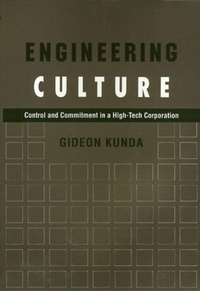
Engineering Culture
Control and Commitment in a High-Tech Corporation
Will be published approx. on 2. August 2006
Book
Hardback
320 pages
978-1-59213-545-5 (ISBN)
Description
Engineering Culture is an award-winning ethnography of the engineering division of a large American high-tech corporation. Now, this influential book-which has been translated into Japanese, Italian, and Hebrew-has been revised to bring it up to date. In Engineering Culture, Gideon Kunda offers a critical analysis of an American company's well-known and widely emulated \u0022corporate culture.\u0022 Kunda uses detailed descriptions of everyday interactions and rituals in which the culture is brought to life, excerpts from in-depth interviews and a wide variety of corporate texts to vividly portray managerial attempts to design and impose the culture and the ways in which it is experienced by members of the organization. The company's management, Kunda reveals, uses a variety of methods to promulgate what it claims is a non-authoritarian, informal, and flexible work environment that enhances and rewards individual commitment, initiative, and creativity while promoting personal growth. The author demonstrates, however, that these pervasive efforts mask an elaborate and subtle form of normative control in which the members' minds and hearts become the target of corporate influence.
Kunda carefully dissects the impact this form of control has on employees' work behavior and on their sense of self. In the conclusion written especially for this edition, Kunda reviews the company's fortunes in the years that followed publication of the first edition, reevaluates the arguments in the book, and explores the relevance of corporate culture and its management today.
Kunda carefully dissects the impact this form of control has on employees' work behavior and on their sense of self. In the conclusion written especially for this edition, Kunda reviews the company's fortunes in the years that followed publication of the first edition, reevaluates the arguments in the book, and explores the relevance of corporate culture and its management today.
Reviews / Votes
"Overall, this is one of the finest ethnographies of an organization culture I have read."-Administrative Science Quarterly "This book remains the classic attempt to come to terms with the reality of work in the new economy, as it emerges to replace the alienation of mass production. Kunda recognizes, even celebrates, the autonomy and engagement of work which has grown up around IT. But he also identifies the ways management quite deliberately limits and controls that autonomy and exploits engagement. And he underscores the price which the new work place exacts from the workers excluded from the realm of autonomy, from those who become overcommitted to it, and from those who, often inadvertently, overstep its boundaries."-Michael Joseph Piore, David W. Skinner Professor of Political Economy, Massachusetts Institute of TechnologyMore details
Edition
Revised
Language
English
Place of publication
Philadelphia PA
United States
Target group
Professional and scholarly
Edition type
Revised edition
Product notice
Unsewn / adhesive bound
Paper over boards
Dimensions
Height: 229 mm
Width: 161 mm
Thickness: 24 mm
Weight
544 gr
ISBN-13
978-1-59213-545-5 (9781592135455)
Copyright in bibliographic data and cover images is held by Nielsen Book Services Limited or by the publishers or by their respective licensors: all rights reserved.
Schweitzer Classification
Person
Gideon Kunda is Associate Professor, Department of Labor Studies, Tel Aviv University.
Content
Acknowledgments to the revised edition Acknowledgments Preface to the Revised Edition Chapter One: Culture and Organization Chapter Two: The Setting Chapter Three: Ideology: Tech Culture Codified Chapter Four: Presentational Rituals: Talking Ideology Chapter Five: Self and Organization: In the Shadow of the Golden Bull Chapter Six: Conclusion Chapter Seven: Epilogue Appendix: Methods -- A Confessional of Sorts Notes References Index