

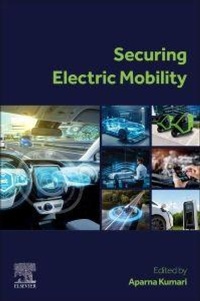
Securing Electric Mobility
Published on 1. May 2026
Book
Paperback/Softback
298 pages
978-0-443-33923-3 (ISBN)
Description
Electric vehicles (EVs) continue to capture a growing share of the smart car market across the globe. Like most new technologies, e-mobility comes with a learning curve. Securing Electric Mobility provides readers with in-demand knowledge relating to the dynamically evolving intersection between information & communication technology and vehicle engineering.
The edited volume offers in-depth understanding of the distinct features of EV cybersecurity. It opens with a description of the fundamental elements of EVs, their interconnectedness, their cyber-physical characteristics and resulting vulnerabilities. It then dissects the digital threat landscape to increase awareness of all possible risks posed by cyberattacks on electric vehicles, and from there it systematically covers data management, regulatory frameworks, existing solutions and emerging cybersecurity protocols and methodologies that are enhanced by blockchain, artificial intelligence, Internet-of-Things integration, machine learning, and real-time monitoring systems. The value of this thorough overview is strengthened further through the inclusion of real-word case studies, which prove the effectiveness of the adopted approaches to safeguard vehicle control systems, owners' personal data, and the broader cyber-physical network and related equipment.
This book proves to be an indispensable, state-of-the-art resource for academia and industry alike as it encourages further transformative, interdisciplinary investigations into the security-assurance complexities that guide EVs' resilience evolution.
The edited volume offers in-depth understanding of the distinct features of EV cybersecurity. It opens with a description of the fundamental elements of EVs, their interconnectedness, their cyber-physical characteristics and resulting vulnerabilities. It then dissects the digital threat landscape to increase awareness of all possible risks posed by cyberattacks on electric vehicles, and from there it systematically covers data management, regulatory frameworks, existing solutions and emerging cybersecurity protocols and methodologies that are enhanced by blockchain, artificial intelligence, Internet-of-Things integration, machine learning, and real-time monitoring systems. The value of this thorough overview is strengthened further through the inclusion of real-word case studies, which prove the effectiveness of the adopted approaches to safeguard vehicle control systems, owners' personal data, and the broader cyber-physical network and related equipment.
This book proves to be an indispensable, state-of-the-art resource for academia and industry alike as it encourages further transformative, interdisciplinary investigations into the security-assurance complexities that guide EVs' resilience evolution.
More details
Language
English
Place of publication
Philadelphia
United States
Target group
Professional and scholarly
College/higher education
Product notice
Paperback (trade)
Unsewn / adhesive bound
Dimensions
Height: 229 mm
Width: 152 mm
Weight
450 gr
ISBN-13
978-0-443-33923-3 (9780443339233)
Copyright in bibliographic data and cover images is held by Nielsen Book Services Limited or by the publishers or by their respective licensors: all rights reserved.
Schweitzer Classification
Other editions
Additional editions
Person
Dr. Aparna Kumari, associated with the Department of Computer Science and Engineering at Nirma University (India), has over 17 years of teaching and research experience in areas such as artificial intelligence, smart grids, blockchain, quantum computing, electric vehicles, IoT, and cybersecurity. She has published extensively in leading journals like IEEE Internet of Things Journal, IEEE Network, and Computer Communications, and has edited books with Springer and Elsevier. Recognized among the top 2% most influential researchers worldwide by Stanford University for five years, she received the prestigious Shri Pralhad P. Chhabria Award - Runner Up for Best Female Professional (Early Career) in 2023 and the EARG Award for Excellence in Research and Development in 2024. Dr. Kumari serves as an editor for reputed journals, conference organizing and session chair, and committee member, contributing significantly to the global research community. Her work continues to bridge cutting-edge technologies with sustainable and secure solutions for future energy and mobility systems.
Content
1. Introduction to electric mobility security
2. The anatomy of electric vehicles and connectivity
3. Understanding threats to electric vehicles and effective counter measures
4. Blockchain-based secure data communication and regularization framework for electric vehicles
5. Cybersecurity realities in electric vehicles
6. Implementing cybersecurity solutions: Energy-efficient path planning for intelligent electric vehicles
7. Simulation-based design and development of a wireless inductive-charging system for an electric vehicle
8. An overview of EV charging: Challenges and cybersecurity issues
9. Optimal planning of a smart parking lot in the active distribution network by implementing long short-term memory to predict uncertainties
10. Beyond electric vehicles: The broader impact
11. An analysis and assessment of lightweight cryptographic primitives for robust intelligent-systems security for electric vehicles
12. Real-world case study in e-mobility cybersecurity: Impact of randomness sources on the behavior of genetic algorithms for electric vehicles
13. Conclusions and future challenges
2. The anatomy of electric vehicles and connectivity
3. Understanding threats to electric vehicles and effective counter measures
4. Blockchain-based secure data communication and regularization framework for electric vehicles
5. Cybersecurity realities in electric vehicles
6. Implementing cybersecurity solutions: Energy-efficient path planning for intelligent electric vehicles
7. Simulation-based design and development of a wireless inductive-charging system for an electric vehicle
8. An overview of EV charging: Challenges and cybersecurity issues
9. Optimal planning of a smart parking lot in the active distribution network by implementing long short-term memory to predict uncertainties
10. Beyond electric vehicles: The broader impact
11. An analysis and assessment of lightweight cryptographic primitives for robust intelligent-systems security for electric vehicles
12. Real-world case study in e-mobility cybersecurity: Impact of randomness sources on the behavior of genetic algorithms for electric vehicles
13. Conclusions and future challenges