

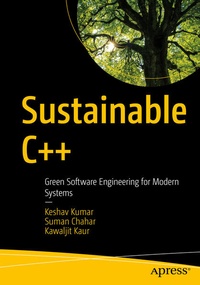
Sustainable C++
Description
Write faster, cleaner, and more sustainable software with modern C++. This book offers practical techniques that combine contemporary language features with real-world strategies to improve both performance and energy use.
You'll explore capabilities from C++17 through C++26 and learn how they can support substantial carbon reduction in systems ranging from IoT and cloud platforms to embedded devices and high-performance computing. Along the way, you'll examine compiler optimizations, data-layout choices, and profiling workflows that expose where software wastes energy, and how to fix it.
This book approaches green computing as an environmental priority that begins with the everyday programming decisions shaping a system's energy footprint. By the end, you'll understand how to make design choices that reduce power consumption, improve memory behavior, and support environmentally responsible software across modern applications.
What You Will Learn:
- Integrate modern C++ features with green-computing principles
- Apply the performance-energy-memory triad to guide design decisions
- Leverage modern C++ language standards to build sustainable software
- Use sustainability metrics and coding practices to reduce energy and resource consumption
Who This Book is for:
Intermediate C++ developers who are familiar with modern C++ fundamentals and wish to deepen their understanding of performance-, energy-, and sustainability-oriented software design, as they progress toward advanced and research-level practices.
More details
Persons
Keshav Kumar is an Assistant Professor at Department of Electronics and Communication Engineering in Pranveer Singh Institute of Technology, Kanpur, India. He is pursuing his PhD in the field of Hardware Security from Lingayas Vidyapeeth, Faridabad, India. He has worked with Chandigarh University, Punjab, India (NIRF 29). He has completed his Master of Engineering in ECE with a specialization in Hardware Security from Chitkara University, Punjab, India. He has also worked as a JRF with NIT Patna and as an Assistant Lecturer at Chitkara University, Punjab, India. He has authored and co-authored 6 books, and over 65+ research papers in the field of Hardware Security, Green Communication, Low-power VLSI Design, Machine Learning Techniques, and IoT. He has also worked with professors from 20 different countries. His areas of specialization include Deep Learning, Hardware Security, Green Communication, Low-power VLSI Design, Machine Learning Techniques, WSN, and IoT. He has experience teaching Python Programming, Embedded Systems, IoT, Computer Networks, and Digital Electronics. He is also associated with Gyancity Research Consultancy Pvt Ltd. He is also a member of IAENG. He has 1200+ citations (Google Scholar), 18 H-index (Google Scholar), and 13 H-Index (Scopus).
Suman Chahar is a distinguished academic figure, currently affiliated with the Institute of Computing at Chandigarh University in Punjab, India. Her extensive contributions are focused on the fields of Web Engineering, Artificial Intelligence, and Data Science. With a remarkable academic journey spanning 17 years and experience garnered from esteemed global institutions such as Guru Jambheshwar University of Science and Technology, Haryana, and Punjab Technical University, Punjab, she has proved to be a leading expert in her domain. A true mentor and guide, Suman has played a pivotal role in supervising numerous undergraduate and postgraduate projects for engineering students as an assistant professor. She has contributed to more than 10 books, both at the national and international level. Her extensive body of work also includes numerous publications in esteemed international and national journals, as well as presentations at conferences.
Dr Kawaljit Kaur is an Associate Professor at the Institute of Computing in Chandigarh University. She has 24 years of teaching experience and a Ph.D in Computer Science from Punjab University. Her academic work spans programming languages, machine learning, and NLP. She has guided numerous postgraduate students in their projects, supervised two Ph.D scholars who have successfully completed their degrees, and is currently mentoring two more doctoral candidates. Dr Kaur has authored a book on Relational Database Management Systems and has published research papers in international conferences and journals, particularly in areas such as anaphora resolution, deep learning for agriculture, explainable AI, and blockchain-based systems. Her career reflects a strong commitment to advancing computational research and mentoring future scholars.
Content
Chapter 1: Introduction to Modern C++ and Green Computing.- Chapter 2: Efficiency in the C++ Language.- Chapter 3: Memory Models and Cache Efficient Programming.- Chapter 4: Data Structures and Algorithms: Efficiently.- Chapter 5: Concurrency, Parallelism and Coroutines.- Chapter 6: Profiling, Benchmarking and Power Measurement.- Chapter 7: Sustainable Software Design Patterns.- Chapter 8: Embedded and IoT Systems Green Computing.- Chapter 9: Sustainable Build Systems and Tools.- Chapter 10: Applications and Case Studies in the Real World.- Chapter 11: Future Opportunities in Sustainable C++ Computing.