

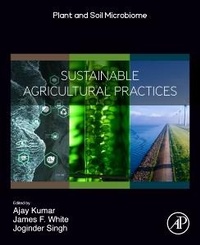
Sustainable Agricultural Practices
Published on 23. February 2024
Book
Paperback/Softback
438 pages
978-0-443-19150-3 (ISBN)
Description
Sustainable Agricultural Practices, a volume in the Plant and Soil Microbiome series, presents foundational information into the successful utilization of different biocontrol agents (especially bacteria and fungi actinomycetes) under field conditions which can help relieve the pressure of overexploitation of synthetic pesticides in agriculture.
The need for sustainable advancement in agriculture practices continues to increase. Traditionally, achieving optimum yields of crops has meant farmers continuously using large amounts of chemical fertilizers or pesticides, but the indiscriminate use of these pesticides has adversely affected the environment, nontarget microorganisms, soil textures, and human health. As many microorganisms, including nitrogen-fixing bacteria and cyanobacteria, can be used as bioinoculants, they offer opportunities not only to enhance the crop productivity but also to maintain the natural properties of agricultural soils.
Sustainable Agricultural Practices explores the multifaceted benefits derived from varieties of microorganisms existing in different components of the ecosystem, many of which could potentially be employed as probiotics for improved human and livestock health.
Researchers seeking to expand their understanding of related fields and students seeking foundational concept coverage will find this volume valuable.
The need for sustainable advancement in agriculture practices continues to increase. Traditionally, achieving optimum yields of crops has meant farmers continuously using large amounts of chemical fertilizers or pesticides, but the indiscriminate use of these pesticides has adversely affected the environment, nontarget microorganisms, soil textures, and human health. As many microorganisms, including nitrogen-fixing bacteria and cyanobacteria, can be used as bioinoculants, they offer opportunities not only to enhance the crop productivity but also to maintain the natural properties of agricultural soils.
Sustainable Agricultural Practices explores the multifaceted benefits derived from varieties of microorganisms existing in different components of the ecosystem, many of which could potentially be employed as probiotics for improved human and livestock health.
Researchers seeking to expand their understanding of related fields and students seeking foundational concept coverage will find this volume valuable.
More details
Series
Language
English
Place of publication
San Diego
United States
Publishing group
Elsevier Science Publishing Co Inc
Target group
Professional and scholarly
Product notice
Paperback (trade)
Unsewn / adhesive bound
Dimensions
Height: 235 mm
Width: 191 mm
Weight
910 gr
ISBN-13
978-0-443-19150-3 (9780443191503)
Copyright in bibliographic data and cover images is held by Nielsen Book Services Limited or by the publishers or by their respective licensors: all rights reserved.
Schweitzer Classification
Other editions
Additional editions
Ajay Kumar | James F. White | Joginder Singh Panwar
Sustainable Agricultural Practices
E-Book
02/2024
Academic Press
€175.00
Available for download
Persons
Ajay Kumar is currently an Assistant Professor at the Amity Institute of Biotechnology, Amity University, Noida, India. He previously served as a Visiting Scientist at the Agricultural Research Organization, Volcani Center, Israel (2018-2022), and completed his doctoral research at the Department of Botany, Institute of Science, Banaras Hindu University, Varanasi, India, focusing on plant-microbe interactions. Dr. Kumar's research expertise spans plant-microbe interactions, microbial biocontrol, postharvest fruit disease management, microbial endophytes of medicinal plants, and cyanobacteria-pesticide interactions. He is a prolific author in leading international journals and is also actively engaged in academic editing with major publishers such as Elsevier, Springer, CRC Press, and Wiley. Dr. Kumar currently serves as an Associate Editor for Frontiers in Microbiology and BMC Microbiology, a Guest Editor for Microorganisms and Plants (MDPI), and a Series Editor for Plant and Soil Microbiome (Elsevier). James F. White is professor of Plant Biology at Rutgers University, New Brunswick, NJ, United States. He received his BS and MS degrees in Botany and Plant Pathology/Mycology from Auburn University, Alabama, and completed his PhD in Botany at the University of Texas at Austin in 1987. Dr. White is internationally recognized for his research on symbiosis, with a focus on endophytic microorganisms. He has authored numerous scientific articles and has written or edited several influential reference books on the biology, taxonomy, and phylogeny of microbial endophytes. He and his research group currently investigate the diversity of endophytic and biostimulant microbes and their functional impacts on host plants, contributing foundational knowledge to plant-microbe interaction biology and sustainable agricultural innovation. Dr. Joginder Singh is a Professor in the Department of Botany at Nagaland University, Lumami, India. His previous positions include a professorship at Lovely Professional University's School of Bioengineering and Biosciences and a Young Scientist role at Jai Narain Vyas University's Microbial Biotechnology and Biofertilizer Laboratory (funded by the Department of Science and Technology, Government of India). He is a member of several scientific societies, including the Association of Microbiologists of India and the European Federation of Biotechnology. Dr. Singh has an extensive publication record, with over 250 research and review articles, 35 edited books (with publishers like Elsevier and Springer), and 125 book chapters. He is a reviewer for numerous prestigious journals. He has actively participated in and presented at numerous national and international scientific events.
Editor
Assistant Professor, Amity Institute of Biotechnology, Amity University, Noida, Uttar Pradesh, India
Professor, Department of Plant Biology and Pathology, School of Environmental & Biological Sciences, Rutgers University, New Brunswick, NJ, United States
Department of Botany, Nagaland University, Nagaland, 798627, India
Content
1. Multifactorial stress combination, plant microbiome recruitment and ROS/antioxidant feedbacks for plant stress alleviation
2. Impact of COVID-19 on global agriculture and food sector
3. State Of The Soil Health Before Maize Intercropped With Eucalyptus Grandis Under Agroforestry Environment In Limpopo Province, South Africa
4. Microbe management: application of mycorrhizal fungi in sustainable agriculture
5. Biodiversity and biotechnological applications of host-specific endophytic fungi for sustainable agriculture and allied sectors
6. Use of PGPRs in abiotic stress management in horticultural areas
7. Plant growth promoting bacteria sustainable use in abiotic stress management
8. Bioprospecting of bacterial endophytes from the tuber of Dioscorea bulbifera
9. Green Synthesis of nanomaterials and their applications in sustainable agriculture
10. Cyanobacterial diversity in the rice field and their potential applications.
11. The potential and possibilities of using mycorrhiza in sustainable agriculture
12. Microbial consortia application in the sustainable agricultural practices
13. Cyanobacterial mats and their application in sustainable Agriculture
14. Beneficial soil microorganisms and their role in sustainable agriculture
15. Evaluating Soil Chemical And Physical And Properties For Maize Production Under Agroforestry Environments In South Africa
16. Cytological observations on intracellular microbes in plants, their roles in sustainable crop production and effects of elevated carbon dioxide on rhizophagy in roots
17. Endophytic fungi: Diversity and their relevance in sustainable agriculture
2. Impact of COVID-19 on global agriculture and food sector
3. State Of The Soil Health Before Maize Intercropped With Eucalyptus Grandis Under Agroforestry Environment In Limpopo Province, South Africa
4. Microbe management: application of mycorrhizal fungi in sustainable agriculture
5. Biodiversity and biotechnological applications of host-specific endophytic fungi for sustainable agriculture and allied sectors
6. Use of PGPRs in abiotic stress management in horticultural areas
7. Plant growth promoting bacteria sustainable use in abiotic stress management
8. Bioprospecting of bacterial endophytes from the tuber of Dioscorea bulbifera
9. Green Synthesis of nanomaterials and their applications in sustainable agriculture
10. Cyanobacterial diversity in the rice field and their potential applications.
11. The potential and possibilities of using mycorrhiza in sustainable agriculture
12. Microbial consortia application in the sustainable agricultural practices
13. Cyanobacterial mats and their application in sustainable Agriculture
14. Beneficial soil microorganisms and their role in sustainable agriculture
15. Evaluating Soil Chemical And Physical And Properties For Maize Production Under Agroforestry Environments In South Africa
16. Cytological observations on intracellular microbes in plants, their roles in sustainable crop production and effects of elevated carbon dioxide on rhizophagy in roots
17. Endophytic fungi: Diversity and their relevance in sustainable agriculture