

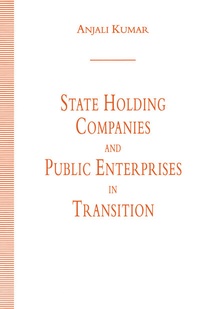
State Holding Companies and Public Enterprises in Transition
Published on 1. January 1993
Book
Paperback/Softback
XVIII, 296 pages
978-1-349-23012-9 (ISBN)
Description
'...very valuable for both policy-makers and researchers...' Professor Athar Hussain, Director, Development Economics Research Programme, STICERD, The London School of Economics and Political Science 'The really novel idea is to bring together the experience of three rather diverse countries and then to discuss Eastern Europe in the light of this experience. State holding companies are likely to play a major role in Eastern Europe over the next ten years or more but very little has been written on them and few of the people advising the East Europeans have any real knowledge about them.' Professor Robert Rowthorn, University of Cambridge '...rich and substantial...' Professor John Toye, Institute of Development Studies, University of Sussex '...most informative...The conclusions are appropriately restrained, well-balanced and wise...The emphasis on the differences between portfolio management and enterprise management is a distinction that East Europe will eventually have to learn.' Raymond Vernon, Emeritus Professor, John F.Kennedy School of Government, Harvard University Large and poorly performing state-owned enterprises pose a problem for countries attempting to move away from government controls towards more liberal economic environments. Privatization is an unproven solution which is proving difficult to implement on a major scale. Intermediate solutions may therefore prove to be the way forward. This book focuses on one of these: the state holding company. It first discusses the state holding company as a managerial form, which permits decentralised public enterprise management, and offers a framework for its analysis. Then, drawing upon the experience of both developed and developing countries, it examines the extent to which the indirect state ownership of public enterprises through holding companies can contribute to transition processes. It shows that the experience of countries like Italy, Egypt and Algeria has direct relevance for institutional structures evolving in the newly transforming countries of Eastern Europe, which are struggling to find a balance between public enterprise ownership and efficiency.
More details
Edition
1st ed. 1993
Language
English
Place of publication
London
United Kingdom
Target group
Professional and scholarly
Product notice
Paperback (trade)
Unsewn / adhesive bound
Illustrations
XVIII, 296 p.
Dimensions
Height: 216 mm
Width: 140 mm
Thickness: 18 mm
Weight
404 gr
ISBN-13
978-1-349-23012-9 (9781349230129)
DOI
10.1007/978-1-349-23010-5
Schweitzer Classification
Other editions
Additional editions
E-Book
07/2016
Palgrave Macmillan
€53.49
Available for download

Book
09/1993
Palgrave Macmillan
€86.66
Article exhausted; check different version
Book
01/1993
St. Martin's Press
€88.99
Article exhausted; check different version
Content
Preface - Acknowledgements - Abbreviations - Currency Equivalents - Public Enterprise Management Through State Holding Companies - Empirical al Experience: An Overview - Italy: IRI and Others - Egypt: Successive Holding Structures - Algeria: Participating Funds - East Europe: New Holding Institutions - A Synthesis - Appendix - Bibliography - Index