

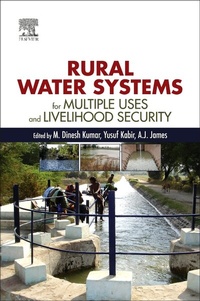
Rural Water Systems for Multiple Uses and Livelihood Security
Published on 3. May 2016
Book
Paperback/Softback
322 pages
978-0-12-804132-1 (ISBN)
Description
Rural Water Systems for Multiple Uses and Livelihood Security covers the technological, institutional, and policy choices for building rural water supply systems that are sustainable from physical, economic, and ecological points-of-view in developing countries. While there is abundant theoretical discourse on designing village water supply schemes as multiple use systems, there is too little understanding of the type of water needs in rural households, how they vary across socio-economic and climatic settings, the extent to which these needs are met by the existing single use water supply schemes, and what mechanisms exist to take care of unmet demands.
The case studies presented in the book from different agro ecological regions quantify these benefits under different agro ecological settings, also examining the economic and environmental trade-offs in maximizing benefits. This book demonstrates how various physical and socio-economic processes alter the hydrology of tanks in rural settings, thereby affecting their performance, also including quantitative criteria that can be used to select tanks suitable for rehabilitation.
The case studies presented in the book from different agro ecological regions quantify these benefits under different agro ecological settings, also examining the economic and environmental trade-offs in maximizing benefits. This book demonstrates how various physical and socio-economic processes alter the hydrology of tanks in rural settings, thereby affecting their performance, also including quantitative criteria that can be used to select tanks suitable for rehabilitation.
More details
Language
English
Place of publication
United States
Target group
Professional and scholarly
Dimensions
Height: 229 mm
Width: 152 mm
Weight
520 gr
ISBN-13
978-0-12-804132-1 (9780128041321)
Copyright in bibliographic data and cover images is held by Nielsen Book Services Limited or by the publishers or by their respective licensors: all rights reserved.
Schweitzer Classification
Other editions
Additional editions
M. Dinesh Kumar | Yusuf Kabir | A. J. James
Rural Water Systems for Multiple Uses and Livelihood Security
E-Book
05/2016
Elsevier
€57.95
Available for download
Persons
Dr Dinesh Kumar is the Executive Director of the Institute for Resource Analysis and Policy in Hyderabad, an Indian think-tank on water management founded by him in 2008. He holds a degree in Civil Engineering (focus on water resources management) and a Ph. D in Water Management. He works on water, agriculture, and energy related issues in India and internationally, heading several research and consultancy projects and training assignments of the organization. He is the author of nearly 300 research publications, including nine academic books, nine edited volumes, and several international, peer-reviewed journal articles. He is on the editorial board of four prestigious international journals, Viz., Water Policy, International Journal of Water Resources Development, PLOS Water journal and Frontiers in Water. In a career spanning 30 years, Kumar has visited 21 countries, for conferences and official work. Yusuf Kabir has 15 years of experience working in water supply and sanitation sector. Yusuf has been with UNICEF since 2007. Prior to that he has worked with organizations like DFID, National Level NGOs, Social and Marketing research consultancy firms like GFK-MODE, ORG India Pvt Ltd, Ramky Infrastructure, SREI Capital Markets, SPAN Consultancy, on issues related with Environmental and livelihood development training and capacity building in the social sector, etc. Yusuf is a commonwealth scholar and a trained policy writer from Central European University, Budapest, Hungary. A J James has over 20 years of research and work experience in a wide-range of rural development issues in India, including water resource management, watershed development, water and sanitation, water pollution, adaptation to climate change, natural resource management, agricultural development, forestry, and poverty alleviation. Another area of specialization is monitoring and evaluation, where he has helped develop innovative methodologies for community-level assessment of qualitative information. He has worked all over India, and also in Nepal, Sri Lanka, Vietnam, Ethiopia and Afghanistan, for major government and donor-supported development projects. His clients include major funding agencies, research & development institutions, consulting firms in India and abroad, as well as non-governmental organisations and government agencies.
Content
Chapter 1. Introduction
Chapter 2. Water, Human Development, Inclusive Growth, and Poverty Alleviation: International Perspectives
Chapter 3. Multiple Water Needs of Rural Households: Studies From Three Agro-Ecologies in Maharashtra
Chapter 4. Multiple-Use Water Systems for Reducing Household Vulnerability to Water Supply Problems
Chapter 5. Sustainability Versus Local Management: Comparative Performance of Rural Water Supply Schemes
Chapter 6. Influence of Climate Variability on Performance of Local Water Bodies: Analysis of Performance of Tanks in Tamil Nadu
Chapter 7. Groundwater Use and Decline in Tank Irrigation? Analysis From Erstwhile Andhra Pradesh
Chapter 8. Reducing Vulnerability to Climate Variability: Forecasting Droughts in Vidarbha Region of Maharashtra, Western India
Chapter 9. Sustainable Access to Treated Drinking Water in Rural India
Chapter 10. Positive Externalities of Surface Irrigation on Farm Wells and Drinking Water Supplies in Large Water Systems: The Case of Sardar Sarovar Project
Chapter 11. Re-Imagining the Future: Experiencing Sustained Drinking Water for All
Chapter 12. Building Resilient Rural Water Systems Under Uncertainties
Chapter 2. Water, Human Development, Inclusive Growth, and Poverty Alleviation: International Perspectives
Chapter 3. Multiple Water Needs of Rural Households: Studies From Three Agro-Ecologies in Maharashtra
Chapter 4. Multiple-Use Water Systems for Reducing Household Vulnerability to Water Supply Problems
Chapter 5. Sustainability Versus Local Management: Comparative Performance of Rural Water Supply Schemes
Chapter 6. Influence of Climate Variability on Performance of Local Water Bodies: Analysis of Performance of Tanks in Tamil Nadu
Chapter 7. Groundwater Use and Decline in Tank Irrigation? Analysis From Erstwhile Andhra Pradesh
Chapter 8. Reducing Vulnerability to Climate Variability: Forecasting Droughts in Vidarbha Region of Maharashtra, Western India
Chapter 9. Sustainable Access to Treated Drinking Water in Rural India
Chapter 10. Positive Externalities of Surface Irrigation on Farm Wells and Drinking Water Supplies in Large Water Systems: The Case of Sardar Sarovar Project
Chapter 11. Re-Imagining the Future: Experiencing Sustained Drinking Water for All
Chapter 12. Building Resilient Rural Water Systems Under Uncertainties