

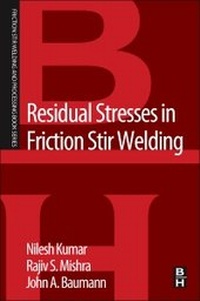
Residual Stresses in Friction Stir Welding
A volume in the Friction Stir Welding and Processing Book Series
Published on 25. November 2013
Book
Paperback/Softback
60 pages
978-0-12-800150-9 (ISBN)
Description
This book describes the fundamentals of residual stresses in friction stir welding and reviews the data reported for various materials. Residual stresses produced during manufacturing processes lead to distortion of structures. It is critical to understand and mitigate residual stresses. From the onset of friction stir welding, claims have been made about the lower magnitude of residual stresses. The lower residual stresses are partly due to lower peak temperature and shorter time at temperature during friction stir welding. A review of residual stresses that result from the friction stir process and strategies to mitigate it have been presented. Friction stir welding can be combined with additional in-situ and ex-situ manufacturing steps to lower the final residual stresses. Modeling of residual stresses highlights the relationship between clamping constraint and development of distortion. For many applications, management of residual stresses can be critical for qualification of component/structure.
More details
Series
Language
English
Place of publication
Woburn
United States
Publishing group
Elsevier - Health Sciences Division
Target group
Professional and scholarly
Researchers, welding engineers, materials processing engineers, design engineers and students
Dimensions
Height: 229 mm
Width: 152 mm
Weight
110 gr
ISBN-13
978-0-12-800150-9 (9780128001509)
Copyright in bibliographic data and cover images is held by Nielsen Book Services Limited or by the publishers or by their respective licensors: all rights reserved.
Schweitzer Classification
Other editions
Additional editions
Nilesh Kulkarni | Rajiv S. Mishra | John A. Baumann
Residual Stresses in Friction Stir Welding
E-Book
11/2013
Butterworth-Heinemann
€38.95
Available for download
Persons
Nilesh. N. Kulkarni completed his M.E. (electronics and telecommunication) from All India Shri Shivaji Memorial Society's Institute of Information Technology, Pune. His areas of interests include biomedical signal and image processing, pattern recognition, and machine learning. Presently, he is working on biomedical signal processing applications. He is a member of IETE and IEI, India and a member of the IEEE. Rajiv S. Mishra is a professor in the Department of Materials Science and Engineering, and Site Director, NSF IUCRC for Friction Stir Processing, at the University of North Texas. Dr. Mishra's publication record includes 255 papers with an h-index of 39. Out of these, 10 of his papers have more than 100 citations. He has many 'firsts' in the field of friction stir welding and processing. He co-authored the first review paper (2005), co-edited the first book on the subject (2007), edited/co-edited seven TMS symposium proceedings, and served as guest editor for Viewpoint Set in Scripta Materialia (2008). He also has three patents in this field. He published the first paper on friction stir processing (2000) as a microstructural modification tool.
Content
Introduction
Residual stresses in friction stir welding process
Effect of residual stresses on properties
Parameters affecting residual stresses
Characterization of residual stresses
Mitigation of residual stresses during FSW
Simulation of friction stir welding for residual stresses and distortions
Summary, conclusions, and future directions
References
Residual stresses in friction stir welding process
Effect of residual stresses on properties
Parameters affecting residual stresses
Characterization of residual stresses
Mitigation of residual stresses during FSW
Simulation of friction stir welding for residual stresses and distortions
Summary, conclusions, and future directions
References