

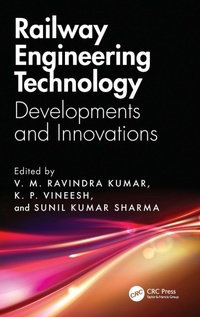
Railway Engineering Technology
Developments and Innovations
1st Edition
Published on 29. September 2025
Book
Hardback
328 pages
978-1-032-83650-8 (ISBN)
Description
This book presents advances in railway engineering, including railway wheels, wheel failure mechanisms, innovations in railway track designs, and axle failures. It covers rail-wheel traction characteristics under various environmental conditions for full-scale test conditions, including braking systems. It provides an understanding of the applications of digital twin technology in railway systems, predictive maintenance, performance optimization, and overall system efficiency. It also emphasizes sustainable practices, energy-efficient technologies, and environmental impact assessments.
Features:
Comprehensively reviews various aspects of railway engineering technology.
Discusses major failure mechanisms and various types of braking systems.
Covers the modernization of railways and high-speed trains.
Explores emerging topics such as digital twin technology, sustainable practices, and autonomous technologies.
Includes case studies of railway component failures and accidents.
This book is aimed at researchers and professionals in railway and mechanical engineering as well as transportation systems.
Features:
Comprehensively reviews various aspects of railway engineering technology.
Discusses major failure mechanisms and various types of braking systems.
Covers the modernization of railways and high-speed trains.
Explores emerging topics such as digital twin technology, sustainable practices, and autonomous technologies.
Includes case studies of railway component failures and accidents.
This book is aimed at researchers and professionals in railway and mechanical engineering as well as transportation systems.
More details
Language
English
Place of publication
London
United Kingdom
Publishing group
Taylor & Francis Ltd
Target group
College/higher education
Professional and scholarly
Academic and Postgraduate
Illustrations
80 s/w Tabellen, 19 s/w Photographien bzw. Rasterbilder, 85 s/w Zeichnungen, 104 s/w Abbildungen
80 Tables, black and white; 85 Line drawings, black and white; 19 Halftones, black and white; 104 Illustrations, black and white
Dimensions
Height: 240 mm
Width: 161 mm
Thickness: 23 mm
Weight
675 gr
ISBN-13
978-1-032-83650-8 (9781032836508)
Copyright in bibliographic data and cover images is held by Nielsen Book Services Limited or by the publishers or by their respective licensors: all rights reserved.
Schweitzer Classification
Other editions
Additional editions
V. M. Ravindra Kumar | K. P. Vineesh | Sunil Kumar Sharma
Railway Engineering Technology
Developments and Innovations
E-Book
09/2025
CRC Press
€73.99
Available for download
V. M. Ravindra Kumar | K. P. Vineesh | Sunil Kumar Sharma
Railway Engineering Technology
Developments and Innovations
E-Book
09/2025
CRC Press
€73.99
Available for download
Persons
V. M. Ravindra Kumar is a faculty member at the School of Mechanical Engineering at VIT-AP University. He received a Ph.D. from the Indian Institute of Technology, Kharagpur. He worked on a major railway engineering problem, "Locomotive Wheel Failure from Excessive Wheel Gauge Change," and successfully identified the root causes of the problem. His research areas include railway engineering, numerical modeling of manufacturing processes, 3D and 4D printing. He has published research articles in various national and international journals and contributed to book and book chapters. He has the experience of working in sponsored research projects.
K. P. Vineesh is a faculty member in the Department of Mechanical Engineering at the National Institute of Technology Calicut. He has 8 years of experience in teaching, research, and academic administration. He obtained his Ph.D. from the Indian Institute of Technology Kharagpur. His major research areas are railway engineering, machine design, metal additive manufacturing, and vehicle dynamics. He has several peer-reviewed international journals in his core research areas and holds two patents.
Sunil Kumar Sharma is a Professor and Chair of Rail Vehicle Technology at the Institute of Railway Vehicles and Railway Technology, Technische Universitaet Dresden, Germany, and an Assistant Professor at Gati Shakti Vishwavidyalaya, Vadodara, a Central University established by the Ministry of Railways, Government of India. He received his Ph.D. from the Indian Institute of Technology, Roorkee. He has worked at the Non-destructive Evaluation and Structural Health Monitoring Laboratory at C.N. University, South Korea. His research interests include vehicle dynamics, contact mechanics, mechatronics, and real-time software-enabled control systems for high-speed rail vehicles. He has published several research articles in national and international journals, contributed to book chapters, and edited a book. He is among the top 2% of scientists in a global list compiled by Stanford University, USA.
K. P. Vineesh is a faculty member in the Department of Mechanical Engineering at the National Institute of Technology Calicut. He has 8 years of experience in teaching, research, and academic administration. He obtained his Ph.D. from the Indian Institute of Technology Kharagpur. His major research areas are railway engineering, machine design, metal additive manufacturing, and vehicle dynamics. He has several peer-reviewed international journals in his core research areas and holds two patents.
Sunil Kumar Sharma is a Professor and Chair of Rail Vehicle Technology at the Institute of Railway Vehicles and Railway Technology, Technische Universitaet Dresden, Germany, and an Assistant Professor at Gati Shakti Vishwavidyalaya, Vadodara, a Central University established by the Ministry of Railways, Government of India. He received his Ph.D. from the Indian Institute of Technology, Roorkee. He has worked at the Non-destructive Evaluation and Structural Health Monitoring Laboratory at C.N. University, South Korea. His research interests include vehicle dynamics, contact mechanics, mechatronics, and real-time software-enabled control systems for high-speed rail vehicles. He has published several research articles in national and international journals, contributed to book chapters, and edited a book. He is among the top 2% of scientists in a global list compiled by Stanford University, USA.
Content
1. Railway Wheels Failure Mechanism and Locally Resonant Bandgap for Vibration Isolation
2. Railway Axles
3. Rail-Wheel Interaction
4. Digital Twins in Railway Systems
5. Regenerative Braking System for Railways
6. Sustainability in Railway Engineering
7. Adaptive Sliding Mode Controller Development to Improve Rail Network Efficiency Through Virtual Coupling: A Case Study Evidence
8. Railway Transition Zones
9. Navigating the Cyber Security Landscape in Railway Infrastructure: Measures, Challenges and Innovation
10. Design and Manufacturing of Railway Track
11. Formulation of a Meta-Model Based Multi-Objective Optimisation Problem for a Rail Vehicle's Dynamic Response
12. Railway Track System and Dynamics
13. Case Studies of Failures in Railway Engineering, High-Speed Rail Innovations, and Challenges in Metro Trains
14. Frictional Braking in Trains
15. Railway Wheel Technology and Evolution of Temperatures in Railway Wheels
2. Railway Axles
3. Rail-Wheel Interaction
4. Digital Twins in Railway Systems
5. Regenerative Braking System for Railways
6. Sustainability in Railway Engineering
7. Adaptive Sliding Mode Controller Development to Improve Rail Network Efficiency Through Virtual Coupling: A Case Study Evidence
8. Railway Transition Zones
9. Navigating the Cyber Security Landscape in Railway Infrastructure: Measures, Challenges and Innovation
10. Design and Manufacturing of Railway Track
11. Formulation of a Meta-Model Based Multi-Objective Optimisation Problem for a Rail Vehicle's Dynamic Response
12. Railway Track System and Dynamics
13. Case Studies of Failures in Railway Engineering, High-Speed Rail Innovations, and Challenges in Metro Trains
14. Frictional Braking in Trains
15. Railway Wheel Technology and Evolution of Temperatures in Railway Wheels