

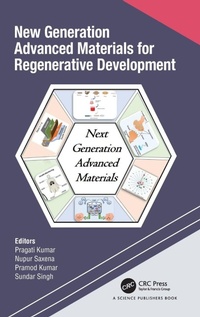
New Generation Advanced Materials for Regenerative Development
1st Edition
Published on 18. May 2026
Book
Hardback
376 pages
978-1-032-67047-8 (ISBN)
Description
The book "New Generation Advanced Materials for Regenerative Development" introduces the readers into the world of next generation of materials with their futuristic applications to serve the mankind. The range of advanced materials includes waste derived carbon nanomaterials, bio-materials, green and biogenic metal chalcogenides, 2D chalcogenides, MOFs, COFs, and non-toxic perovskites. All these materials possess divine qualities and have been researched to be made free from any delinquency. Further, the applications of these super smart materials are discussed within the framework of regenerative development for the ease-of-life for humans on earth. This book contains high quality review articles on the high-end applications of these emerging materials.
More details
Language
English
Place of publication
London
United Kingdom
Publishing group
Taylor & Francis Ltd
Target group
College/higher education
Professional and scholarly
Academic and Postgraduate
Product notice
Laminated cover
Illustrations
21 farbige Abbildungen, 36 s/w Photographien bzw. Rasterbilder, 17 Farbfotos bzw. farbige Rasterbilder, 19 s/w Zeichnungen, 4 farbige Zeichnungen, 16 s/w Tabellen, 55 s/w Abbildungen
16 Tables, black and white; 4 Line drawings, color; 19 Line drawings, black and white; 17 Halftones, color; 36 Halftones, black and white; 21 Illustrations, color; 55 Illustrations, black and white
Dimensions
Height: 234 mm
Width: 156 mm
Thickness: 22 mm
Weight
714 gr
ISBN-13
978-1-032-67047-8 (9781032670478)
Copyright in bibliographic data and cover images is held by Nielsen Book Services Limited or by the publishers or by their respective licensors: all rights reserved.
Schweitzer Classification
Other editions
Additional editions
Pragati Kumar | Nupur Saxena | Pramod Kumar
New Generation Advanced Materials for Regenerative Development
E-Book
05/2026
CRC Press
€65.99
Available for download
Pragati Kumar | Nupur Saxena | Pramod Kumar
New Generation Advanced Materials for Regenerative Development
E-Book
05/2026
CRC Press
€65.99
Available for download
Persons
Dr. Pragati Kumar is Sr. Assistant Professor in Department of Physics and Astronomical Sciences, Central University of Jammu, India since 2016. Dr. Kumar has more than 17 years research and teaching experience. His research includes nanostructures, thin films, composites, and 2D materials, ion beam techniques, optoelectronic devices, sensors and photocatalysis. Dr. Kumar has published 43 research papers, 15 chapters, and edited 3 books with international publishers as well as editor in many international journals.
Dr. Nupur Saxena is working as DST-Women Scientist, Department of Physics, IIT Jammu, India. She has more than 19 years of research experience in nanostructures, thin films, composites, ion beam techniques, optoelectronic devices, sensors and photocatalysis. She has published 30 research papers, 11 chapters, presented 43 papers in conferences, and edited 01 book with international publisher. She is a life time member of many scientific societies, reviewer as well as editor in many international journals.
Dr. Pramod Kumar received his Ph.D. degree from (2015) the University of Delhi, India. Currently, he is an Assistant Professor of the Department of Chemistry and Chemical Sciences, at the Central University of Himachal Pradesh. His research interests include inorganic-based nanoparticles for drug delivery, photodynamic therapy. Current research interests are hybrid nanoparticles, hydrogel nanoparticles, metal organic frameworks and quantum dot. He has published more than 51 articles in leading scientific journals.
Dr. Sundar Singh is a Professor in the Department of Physics at Bareilly College, Bareilly (India). Prof. Singh has published 13 books from National-level publishers, 22 research papers in journals of national and international repute, presented 20 research papers and delivered 12 talks in conferences, and has also completed one research project. He has supervised one Ph.D. (second one is pursuing) and 22 postgraduate dissertations. His research interests include DMS, QDs, solar cells, etc.
Dr. Nupur Saxena is working as DST-Women Scientist, Department of Physics, IIT Jammu, India. She has more than 19 years of research experience in nanostructures, thin films, composites, ion beam techniques, optoelectronic devices, sensors and photocatalysis. She has published 30 research papers, 11 chapters, presented 43 papers in conferences, and edited 01 book with international publisher. She is a life time member of many scientific societies, reviewer as well as editor in many international journals.
Dr. Pramod Kumar received his Ph.D. degree from (2015) the University of Delhi, India. Currently, he is an Assistant Professor of the Department of Chemistry and Chemical Sciences, at the Central University of Himachal Pradesh. His research interests include inorganic-based nanoparticles for drug delivery, photodynamic therapy. Current research interests are hybrid nanoparticles, hydrogel nanoparticles, metal organic frameworks and quantum dot. He has published more than 51 articles in leading scientific journals.
Dr. Sundar Singh is a Professor in the Department of Physics at Bareilly College, Bareilly (India). Prof. Singh has published 13 books from National-level publishers, 22 research papers in journals of national and international repute, presented 20 research papers and delivered 12 talks in conferences, and has also completed one research project. He has supervised one Ph.D. (second one is pursuing) and 22 postgraduate dissertations. His research interests include DMS, QDs, solar cells, etc.
Content
Preface. Waste-Derived Carbon Nanostructures. Green and Biogenic Synthesis of Metal Chalcogenide Nanostructures. Strategies for the Growth of 2D Chalcogenides. Nanostructures of Metal Organic Frameworks (MOFs) and Covalent Organic Frameworks (COFs). Non-Toxic Perovskite Nanomaterials. High Entropy Materials for Next-Generation Energy Conversion and Storage Devices. Energy-Saving Materials in Self-Powered Photodetectors and LEDs. Smart Materials for Green, Flexible, and Wearable Electronics. New Materials in Biosensing, Bioimaging, and Biomedical Application. DNA: An Emerging Biomaterial for Environment, Health, and Agriculture Sectors. Biopolymers, Bioplastics, and Carbon-Based Materials for Food Packaging. Emerging Materials in Recent Development of Volatile Organic Compound (VOC) Sensors. Novel Materials in Water Pollutant Ion Sensors. Emerging Catalytic Materials in H2 Evolution, CO2 Reduction, and Environmental Remediation. Polymer Nanocomposites-Based Memristive Devices for Neuromorphic Computing. Index.