

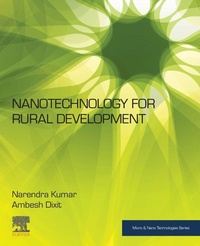
Nanotechnology for Rural Development
Published on 26. March 2021
Book
Paperback/Softback
274 pages
978-0-12-824352-7 (ISBN)
Description
Nanotechnology for Rural Development is designed to present nanotechnology-based solutions to the challenges faced by rural populations, particularly in underdeveloped and developing countries. The book focuses on agriculture, biomass management, food processing and water management, in terms of its purification and decontamination. The treatment of wastewater and the harnessing of renewable energy are also covered. In addition, the book deals with the application of nanotechnology in the areas of consumer goods, such as textiles, ceramics, food processing and packaging, and other related spheres.
The book provides information on the green synthesis of nanomaterials, using prevalent natural resources and their applications for textiles, ceramics, portiere, and food packaging. It also addresses low-cost solutions using materials such as biomass waste for water purification and decontamination. For example, lignocellulosic biomass can be converted into nutrient adsorbents, energy, fuel and storage. Above all, it protects agriculture crops from insects and other pests, and produces quality products in high yields.
This volume offers insight into the intricacies of the problems faced by large populations living in rural areas, particularly in underdeveloped and developing countries. It also discusses the natural renewable resources available locally and how nanotechnology can best use them to increase the quality and yield of agricultural products, as well as how to engage the population, specifically women, in gainful productive activities.
The book provides information on the green synthesis of nanomaterials, using prevalent natural resources and their applications for textiles, ceramics, portiere, and food packaging. It also addresses low-cost solutions using materials such as biomass waste for water purification and decontamination. For example, lignocellulosic biomass can be converted into nutrient adsorbents, energy, fuel and storage. Above all, it protects agriculture crops from insects and other pests, and produces quality products in high yields.
This volume offers insight into the intricacies of the problems faced by large populations living in rural areas, particularly in underdeveloped and developing countries. It also discusses the natural renewable resources available locally and how nanotechnology can best use them to increase the quality and yield of agricultural products, as well as how to engage the population, specifically women, in gainful productive activities.
More details
Series
Language
English
Place of publication
United States
Target group
Professional and scholarly
Materials scientists and engineers
Product notice
Paperback (trade)
Dimensions
Height: 235 mm
Width: 191 mm
Thickness: 15 mm
Weight
481 gr
ISBN-13
978-0-12-824352-7 (9780128243527)
Copyright in bibliographic data and cover images is held by Nielsen Book Services Limited or by the publishers or by their respective licensors: all rights reserved.
Schweitzer Classification
Other editions
Additional editions
Narendra Kumar | Ambesh Dixit
Nanotechnology for Rural Development
E-Book
03/2021
Elsevier
€175.00
Available for download
Persons
Dr Narendra Kumar is a former Director and DRDO fellow (Ministry of Defense, Govt. of India). He has a PhD in Organometallic Chemistry from Delhi University and has wide experience in working on a variety of advanced materials, including organometallics, liquid crystals, conducting polymers, and nanomaterials. Dr Kumar has published more than 110 research papers, four books, and holds 12 patents. For his pioneering R&D work on advanced materials for defense applications, he received the prestigious DRDO Technology Cash Award (1996) and Scientist of the Year Award (2005). He is also a member of several professional societies, including the American Chemical Society and the Material Research Society. He has been recently nominated as the President of the Jodhpur chapter of Marudhara Vigyan Bharti, an Indian organization for promoting science and technology in the rural areas of the country. Dr Ambesh Dixit (PhD, 2010, Wayne State University, Michigan, USA) is an Associate Professor at the Indian Institute of Technology Jodhpur, India. He has more than ten years' experience in computational and experimental condensed matter physics with a special emphasis on the design and development of materials for different applications. He has edited two books with Springer and authored another, as well as published his research in several international journals. He is an Editorial Board member of the Elsevier journal 'Vacuum', a life member of the Materials Research Society of India, the Magnetic Society of India, the Indian Carbon Society, and an annual member of IEEE since 2019 and of the American Physical Society since 2007.
Content
1. Nanotechnology in rural development2. Nanotechnology in agriculture3. Nanotechnology in processing, preservation, and packing of food4. Management of biomass5. Nanotechnology in water management6. Energy for rural development7. Employment opportunities in rural areas