

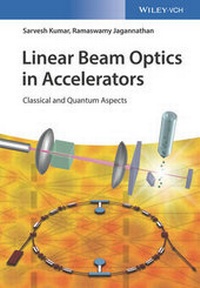
Linear Beam Optics in Accelerators
Classical and Quantum Aspects
Will be published approx. 2030
Book
Hardback
460 pages
978-3-527-41243-3 (ISBN)
Description
This first rigorous quantum treatment of charged particle beams in accelerators describes the design of a number of common passive and active accelerator components. In addition, different types of ion sources are characterized in terms of beam emittance, currents and profiles.
To give beginners in the field a good understanding of the techniques involved, field computational analysis of real beam components is demonstrated using standard beam optics and field computational codes and the transfer matrix approach is used to calculate design parameters of beam optical components. Data and geometry files supporting these examples are available as supplementary material online. The students' grasp of these theoretical and numerical methods is reinforced by specific problem sections, with a solutions manual also available online. The final step - applying the tools learned from earlier chapters to actual hardware design - is supported by discussions of practical difficulties usually encountered in real world situations. Finally, the book presents a quantum theory of charged particle beam optics, which was developed as recently as the past few decades and only available in the research literature until now.
To give beginners in the field a good understanding of the techniques involved, field computational analysis of real beam components is demonstrated using standard beam optics and field computational codes and the transfer matrix approach is used to calculate design parameters of beam optical components. Data and geometry files supporting these examples are available as supplementary material online. The students' grasp of these theoretical and numerical methods is reinforced by specific problem sections, with a solutions manual also available online. The final step - applying the tools learned from earlier chapters to actual hardware design - is supported by discussions of practical difficulties usually encountered in real world situations. Finally, the book presents a quantum theory of charged particle beam optics, which was developed as recently as the past few decades and only available in the research literature until now.
More details
Language
English
Place of publication
Weinheim
Germany
Target group
Professional and scholarly
Illustrations
50 s/w Abbildungen, 20 farbige Abbildungen
Dimensions
Height: 240 mm
Width: 170 mm
ISBN-13
978-3-527-41243-3 (9783527412433)
Copyright in bibliographic data and cover images is held by Nielsen Book Services Limited or by the publishers or by their respective licensors: all rights reserved.
Schweitzer Classification
Persons
Sarvesh KUMAR is working as a young scientist in the Beam Transport laboratory at the Inter University Accelerator Centre (IUAC), New Delhi. He is extensively involved in beam dynamics simulations and beam optical components designing for the Low Energy Ion Beam facility (LEIBF) and the High Current Injector (HCI) facility based upon normal and superconducting electron resonance ion sources respectively. He has obtained his bachelor and master degrees in physics from Kurukshetra University, Haryana. His expertise include real time ion beam tuning in LEIBF and the main accelerator of IUAC, PELLETRON. He has been awarded first prize in national conferences like InPAC and is a member of Particle Accelerator Society of India (PASI).
Ramaswamy JAGANNATHAN, born in 1949, got his BSc and MSc in Physics in 1969 and 1971 from the University of Madras and his PhD in theoretical physics from the Institute of Mathematical Sciences (IMSc), Chennai, in 1976. After being a lecturer in physics for three years in St. Joseph's college, Tiruchy, Jagannathan joined the IMSc as assistant professor of physics in 1980 and retired as senior professor in 2009. He is currently adjunct professor of physics at the Chennai Mathematical Institute (CMI). His main field of research interest is mathematical physics, in particular, quantum theory, classical and quantum Groups, and nonlinear dynamics.
Ramaswamy JAGANNATHAN, born in 1949, got his BSc and MSc in Physics in 1969 and 1971 from the University of Madras and his PhD in theoretical physics from the Institute of Mathematical Sciences (IMSc), Chennai, in 1976. After being a lecturer in physics for three years in St. Joseph's college, Tiruchy, Jagannathan joined the IMSc as assistant professor of physics in 1980 and retired as senior professor in 2009. He is currently adjunct professor of physics at the Chennai Mathematical Institute (CMI). His main field of research interest is mathematical physics, in particular, quantum theory, classical and quantum Groups, and nonlinear dynamics.
Content
Preface
1 Basic Principles of Particle Accelerators
1.1 History of Accelerators
1.2 Units in Accelerator Physics
1.3 Common Components of Accelerators
1.4 Electrostatic Accelerators
1.5 Cyclotrons
1.6 Betatrons
1.7 Synchrotons
1.8 Synchrocyclotrons
1.9 Storage Rings
1.10 FFAG Accelerators
1.11 Wakefield Accelerators
1.12 Colliders
Problems
2 Ion Sources
2.1 Plasma Physics in Ion Sources
2.2 Negative Ion Sources
2.2.1 Sputter Ion Sources
2.2.2 Charge Exchange Ion Sources
2.3 Positive Ion Sources
2.3.1 Penning Ion Sources
2.3.2 Duoplasmatrons
2.3.3 Microwave Ion Sources
2.3.4 ECR Ion Sources
2.3.5 Laser Ion Sources
2.3.6 Vacuum Arc Ion Sources
2.3.7 High Current Gaseous Ion Sources
2.4 Sources in Colliders
2.4.1 Electron Sources
2.4.2 Positron Sources
2.4.3 Proton Sources
2.4.4 Antiproton Sources
Problems
3. Beam Optics
3.1 Phase Space
3.2 Liouville's Theorem
3.3 Hill's Equations
3.4 Emittance and Brightness
3.5 Transfer Matrix
3.6 Transverse Beam Dynamics
3.7 Longitudinal Beam Dynamics
3.8 Nonlinear effects
Problems
4. Magnetostatic Devices
4.1 Motion of a Charged Particle in a Magnetic Field
4.2 Solenoid Magnets
4.3 Dipole Magnets
4.3.1 Achromatic Magnets
4.3.2 Corrector Magnets
4.3.3 Septa and Kicker Magnets
4.3.4 Scanner Magnets
4.4 Quadrupole Magnets
4.4.1 Quadrupole Doublets
4.4.2 Quadrupole Triplets
4.4.3 FODO Lattice
4.5 Steerer Magnets
4.6 Wien Filter
4.7 Undulators and Wigglers
Problems
5. Electrostatic Devices
5.1 Motion of a Charged Particle in an Electric Field
5.2 Electrostatic Gap Lens
5.3 Einzel Lens
5.4 Electrostatic Dipoles
5.5 Electrostatic Quadrupoles
5.6 Electrostatic Accelerating Tubes with High Voltage Deck
Problems
6. Radio Frequency Devices
6.1 Effect of an RF field on a Charged Particle
6.2 RF Gap
6.3 RF Bunchers
6.4 RF Choppers
6.4 Multiharmonic Buncher
6.5 RF Accelerating Cavities
6.5.1 Radiofrequency Quadrupoles
6.5.2 Drift Tube Linacs
6.5.3 Superconducting Linacs
Problems
7. Beam Diagnostic Devices
7.1 Faraday Cups
7.2 Beam Profile Monitors
7.3 Transverse Slits
7.4 Transverse Emittance Measurements
7.5 Longitudinal Emittance Measurements
Problems
8. Applications of Accelerators
8.1 Nuclear Physics
8.2 Materials Sciences
8.3 Atomic Physics
8.4 Plasma Physics
8.5 Radiation Biology
8.6 Accelerator Mass Spectroscopy
8.7 Elementary Particle Physics
Problems
9. Quantum Theory of Charged-Particle Optics: General Formalism
9.1 Classical Theory of Charged-Particle Optics: Hamiltonian Formalism
9.2 Basic Principles of Quantum Mechanics
9.3 Quantum Mechanics of Charged-Particle Optics: General Formalism
Problems
10. Quantum Theory of Non-relativistic Charged-Particle Optics
10.1 Magnetic Optical Elements
10.2 Electrostatic Optical Elements
10.3 Applications:
10.3.1 Nonrelativistic Ion Accelerator
10.3.2 Image Formation in Electron Microscopy
Problems
11. Quantum Theory of Relativistic Charged-Particle Optics
11.1 Optical Elements of High Energy Accelerators
11.2 Beam Optics of Charged Spinless Particles Based on the Klein-Gordan Equation
11.3 Beam Optics of Charged Spin-1/2 Particles Based on the Dirac Equation
Problems
12. Other Quantum Aspects of Accelerator Beam Physics
12.1 Quantum Field Theory: A Brief Summary
12.2 Some Beam Physics Phenomena Involving Quantum Mechanics:
12.2.1 Synchrotron Radiation
12.2.2 Free Electron Lasers
12.2.3 Beamstrahlung
12.2.4 Sokolov-Ternov Effect and Beam Polarization
Problems
Appendices
Solutions to Chapter Problems
Index
1 Basic Principles of Particle Accelerators
1.1 History of Accelerators
1.2 Units in Accelerator Physics
1.3 Common Components of Accelerators
1.4 Electrostatic Accelerators
1.5 Cyclotrons
1.6 Betatrons
1.7 Synchrotons
1.8 Synchrocyclotrons
1.9 Storage Rings
1.10 FFAG Accelerators
1.11 Wakefield Accelerators
1.12 Colliders
Problems
2 Ion Sources
2.1 Plasma Physics in Ion Sources
2.2 Negative Ion Sources
2.2.1 Sputter Ion Sources
2.2.2 Charge Exchange Ion Sources
2.3 Positive Ion Sources
2.3.1 Penning Ion Sources
2.3.2 Duoplasmatrons
2.3.3 Microwave Ion Sources
2.3.4 ECR Ion Sources
2.3.5 Laser Ion Sources
2.3.6 Vacuum Arc Ion Sources
2.3.7 High Current Gaseous Ion Sources
2.4 Sources in Colliders
2.4.1 Electron Sources
2.4.2 Positron Sources
2.4.3 Proton Sources
2.4.4 Antiproton Sources
Problems
3. Beam Optics
3.1 Phase Space
3.2 Liouville's Theorem
3.3 Hill's Equations
3.4 Emittance and Brightness
3.5 Transfer Matrix
3.6 Transverse Beam Dynamics
3.7 Longitudinal Beam Dynamics
3.8 Nonlinear effects
Problems
4. Magnetostatic Devices
4.1 Motion of a Charged Particle in a Magnetic Field
4.2 Solenoid Magnets
4.3 Dipole Magnets
4.3.1 Achromatic Magnets
4.3.2 Corrector Magnets
4.3.3 Septa and Kicker Magnets
4.3.4 Scanner Magnets
4.4 Quadrupole Magnets
4.4.1 Quadrupole Doublets
4.4.2 Quadrupole Triplets
4.4.3 FODO Lattice
4.5 Steerer Magnets
4.6 Wien Filter
4.7 Undulators and Wigglers
Problems
5. Electrostatic Devices
5.1 Motion of a Charged Particle in an Electric Field
5.2 Electrostatic Gap Lens
5.3 Einzel Lens
5.4 Electrostatic Dipoles
5.5 Electrostatic Quadrupoles
5.6 Electrostatic Accelerating Tubes with High Voltage Deck
Problems
6. Radio Frequency Devices
6.1 Effect of an RF field on a Charged Particle
6.2 RF Gap
6.3 RF Bunchers
6.4 RF Choppers
6.4 Multiharmonic Buncher
6.5 RF Accelerating Cavities
6.5.1 Radiofrequency Quadrupoles
6.5.2 Drift Tube Linacs
6.5.3 Superconducting Linacs
Problems
7. Beam Diagnostic Devices
7.1 Faraday Cups
7.2 Beam Profile Monitors
7.3 Transverse Slits
7.4 Transverse Emittance Measurements
7.5 Longitudinal Emittance Measurements
Problems
8. Applications of Accelerators
8.1 Nuclear Physics
8.2 Materials Sciences
8.3 Atomic Physics
8.4 Plasma Physics
8.5 Radiation Biology
8.6 Accelerator Mass Spectroscopy
8.7 Elementary Particle Physics
Problems
9. Quantum Theory of Charged-Particle Optics: General Formalism
9.1 Classical Theory of Charged-Particle Optics: Hamiltonian Formalism
9.2 Basic Principles of Quantum Mechanics
9.3 Quantum Mechanics of Charged-Particle Optics: General Formalism
Problems
10. Quantum Theory of Non-relativistic Charged-Particle Optics
10.1 Magnetic Optical Elements
10.2 Electrostatic Optical Elements
10.3 Applications:
10.3.1 Nonrelativistic Ion Accelerator
10.3.2 Image Formation in Electron Microscopy
Problems
11. Quantum Theory of Relativistic Charged-Particle Optics
11.1 Optical Elements of High Energy Accelerators
11.2 Beam Optics of Charged Spinless Particles Based on the Klein-Gordan Equation
11.3 Beam Optics of Charged Spin-1/2 Particles Based on the Dirac Equation
Problems
12. Other Quantum Aspects of Accelerator Beam Physics
12.1 Quantum Field Theory: A Brief Summary
12.2 Some Beam Physics Phenomena Involving Quantum Mechanics:
12.2.1 Synchrotron Radiation
12.2.2 Free Electron Lasers
12.2.3 Beamstrahlung
12.2.4 Sokolov-Ternov Effect and Beam Polarization
Problems
Appendices
Solutions to Chapter Problems
Index