

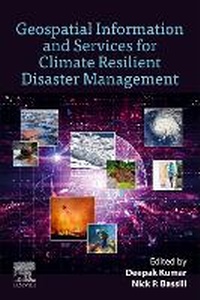
Geospatial Information and Services for Climate Resilient Disaster Management
Published on 27. November 2025
Book
Paperback/Softback
296 pages
978-0-443-29216-3 (ISBN)
Description
Geospatial Information and Services for Climate Resilient Disaster Management explores how cutting-edge technology can shape our response to climate-related disasters. Leading experts uncover the indispensable role that geospatial information and services can play in disaster preparedness, response, and recovery. The book opens with an overview of climate resilient disaster management and the application of geospatial technology. The chapters next undertake a thorough examination of early warning systems, risk assessment, vulnerability mapping, resource allocation, and disaster response. Following from those vital tools and applications, the editors then evaluate climate adaptation planning and community engagement in the light of geospatial technology.
The book wraps up with real-world case studies and success stories along with a discussion of current challenges and future trends. Readers concerned with the rising connections between natural disaster and climate change will be inspired by this inside view of the latest innovations in geospatial information and services.
The book wraps up with real-world case studies and success stories along with a discussion of current challenges and future trends. Readers concerned with the rising connections between natural disaster and climate change will be inspired by this inside view of the latest innovations in geospatial information and services.
More details
Language
English
Place of publication
Philadelphia
United States
Target group
Professional and scholarly
Dimensions
Height: 229 mm
Width: 152 mm
Weight
450 gr
ISBN-13
978-0-443-29216-3 (9780443292163)
Copyright in bibliographic data and cover images is held by Nielsen Book Services Limited or by the publishers or by their respective licensors: all rights reserved.
Schweitzer Classification
Other editions
Additional editions
Deepak Kumar | Nick Bassill
Geospatial Information and Services for Climate Resilient Disaster Management
E-Book
11/2025
Elsevier
€140.99
Available for download
Persons
Dr. Deepak Kumar is a Research Scientist in the Atmospheric Sciences Group at Texas Tech University. He previously served as a Research Scientist at the Atmospheric Sciences Research Center, State University of New York at Albany, and as an Assistant Professor at Amity University, Delhi-NCR. His research focuses on geospatial sciences, computational sciences, climate change, sustainability, and the urban-climate-energy nexus. His work integrates remote sensing, geoinformatics, environmental studies, energy systems, urban weather, and climate modelling to support interdisciplinary research and policy applications. Dr. Kumar has experience in research design, data analysis, modelling, visualization, and implementation across environmental and climate-related projects. He also contributes to academic and professional activities through conference participation, outreach, training, and scholarly associations.
Nick P. Bassill has several years of experience in climate computing research and its impact assessment. Dr. Bassill received his PhD in Atmospheric and Oceanic Sciences from the University of Wisconsin-Madison, with a research focus on ensemble and parameterization studies. Afterwards, he worked as a post-Doctoral researcher at the University of Utah, where he studied aspects of Hurricane Sandy's unusual track (including what led some models to make an incorrect forecast). Afterwards, he began work as a Post-Doctoral researcher with the New York State Mesonet to begin building an operational analysis system that would utilize Mesonet observations. Concurrently, he is actively involved in building meteorological products for and doing basic research with the New York State Mesonet. Currently, Nick predominantly spends his time working with the Center of Excellence on a variety of projects. He has published various research papers in international journals of high repute. He has also conducted sessions on Numerical weather prediction, with a specialization in WRF modelling, Data assimilation, Weather forecasting, Tropical cyclones, Data analysis of both gridded model data and weather observations and the New York State Mesonet. He also has experience in providing scientific leadership to high-profile strategic computational sustainability and conservation initiatives with several years of research experience. Managed cross-sectoral and interdisciplinary teams of professionals to deliver on complex research projects. Currently, he is working as a Director of Research & Development the at Center of Excellence, State University of New York at Albany. His core area of Interest covers Financial Markets, Energy & Utilities, Emergency Management, Risk Management, Climate Computing, AI and Machine Learning, and Industry 4.0.
Nick P. Bassill has several years of experience in climate computing research and its impact assessment. Dr. Bassill received his PhD in Atmospheric and Oceanic Sciences from the University of Wisconsin-Madison, with a research focus on ensemble and parameterization studies. Afterwards, he worked as a post-Doctoral researcher at the University of Utah, where he studied aspects of Hurricane Sandy's unusual track (including what led some models to make an incorrect forecast). Afterwards, he began work as a Post-Doctoral researcher with the New York State Mesonet to begin building an operational analysis system that would utilize Mesonet observations. Concurrently, he is actively involved in building meteorological products for and doing basic research with the New York State Mesonet. Currently, Nick predominantly spends his time working with the Center of Excellence on a variety of projects. He has published various research papers in international journals of high repute. He has also conducted sessions on Numerical weather prediction, with a specialization in WRF modelling, Data assimilation, Weather forecasting, Tropical cyclones, Data analysis of both gridded model data and weather observations and the New York State Mesonet. He also has experience in providing scientific leadership to high-profile strategic computational sustainability and conservation initiatives with several years of research experience. Managed cross-sectoral and interdisciplinary teams of professionals to deliver on complex research projects. Currently, he is working as a Director of Research & Development the at Center of Excellence, State University of New York at Albany. His core area of Interest covers Financial Markets, Energy & Utilities, Emergency Management, Risk Management, Climate Computing, AI and Machine Learning, and Industry 4.0.
Content
1. Introduction
2. Understanding Climate Resilient Disaster Management
3. Geospatial Technology in Disaster Management
4. Early Warning Systems
5. Risk Assessment and Vulnerability Mapping
6. Resource Allocation and Disaster Response
7. Climate Adaptation Planning
8. Community Engagement and Education
9. Case Studies and Success Stories
10. Challenges and Future Trends
2. Understanding Climate Resilient Disaster Management
3. Geospatial Technology in Disaster Management
4. Early Warning Systems
5. Risk Assessment and Vulnerability Mapping
6. Resource Allocation and Disaster Response
7. Climate Adaptation Planning
8. Community Engagement and Education
9. Case Studies and Success Stories
10. Challenges and Future Trends