

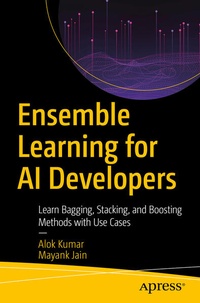
Ensemble Learning for AI Developers
Learn Bagging, Stacking, and Boosting Methods with Use Cases
Published on 19. June 2020
Book
Paperback/Softback
XVI, 136 pages
978-1-4842-5939-9 (ISBN)
Description
Use ensemble learning techniques and models to improve your machine learning results.
Ensemble Learning for AI Developers starts you at the beginning with an historical overview and explains key ensemble techniques and why they are needed. You then will learn how to change training data using bagging, bootstrap aggregating, random forest models, and cross-validation methods. Authors Kumar and Jain provide best practices to guide you in combining models and using tools to boost performance of your machine learning projects. They teach you how to effectively implement ensemble concepts such as stacking and boosting and to utilize popular libraries such as Keras, Scikit Learn, TensorFlow, PyTorch, and Microsoft LightGBM. Tips are presented to apply ensemble learning in different data science problems, including time series data, imaging data, and NLP. Recent advances in ensemble learning are discussed. Sample code is provided in the form of scripts and the IPython notebook.
Ensemble Learning for AI Developers starts you at the beginning with an historical overview and explains key ensemble techniques and why they are needed. You then will learn how to change training data using bagging, bootstrap aggregating, random forest models, and cross-validation methods. Authors Kumar and Jain provide best practices to guide you in combining models and using tools to boost performance of your machine learning projects. They teach you how to effectively implement ensemble concepts such as stacking and boosting and to utilize popular libraries such as Keras, Scikit Learn, TensorFlow, PyTorch, and Microsoft LightGBM. Tips are presented to apply ensemble learning in different data science problems, including time series data, imaging data, and NLP. Recent advances in ensemble learning are discussed. Sample code is provided in the form of scripts and the IPython notebook.
What You Will Learn
- Understand the techniques and methods utilized in ensemble learning
- Use bagging, stacking, and boosting to improve performance of your machine learning projects by combining models to decrease variance, improve predictions, and reduce bias
-
Enhance your machine learning architecture with ensemble learning
Who This Book Is For
Data scientists and machine learning engineers keen on exploring ensemble learning
More details
Edition
1st ed.
Language
English
Place of publication
Berkeley
United States
Target group
Professional and scholarly
Illustrations
51 s/w Abbildungen
XVI, 136 p. 51 illus.
Dimensions
Height: 235 mm
Width: 155 mm
Thickness: 9 mm
Weight
242 gr
ISBN-13
978-1-4842-5939-9 (9781484259399)
DOI
10.1007/978-1-4842-5940-5
Schweitzer Classification
Other editions
Additional editions
Alok Kumar | Mayank Jain
Ensemble Learning for AI Developers
Learn Bagging, Stacking, and Boosting Methods with Use Cases
E-Book
06/2020
APress
€52.99
Available for download
Persons
Alok Kumar
is an AI practitioner and innovation lead at Publicis Sapient. He has extensiveexperience in leading strategic initiatives and driving cutting-edge, fast-paced innovations. He won several awards and he is passionate about democratizing AI knowledge. He manages multiple non- profit learning and creative groups in NCR.
Mayank Jain currently works as Manager Technology at the Publicis Sapient Innovation Lab Kepler as an AI/ML expert. He has more than 10 years of industry experience working on cutting-edge projects to make computers see and think using techniques such as deep learning, machine learning, and computer vision. He has written several international publications, holds patents in his name, and has been awarded multiple times for his contributions.
Mayank Jain currently works as Manager Technology at the Publicis Sapient Innovation Lab Kepler as an AI/ML expert. He has more than 10 years of industry experience working on cutting-edge projects to make computers see and think using techniques such as deep learning, machine learning, and computer vision. He has written several international publications, holds patents in his name, and has been awarded multiple times for his contributions.
Content
Chapter 1: Why Ensemble Techniques Are Needed.- Chapter 2: Mix Training Data.- Chapter 3: Mix Models.- Chapter 4: Mix Combinations.- Chapter 5: Use Ensemble Learning Libraries.- Chapter 6: Tips and Best Practices.