

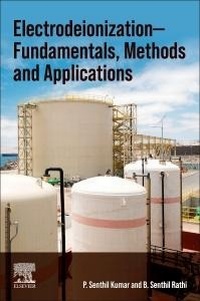
Electrodeionization
Fundamentals, Methods and Applications
Published on 24. January 2024
Book
Paperback/Softback
300 pages
978-0-443-18983-8 (ISBN)
Description
Electrodeionization: Fundamentals, Methods and Applications explains the latest developments in research on ion exchange membranes, wastewater zero discharge based on ion exchange membranes, membrane capacitive deionization, membrane free, and resin wafer electrodeionization cells. This cost-effective method efficiently assists in ion removal and recovery and is suitable for a wide range of applications, including desalination, water and wastewater treatment, extraction of high-value products, concentrating and purifying operations, and energy savings, and as such will be of interest to researchers and students working on these areas as well as those in chemicals manufacture, energy generation and storage.
Electrodeionization is a fully advanced ion exchange method that combines ion exchange, electrodialysis, and elusion procedures for metal particle removal from wastewater.
Electrodeionization is a fully advanced ion exchange method that combines ion exchange, electrodialysis, and elusion procedures for metal particle removal from wastewater.
More details
Language
English
Place of publication
Philadelphia
United States
Target group
Professional and scholarly
Product notice
Paperback (trade)
Unsewn / adhesive bound
Dimensions
Height: 229 mm
Width: 152 mm
Weight
450 gr
ISBN-13
978-0-443-18983-8 (9780443189838)
Copyright in bibliographic data and cover images is held by Nielsen Book Services Limited or by the publishers or by their respective licensors: all rights reserved.
Schweitzer Classification
Other editions
Additional editions
E-Book
01/2024
Elsevier
€200.00
Available for download
Persons
Dr. P. Senthil Kumar is an Associate Professor in the Centre for Pollution Control and Environmental Engineering, Pondicherry University, Kalapet, Puducherry, India. He has a wide research experience in the fields of water/wastewater. He has 17 years of teaching and research experience. He has 30100 citations with an author's h-index of 85 along with an i10 index of 464. He has been listed in Clarivate Highly Cited Researcher 2022 (Cross-Field) and also received the AICTE National Technical Teachers Award (NTTA 2022).
Dr. B. Senthil Rathi is an Assistant Professor (SG) in the Department of Bioengineering, Institute of Biotechnology, Saveetha School of Engineering, SIMATS, Chennai, 602105, India. She has a wide research experience in the fields of Water/Wastewater Analysis, Emerging contaminants removal, Adsorption, Pollution Control Treatment Methods and Electrochemical treatment methods. She has 10 years of teaching and research experience.
Dr. B. Senthil Rathi is an Assistant Professor (SG) in the Department of Bioengineering, Institute of Biotechnology, Saveetha School of Engineering, SIMATS, Chennai, 602105, India. She has a wide research experience in the fields of Water/Wastewater Analysis, Emerging contaminants removal, Adsorption, Pollution Control Treatment Methods and Electrochemical treatment methods. She has 10 years of teaching and research experience.
Content
1. Introduction
2. Technology overview of electrodeionization
3. Configuration and mechanism of electrodeionization module
4. Construction of Electrodeionization
5. Application and comparison of Electrodeionization
6. Heavy metal ions removal
7. Electrodeionization in Desalination and Water-softening
8. Production of high pure water using Electrodeionization
9. Advances future scope in Electrodeionization
10. Economics and environmental aspects of the EDI technique
2. Technology overview of electrodeionization
3. Configuration and mechanism of electrodeionization module
4. Construction of Electrodeionization
5. Application and comparison of Electrodeionization
6. Heavy metal ions removal
7. Electrodeionization in Desalination and Water-softening
8. Production of high pure water using Electrodeionization
9. Advances future scope in Electrodeionization
10. Economics and environmental aspects of the EDI technique