

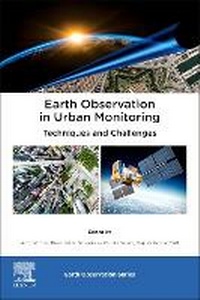
Earth Observation in Urban Monitoring
Techniques and Challenges
Published on 13. November 2023
Book
Paperback/Softback
422 pages
978-0-323-99164-3 (ISBN)
Description
Earth Observation in Urban Monitoring: Techniques and Challenges presents the latest techniques of remote sensing in urban monitoring, along with methods for quantitative and qualitative assessment using state-of-the-art Earth observation technologies. The book details the advances of remote sensing technologies in urban environmental monitoring for a range of practical and research applications, Earth observation datasets, remote sensing of environmental considerations, geostatistical techniques and resilience perspectives. Chapters cover sensor applications, urban growth modelling, SAR applications, surveying techniques, satellite time series analysis and a variety of other remote sensing technologies for urban monitoring.
Each chapter includes detailed case studies at a variety of scales and from a variety of geographies, offering up-to-date, global, urban monitoring methodologies for researchers, scientists and academics in remote sensing, geospatial research, environmental science and sustainability.
Each chapter includes detailed case studies at a variety of scales and from a variety of geographies, offering up-to-date, global, urban monitoring methodologies for researchers, scientists and academics in remote sensing, geospatial research, environmental science and sustainability.
More details
Series
Language
English
Place of publication
Philadelphia
United States
Target group
Professional and scholarly
Product notice
Paperback (trade)
Dimensions
Height: 235 mm
Width: 191 mm
Thickness: 22 mm
Weight
726 gr
ISBN-13
978-0-323-99164-3 (9780323991643)
Copyright in bibliographic data and cover images is held by Nielsen Book Services Limited or by the publishers or by their respective licensors: all rights reserved.
Schweitzer Classification
Other editions
Additional editions
Amit Kumar | Prashant K. Srivastava | Purabi Saikia
Earth Observation in Urban Monitoring
Techniques and Challenges
E-Book
11/2023
Elsevier
€165.00
Available for download
Persons
Dr. Amit Kumar is an Assistant Professor in the Department of Geoinformatics, Central University of Jharkhand, India. He is involved in interdisciplinary research with a focus on man-environment interaction, disaster risk and resilience, and climate change implications primarily in the urban milieu. His main areas of research are improving urban ecology through physio-socio-economic-hazard-risk investigations and methods to augment ecological quality using geoinformatics and machine learning techniques. He is engaged with various research projects including state-of-the-art LTEO projects of the Ministry of Environment, Forest and Climate Change; NASA-ISRO SAR; GISAT; and Airborne Hyperspectral Sensing missions. Dr Kumar has published over 60 research articles in various journals and books of international and national repute. He is a member of various academic societies including IUCN-Commission on Ecosystem Management (South Asia), National Association of Geographers India, and Global Forest Biodiversity Initiatives, USA. Prashant K. Srivastava is working at IESD, Banaras Hindu University, as a faculty and was affiliated with Hydrological Sciences, NASA Goddard Space Flight Center, as research scientist on SMAP satellite soil mois ture retrieval algorithm development, instrumentation, and simulation for various applications. He received his PhD degree from the Department of Civil Engineering, University of Bristol, Bristol, United Kingdom. Prashant was the recipient of several awards such as NASA Fellowship, USA; University of Maryland Fellowship, USA; Commonwealth Fellowship, UK; Early Career Research Award (ECRA, DST, India), CSIR, as well as UGC JRF-NET (2005, 2006). He is leading a number of projects funded from reputed agencies in India as well as world. He was also a collaborator with NASA JPL on SMAP soil mois ture calibration and validation as well as Scatsat-1, NISAR, AVIRIS-NG missions of India. Prashant made more than 200+ publications in peer-reviewed journals and published 14 books with reputed publishing house such as Springer, Taylor and Francis, AGU-Wiley, and Elsevier, and several book chapters with good cita tion index. He presented his work in several conferences and workshops and is acting as a convener for the last few years in EGU, Hydroinformatics (HIC), and other conferences. He is also acting as Regional Editor Asia-Geocarto International (T & F), Associate Editor-Journal of Hydrology (Elsevier), GIScience and Remote Sensing (T & F), Remote Sensing Applications: Society and Environment (Elsevier), Sustainable Environment (T & F), Water Resources Management (Springer), Frontiers Remote Sensing, Associate Editor- Remote Sensing-MDPI, Associate Editor- Environment, Development and Sustainability (Springer), Environmental Processes (Springer), Bull of Env and Sci Res. Dr. Purabi Saikia is an Associate Professor in the Department of Botany, Institute of Science, Banaras Hindu University, India. Her research focuses on phytosociology, population and regeneration ecology, plant-soil interactions, invasive species, ecological niche modelling, forest ecosystems, and conservation biology. She has led research projects funded by agencies including DST, DBT, SERB, MoEFCC, and UGC, with work related to vegetation dynamics and biodiversity conservation in India. Dr. Saikia has published research articles, contributed book chapters, and authored academic books in the fields of ecology and environmental science. She has supervised doctoral research scholars and continues to mentor students and early-career researchers. She is also associated with international initiatives including the IUCN Commission on Ecosystem Management and the Global Forest Biodiversity Initiative (GFBI). Professor R. K. Mall is Dean and Head of the Institute of Environment & Sustainable Development, Banaras Hindu University. Prof Mall received his Ph.D. in Geophysics from Banaras Hindu University. With about thirty years of professional experience, he has gained extensive knowledge in the field of research and academia, administration, and managerial capacity in the fields of simulation modelling, climate change / disaster risk management and related issues, sustainable development and poverty alleviation, agro-advisory services for farmers. Prof. Mall has been the principal investigator of various projects with a combined total grant exceeding GBP150 million. As a major milestone Prof. Mall has established the "DST-Mahamana Centre of Excellence in Climate Change Research? at BHU under Prime Minister's National Action Plan on Climate Change in 2017. As of now, Prof. Mall has visited more than 25 countries for various international conferences, seminars, training and international collaborations and received several awards and recognitions worldwide. He has conferred several awards such as Senior & Regular Associateship of ICTP-Italy, TWAS-CAS fellow (2006), Visiting Scientist/Professor at ANU-Australia, GMU-USA, Purdue-USA & ICTP-Italy etc. Prof. Mall has published over 100 research papers, 17 books, and various book chapters, and supervised over 8 Ph.D. students. He has developed robust models based on social, economic, and environmental vulnerability of India and the South Asia region, found to be immensely applicable for regional and sub regional planning (UNDRR, SAARC-Disaster Management Centre, UNDP, World Bank, IMD, CGWB etc.). He also serves as consultant and policy adviser for various State Government, Central Government Departments as well as UN and other international agencies. He has also represented several Government of India delegations in the Asian Ministerial Conference on Disaster Risk Reduction (AMCDRR) and Global Platform on Disaster Risk Reduction (GPDRR) in Indonesia, Switzerland, Thailand, Japan, and India.
Editor
Assistant Professor, Department of Geoinformatics, Central University of Jharkhand, India
Remote Sensing Laboratory, Institute of Environment and Sustainable Development, Banaras Hindu University, Varanasi, Uttar Pradesh, India
Associate Professor, Department of Botany, Institute of Science, Banaras Hindu University, India
DST-Mahamana Centre of Excellence in Climate Change, Institute of Environment and Sustainable Development, Banaras Hindu University, Varanasi, Uttar Pradesh, India
Content
Chapter 1: Introduction to earth observation in urban monitoring
Chapter 2: Major challenges in the urbanizing world and role of earth observations for livable cities
Chapter 3: The role of nocturnal earth observation in urban environment monitoring
Chapter 4: Surveying techniques for urban areas
Chapter 5: Geoinformation for integrated urban water resource management
Chapter 6: Advances in remote sensing in measuring urban heat island effect and its management
Chapter 7: Impact of seasonality and land use changes on urban heat island using earth-observing satellites
Chapter 8: Using PlanetScope imagery and GEOBIA to map urban green spaces
Chapter 9: Deep learning approach for monitoring urban land cover changes
Chapter 10: Earth observation applications for urban mapping and monitoring: research prospects, opportunities and challenges
Chapter 11: Earth observations and AIML for urban growth modeling
Chapter 12: Monitoring urban ecological conditions using remote sensing
Chapter 13: Landscape modeling for management of the urban environment .
Chapter 14: Artificial intelligence for sustainable urban climate studies
Chapter 15: Geoinformation for urban Geoenvironmental hazard-risk and vulnerability assessment
Chapter 16: Nature-based solutions and ecological urban planning and design for the sustainable urban environments
Chapter 17: Shrinking urban green spaces, increasing vulnerability: solving the conundrum of the demand-supply gap in an urbanizing city
Chapter 18: Earth observations for urban policies and future pathways for urban environmental research
Chapter 2: Major challenges in the urbanizing world and role of earth observations for livable cities
Chapter 3: The role of nocturnal earth observation in urban environment monitoring
Chapter 4: Surveying techniques for urban areas
Chapter 5: Geoinformation for integrated urban water resource management
Chapter 6: Advances in remote sensing in measuring urban heat island effect and its management
Chapter 7: Impact of seasonality and land use changes on urban heat island using earth-observing satellites
Chapter 8: Using PlanetScope imagery and GEOBIA to map urban green spaces
Chapter 9: Deep learning approach for monitoring urban land cover changes
Chapter 10: Earth observation applications for urban mapping and monitoring: research prospects, opportunities and challenges
Chapter 11: Earth observations and AIML for urban growth modeling
Chapter 12: Monitoring urban ecological conditions using remote sensing
Chapter 13: Landscape modeling for management of the urban environment .
Chapter 14: Artificial intelligence for sustainable urban climate studies
Chapter 15: Geoinformation for urban Geoenvironmental hazard-risk and vulnerability assessment
Chapter 16: Nature-based solutions and ecological urban planning and design for the sustainable urban environments
Chapter 17: Shrinking urban green spaces, increasing vulnerability: solving the conundrum of the demand-supply gap in an urbanizing city
Chapter 18: Earth observations for urban policies and future pathways for urban environmental research